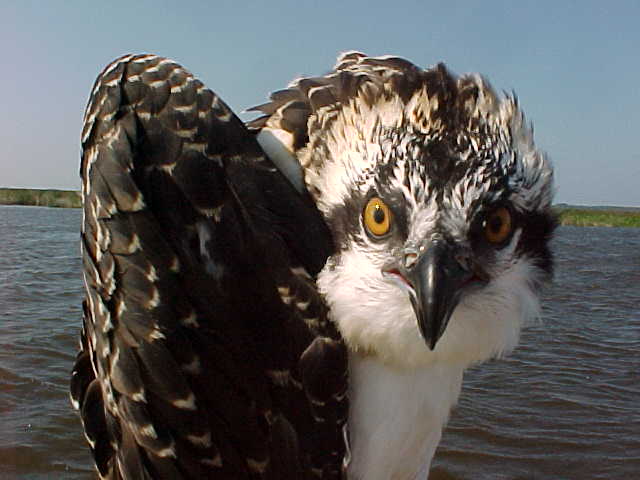
Summer Osprey Sightings

Photo of the Week – Osprey at Back Bay National Wildlife Refuge (VA)” by U. S. Fish and Wildlife Service – Northeast Region is marked with Public Domain Mark 1.0.

Near the intersection of Rt. 26 and Rt. 150, the Bald Eagle Overlook faces out over Foster Joseph Sayers Lake. Here, I watched a pair of Osprey dominate the northern bank of the lake all summer.

Considering the nearby Bald Eagle State Park, watching Osprey feels traitorous. I see at least one Bald Eagle per day while on my lunch walks- this is a gift I will never take for granted. Yet every time I spot an Osprey, I become transfixed, waiting for their yellow glare to pass over me.

The thing I like most about Osprey is their look; always torn between bewildered or cool. At the right angle, with ruffled feathers and wide eyes, Osprey have the same visage of a mad scientist. In flight, Osprey are every inch a predator with their long wings spread over the skies.

I usually find the osprey pair situated in a snag between Bald Eagle Overlook and the Rt. 26 causeway. Before the Osprey, this area had a fluctuating cast of characters. A normal day for me would be to spot Bald Eagles next to crows, next to starlings or even mourning doves. Aside from Double Crested Cormorants, no other birds appear here with any regularity.  

Ospreys prefer areas close to open water, with no overhead forest canopy. Perching on snags gives the birds a long view up and down the lake. Fish are their preferred prey and will live-catch every meal. Rarely did I ever see another species in the snags while the Osprey were nearby. Even the Cormorants would stay quiet while the Osprey glided by.

As I kept an eye on the Osprey all summer, gears turned in my mind. Osprey nest in Pennsylvania from March to August, with nests as close as Clinton County. Nests occur up to 1600ft away from open water. Additionally, nests are large, made of sticks and twigs. In Pennsylvania, many nests are on man-made structures, like buildings and telephone poles.
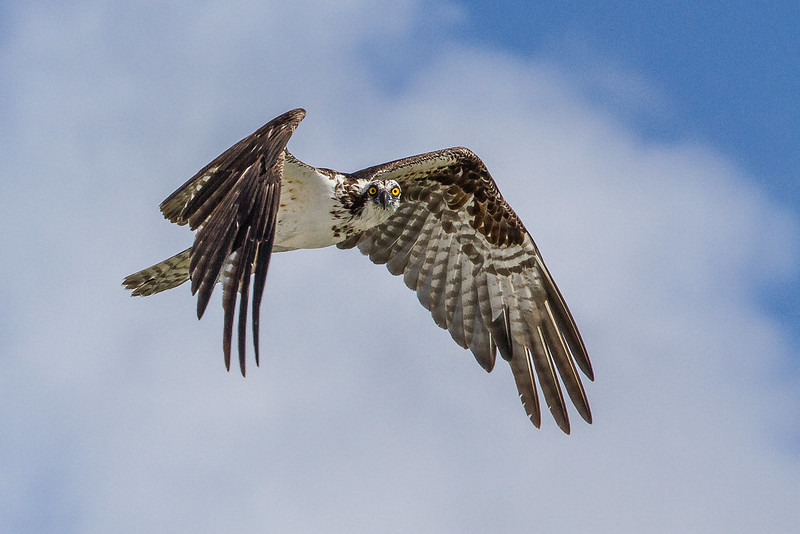
Osprey in Flight” by Andy Morffew is licensed under CC BY 2.0.

Knowing this, I started looking for a nest. My search was in vain- I never saw a single stick. Bald Eagle State Park rangers searched the whole park for a sign, and never had anything to report. The Rangers told me that age and inexperience may prevented the Osprey from nesting.

Despite our searching, Osprey nests can be difficult to find. This difficulty has led to many states enacting nest surveys. The Pennsylvania Game Commission enacted the Osprey Nest Survey program in the 1980s. The program relies on volunteers to follow a protocol and report to the Commission via email. The Commission uses the reports to update the Pennsylvania Natural Heritage Program databases.

In addition to nest surveys, some organizations build and erect nesting platforms. These platforms encourage Osprey to nest away from infrastructure and in safer areas. Many platforms are also equipped with cameras, which livestream nest activities.

Now that Fall has arrived, the Osprey have moved on to their wintering grounds in South America. I doubt I will see another Osprey until they decide to return to Bald Eagle State Park. I hope the excellent habitat draws them to return and nest in an accessible area!

Works Cited

Hawk Mountain Sanctuary. Osprey. Hawk Mountain Sanctuary, 2014, www.hawkmountain.org/raptors/osprey. Accessed 13 Sept. 2024.

Morffew, Andy. “Osprey in Flight.” Flickr, Digital Photograph, 4 Dec. 2012, www.flickr.com/photos/66020093@N03/8244633979. Accessed 4 Dec. 2024.

Pennsylvania Game Commission. Osprey Nest Survey. Pennsylvania Game Commission, 2019, www.pgc.pa.gov/InformationResources/GetInvolved/Pages/OspreyNestSurvey.aspx. Accessed 13 Sept. 2024.

—. “Osprey Species Profile.” Osprey Species Profile, Pennsylvania Game Commission, www.pgc.pa.gov/Wildlife/EndangeredandThreatened/pages/osprey.aspx. Accessed 13 Sept. 2024.

United States Fish and Wildlife Service. “Photo of the Week – Osprey at Back Bay National Wildlife Refuge (VA).” Flickr, Digital Photograph, 14 Apr. 2010, www.flickr.com/photos/43322816@N08/4520680333. Accessed 13 Sept. 2024.

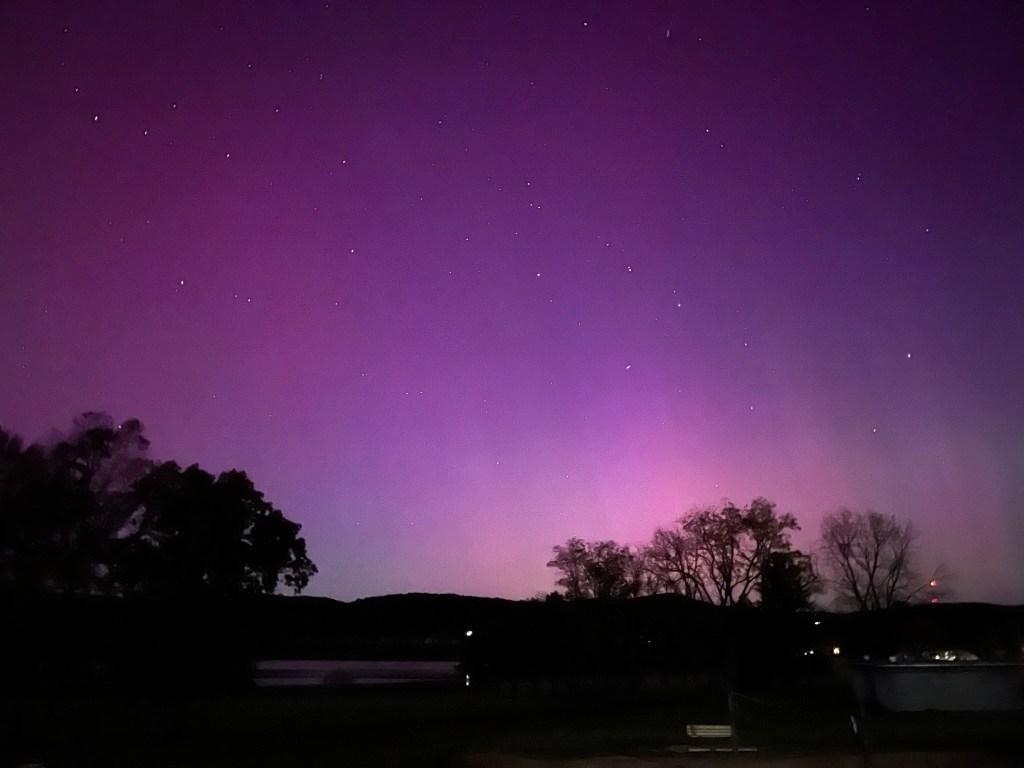
Stars and Skies

Aurora Borealis on 10/10/24 in Centre County

Over the last two weeks, our area has been dazzled by astronomical phenomena. First, aurora borealis danced over the Pennsylvania skies. Then, an ancient comet streaked past us after sunset for a few nights. These events remind me that nature extends beyond our communities and forests, into the final frontier.

Nature is not isolated to what is occurring at Earth’s surface. Stars, comets, planets, and moons are all part of nature, just as rocks, soil, and water. Like animate phenomena, inanimate phenomena interact with other phenomena through physics and chemistry.

Aurora Borealis on 10/10/2024 in Centre County

Aurora borealis, for example, are caused by magnetic storms triggered by solar activity. The auroras seen in Pennsylvania were the result of a solar flare. Auroras are uncommon in Pennsylvania but will occur in lower latitudes during periods of high solar activity, the solar maximum. Every 11 years, the Sun’s magnetic poles flip in the Solar Cycle, causing the Sun to have an increase in activity. This activity increases space weather- which eventually may trigger auroras.

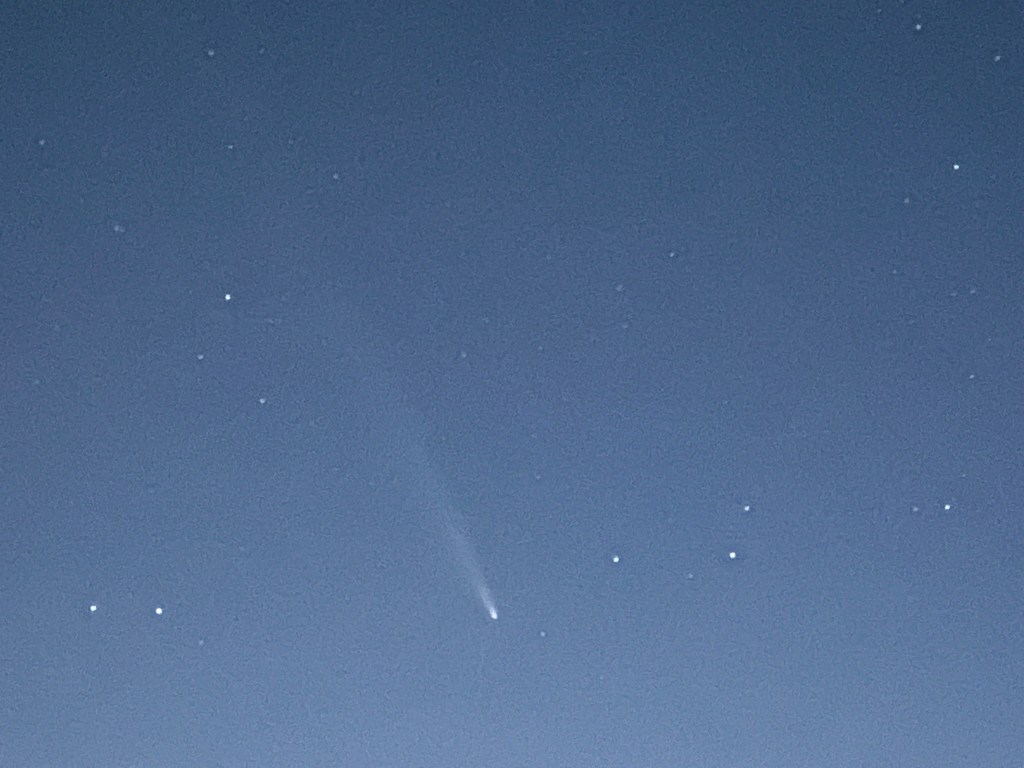
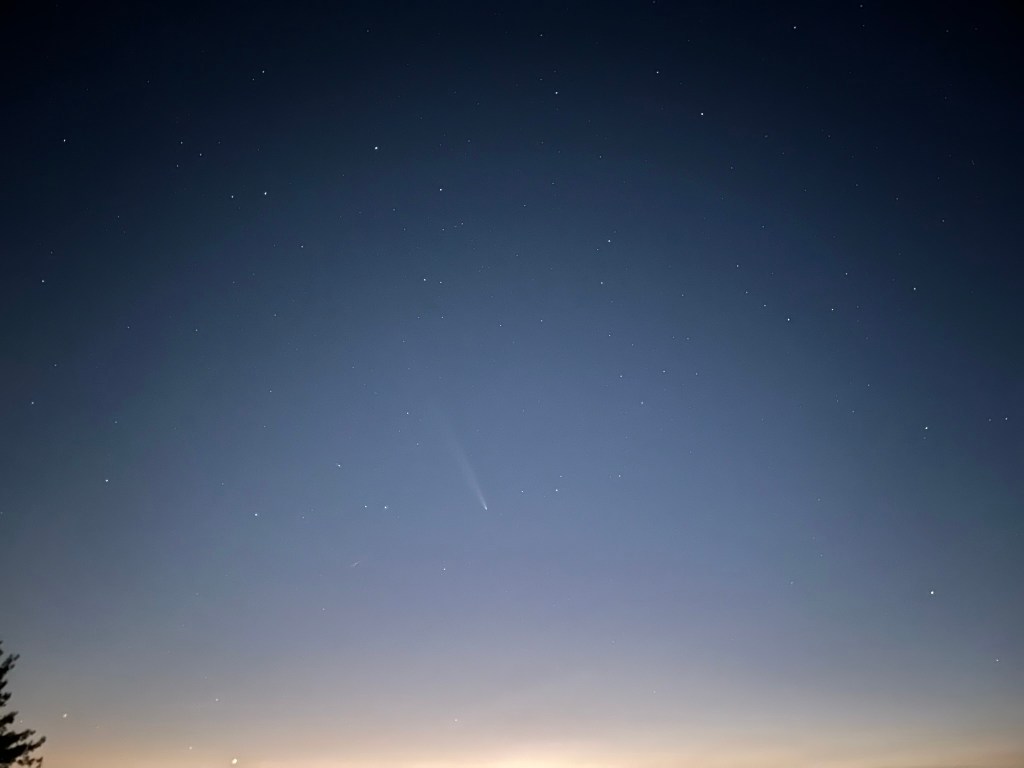
Other inanimate natural phenomena, like Comet A3, occur on a grander scale. C/2023 A3 (Tsuchinshan–ATLAS) has an 80,000-year loop around our solar system. This was the first time Comet A3 has been observed during written human history. The comet was visible in the Northern Hemisphere for a brief window after sunset as it swung around the Sun and passed by Earth. Comet A3 is from the Oort Cloud, an enormous shell of space debris hovering around our solar system. Most, if not all, long-period comets like Comet A3 originate from the Oort Cloud.

C/2023 A3 Tsuchinshan-ATLAS on 10/17/2024 in Centre County

These inanimate phenomena cause great effects in animate phenomena. For example, during a total solar eclipse, the sudden change in light can cause animals to be disoriented. Human beings exhibit a variety of behaviors due to what is happening over our heads. As an astronomical observer, the stars, meteors, comets, and auroras fill me with total and complete awe. With the way my fellow comet-watchers reacted last Thursday, I would say that I’m not the only one.

Thursday evening, I was in a tizzy over the comet, rushing through dinner and scurrying out the door promptly at 6:45pm. I thought I had seen the comet out my kitchen window, but it was only the contrail of an airplane. My partner dropped me off at the dike and I sidled up to a group of people waiting patiently for twilight. Everyone else in the group was from the Philadelphia area, happening to be in the right place at the right time. Together, we chatted about astronomical clubs and events. We discussed at length the differences of stargazing in rural areas versus urban areas. Mostly, we admired the landscape before us.

C/2023 A3 Tsuchinshan-ATLAS on 10/17/2024 in Centre County

An interesting study, The Social Effects of An Awesome Solar Eclipse, makes the claim that observing and interacting with solar eclipses causes people to feel a greater connection to the Earth, their communities, and their own selves. On Thursday, this claim was proven as we gasped at the sight of the comet over us. We all agreed that we felt lucky to have been able to see the comet, and to have the experience together.

After my partner picked me up, my heart was full of emotion. I was full of love for the Earth, excited to have seen the comet with my binoculars, and proud to have taken a handful of pictures. I admit to crying a little bit- at moments like these, I feel overwhelmingly lucky to be alive and bear witness to nature’s perfect beauty.

Our Wild Neighbor, the Red-tailed Hawk

Red-tailed Hawk” by Becky Matsubara is licensed under CC BY 2.0.

A Red-tailed Hawk swooped down through the trees, lighting a branch to watch who passed by. I was there- walking through Hort Woods after lunch with my colleagues. It’s been a while since I saw a hawk on campus, and years since I’ve been near to my favorite bird.

In medieval folklore, witches had a familiar, a type of supernatural companion. In a way, Red-tailed Hawks are my familiar, appearing at unusual moments to direct my attention. When I was fifteen, I had a close call with a hawk while refilling bird feeders. As I was shimmying the barrel of a feeder up its string, a soft whump sounded behind me. A chill crept up my neck as I turned- only to find a Red-tailed Hawk deep in the snow. It had likely seen prey in the yard and dived, not minding the teen bumbling around in a snowsuit.

When I was nineteen, I saw a Red-tailed Hawk crash-land on the road, bleeding and injured. I called the bird in to the Game Commission, and waited with it until the warden rescued and toted it off. Again, when I was twenty-six, I was talking on the phone in a courtyard when a Red-tail decided to take a seat on a brick wall. It enjoyed its lunch while I chatted with my Mom. The Red-tailed Hawks showed no fear of me, or of our surroundings.

Fear doesn’t appear to be part of a Red-tailed Hawk’s vocabulary. When mated, Red-tailed Hawks will guard their territory together. If a human strays too close, the hawks will take no qualm in scaring them away. The Red-tailed Hawks in my area will dive across I-99 traffic to hit prey in grassy medians. They’ll perch while a PennDOT mower rumbles past, surveying for new-exposed food.

Red-tailed Hawk” by U. S. Fish and Wildlife Service – Northeast Region is marked with Public Domain Mark 1.0.

On my daily commute, I see at least two hawks per day. Road warriors, hunting the hills between Bellefonte and State College. A huge swath of I-99 passes by SCI Rockview and Penn State research farms, excellent habitat for prey. Plus, the cultivated fields help form the thermals Red-tailed Hawks use to travel. Interspersed are WMUs, permitting wildlife to live with little human interference.

I’m not the only person with a love of wild raptors. I recently learned about HawkCount, which records the data collected from raptor watches. Over 300 sites dot North America- with 5 located near me. Right now, Fall watches are occurring at Jacks Mountain and Stone Mountain. I was able to sign up for daily email updates tallying the number of birds observed. I’m fascinated by how many raptors pass through my area during their migration. I’ve been more observant in the field, now that I have a better understanding of what I’m looking for.

I marked my sighting in eBird, delaying our march back to the office. Yet, as soon as I had seen the hawk, it was gone again. None of my colleagues had the chance to look up into the eyes of our wild neighbor. I explained to them the importance of my stop and eBird, but they continued as if nothing was out of the ordinary. I spent the rest of the day wondering what else my wild neighbor had wanted me to see.

Works Cited

Aucker, Jeff. “Hawkwatch Site Profile – Bald Eagle Mountain – Port Matilda.” HawkCount, 2023, www.hawkcount.org/siteinfo.php?rsite=635. Accessed 13 Sept. 2024.

Bohn, Mark, and U.S. Fish and Wildlife Service. “Red-Tailed Hawk.” Flickr, Digital Photograph, 20 Dec. 2010, www.flickr.com/photos/43322816@N08/5277662783. Accessed 13 Sept. 2024.

Bolgiano, Nick. “HawkWatch Site Profile – Bald Eagle Mountain – Eagle Field.” HawkCount, 2019, www.hawkcount.org/siteinfo.php?rsite=809. Accessed 13 Sept. 2024.

—. “HawkWatch Site Profile – Tussey Mountain HawkWatch.” HawkCount, 2024, www.hawkcount.org/siteinfo.php?rsite=438. Accessed 13 Sept. 2024.

Grove, Greg. “HawkWatch Site Profile – Stone Mtn.” HawkCount, 2015, www.hawkcount.org/siteinfo.php?rsite=436. Accessed 13 Sept. 2024.

Matsubara, Becky. “Red-Tailed Hawk.” Flickr, Digital Photograph, 26 Jan. 2017, www.flickr.com/photos/130819719@N05/32406640251. Accessed 13 Sept. 2024.

Pennsylvania Game Commission. “Hawks and Falcons.” Wildlife Note, Pennsylvania Game Commission, www.pgc.pa.gov/Education/WildlifeNotesIndex/Pages/Hawks-and-Falcons.aspx. Accessed 13 Sept. 2024.

Smith, Darrell. “HawkWatch Site Profile – Jacks Mountain.” HawkCount, 2023, www.hawkcount.org/siteinfo.php?r=on&rsite=104&go=Go+To+Hawkwatch+Profile. Accessed 13 Sept. 2024.

Indiana County’s Buttermilk Falls

Usually the drive home from Pittsburgh area is uneventful- easy miles on Rt. 22 punctuated by Sheetz and upland forests. After 30 minutes on the road headed home, we decided to take a minor detour to Buttermilk Falls Natural Area.

A few miles down a country road, we pulled up to a gate staffed by a security guard. He provided simple directions: McFeely Trail to our right, and the Falls Trail to our left. After parking in the overflow section, we stretched our legs and headed to the trail on our left.

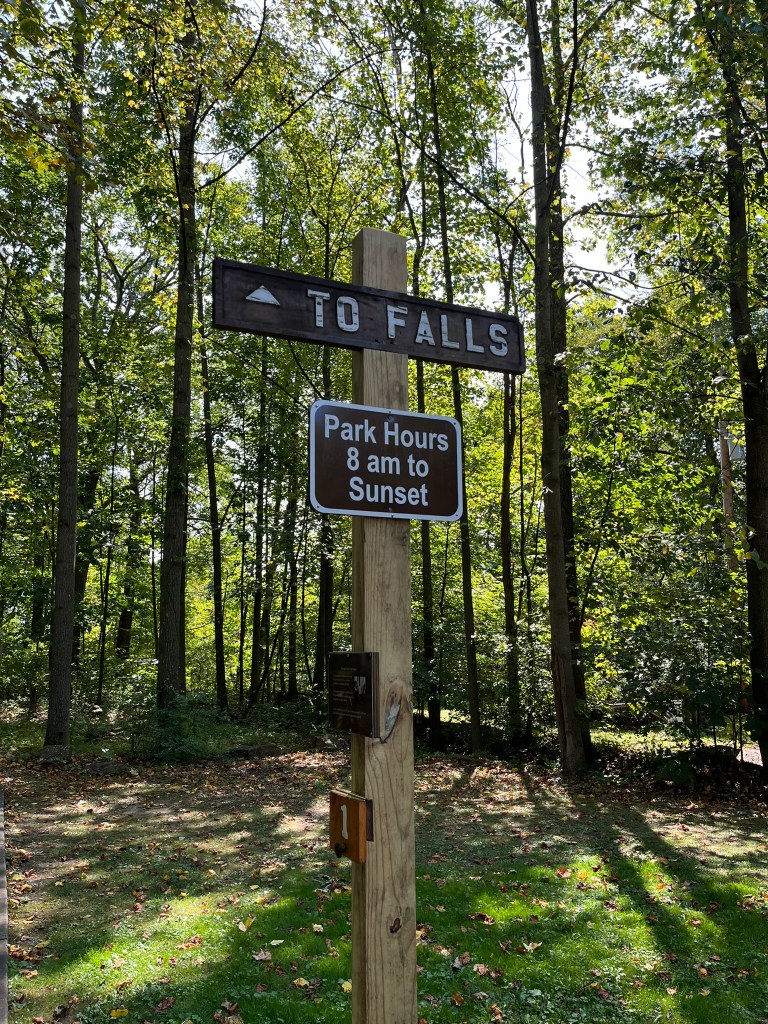
Crisp 65° air filtered through the trees while we meandered down the trail. We admired the accessibility of the walkway as it gracefully turned down the valley. Plenty of signs warned visitors to not stray off the trail- delicate plants grew near the Falls. I noticed plenty of common jewelweed, a sign that deer avoid the area.

We neared the first viewing platform in short order. Stepping out to the wooden deck, I couldn’t see any running water through the trees and brush. Straining my ears over the sounds of other hikers, I couldn’t hear a waterfall at all.

Past the first viewing platform, the trail continued over the crest of the falls to a second viewing area. Stairs descended the far side of the valley and led to a platform under Buttermilk Falls. Once we were on the Eclipse Bridge, I realized that Hires Run was very low. Water still descended the valley, but it was a gentle trickle than the roar I was hoping for.

Other hikers passed us as I led my partner down the stairs. Late summer wildflowers leaned over the cliffside; wood asters full of bumble bees. As we neared Buttermilk Falls, the scent of cool, wet rock permeated the air. As I waited for hikers to clear the area, I watched two small fish dart in the water pooling at the falls’ base.

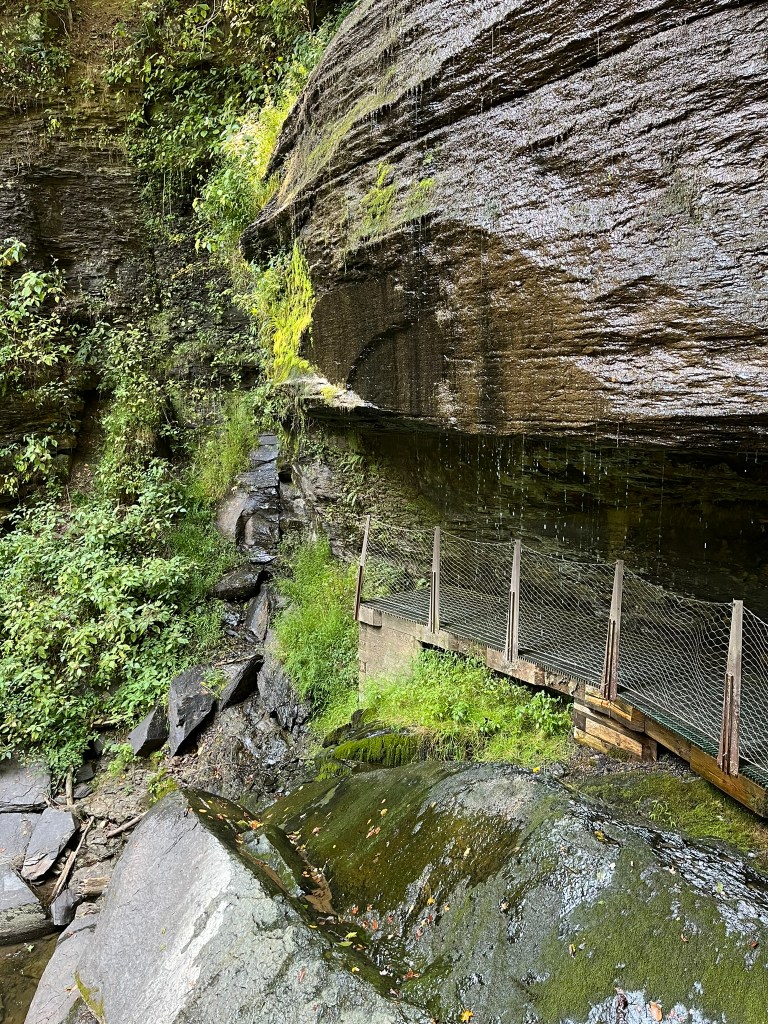
We were soon able to walk behind Buttermilk Falls. A thick block of sandstone between two layers of shale allowed for an overhang to develop. Unfortunately, graffiti covered some of the shale wall behind the Falls. I wondered why visitors would want to deface natural beauty with grotesque images. As if to spite the graffiti, moss was spreading over the rock.

After snapping a few pictures, we started climbing back up the stairs to take a look at the rubble by the falls’ crest. From 1930 to 1956, Mr. Roger’s grandfather owned property along Hires Run, which Mr. Rogers visited as a boy. The foundation of the home, and the weirs used to dam Hires Run are still there. As children were exploring the area, I didn’t dare disturb the rocks to look for salamanders.

Walking back up the trail, we took our time to talk about football and decide that we will have to stop again. I want to visit in spring, when Hires Run is high and wildflowers are in bloom. My partner would like to visit when the Fall colors riot through the valley in mid-October. At any time, Buttermilk Falls are beautiful, and worth preserving. I’m thankful Indiana County Parks cares for this area and encourages visitors to do the same.

Works Cited

Indiana County Parks & Trails. “Buttermilk Falls.” Indiana County Parks & Trails, 26 Feb. 2024, www.indianacountyparks.org/our-parks/buttermilk-falls/. Accessed 9 Sept. 2024.