
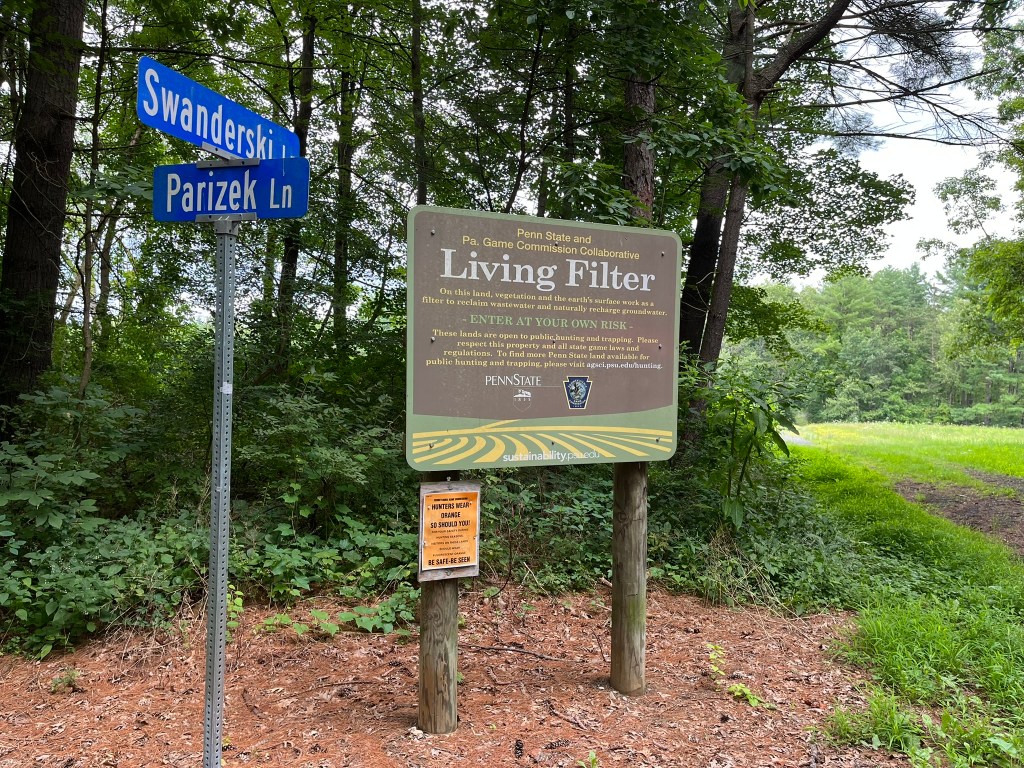
I participated in this event as part of my commitment to Centred Outdoor’s Outdoor Leadership Cohort. I recommend participating in their events throughout the Summer and Fall seasons. You can check out their schedule on their website. Please consider supporting Centred Outdoors and Clearwater Conservancy today.
Last Sunday, I packed a bag and dashed out the door to reach Penn State’s Living Filter in time for the 1:00pm guided tour. I wasn’t sure what to expect… I had gathered from promotional materials that the Living Filter was an experiment, yet also an established wastewater management practice. From the guided walk, I learned the Living Filter was much more than what met my eye.

Dr. Preisendanz from the Department of Agricultural and Biological Engineering met us at the sign-in station to share the history of the Living Filter. For almost four decades, Penn State has used their wastewater effluent as forest and crop irrigation. The hope is that after nourishing the plants and crops, the water will recharge groundwater aquifers. Wastewater is sprayed over the foliage using aboveground pipe systems. This wastewater is some of the cleanest wastewater around- Penn State recently upgraded their wastewater treatment facility to better treat the wastewater from University Park campus and part of State College.
Penn State staff, faculty, and researchers play an active role in maintaining the Living Filter. To ensure proper safety and security of the pipes, staff manually turn on and off the sprayer systems and handle the collection of samples for researchers. Working together, they have managed to eliminate the direct discharge of wastewater into streams and assist in maintaining the base flow of Spring Creek. Plus, this system supports different crops which are used to nourish research animals, eliminating the need to purchase and transport commercial feed.
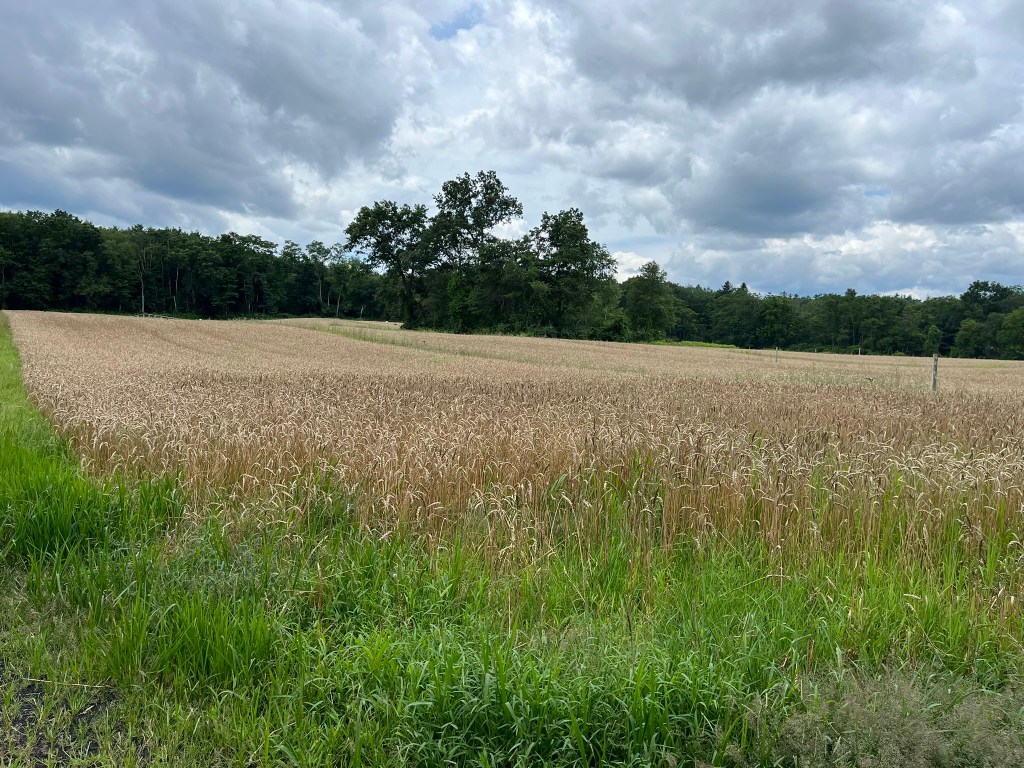
During our walk, we soaked in the lush foliage around the service roads. Thick bushes of jewelweed lined our walking path. Grain crops emanated a warm and comforting glow over the hills. Climbing up over the grain fields, we passed into fields of tall, strong corn. While the hedgerows were not perfect, they were tidy. However, not all plants love the nutrient-rich water. Some trees, most of species that prefer dryer territory, were fading or even already dead. Penn State technical service staff maintain the safety of the Living Filter by removing any dead trees before, or immediately after a tree goes down.
While the Living Filter is an inspiring facility, what caught me by surprise was the investment of the community members attending the outing. Our small crowd was certainly a mix of ages, experiences, and knowledge. We stopped multiple times during the walk to ask Dr. Preisendanz questions, which she met with enthusiasm. I felt comfortable in this group of (mostly) strangers, and happy to listen to the discussion surrounding wastewater management and sustainable agriculture. I learned that the morning group was larger and had even more questions than us. The 11:00 am group took over an hour, while ours was just under!

On my way home from the outing, I drove past the site of the old Radio Astronomy Building. Now a decommissioned special services building, the area of what used to study celestial objects using radio waves now is the home of the Living Filter’s second half. I didn’t stop to check it out as I was unsure of the permissions one would need to see it for themselves. The initial portion of the Living Filter, on State Game Lands 176, is publicly available. However, be warned that the sprayers are turned on for all other days- even in the middle of winter.
I enjoyed my visit to Penn State’s Living Filter. The “lesson” was fun, the walk was easy, and the attendees were interesting. While this place is checked off my To-Visit List for the Summer, it’s on my To-Visit List for the Winter. Dr. Preisendanz shared the area is a winter wonderland starting in December and worth the trip. For now, when I wash my dishes in the breakroom sink, I know the water will exit the system at the Living Filter!


 autumn's country diary