The 2025 Bill Russell Foray

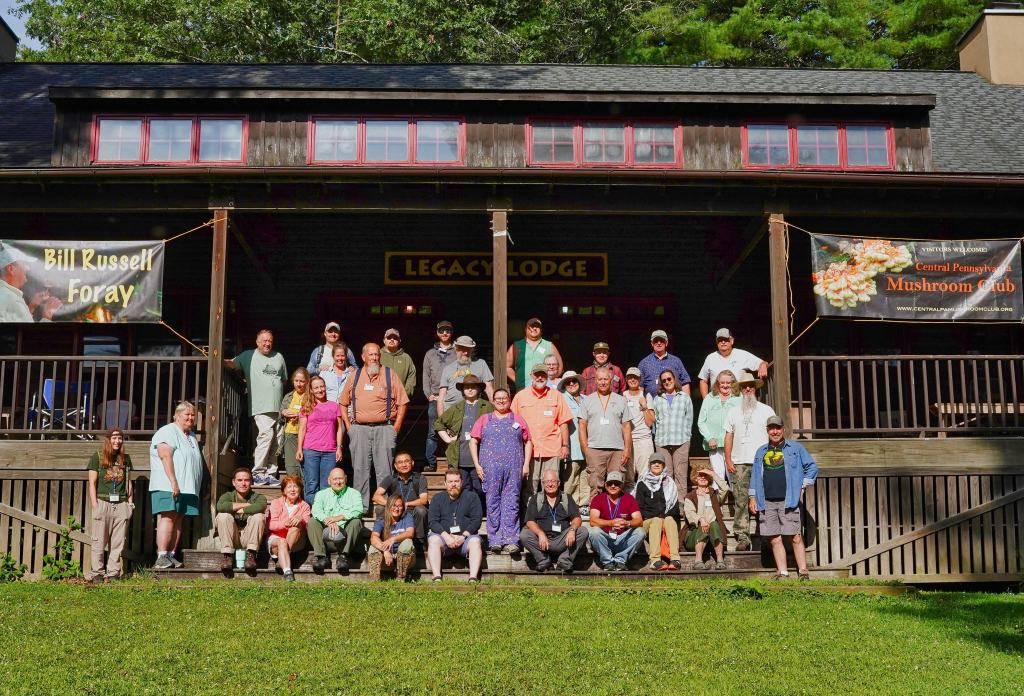
The 2025 Bill Russell Foray group photo, courtesy Rodney Spencer

Once our honeymoon wrapped up, there was one thing on my mind: the 2025 Bill Russell Foray, held by the Central Pennsylvania Mushroom Club. While we wandered through the Finger Lakes, I mulled over what the first weekend in August would have in store for me. I had never visited Camp Golden Pond, a Girl Scout Camp now transformed into a private campground. In my typical overthinker style, I read countless reports of other forays happening up and down the East Coast. By the time August 7th rolled around, I was exuberant.

On Friday afternoon, my sister and I took off in my loaded-up Jeep, headed for Petersburg. My sister was equally as excited as myself, and as we passed Jo Hayes Vista, we realized we were far ahead of schedule. To kill some time, we stopped at Shaver’s Creek Environmental Center. We zipped through the exhibits, tip-toed through Klingsberg Aviary, and took a long break kneeling in the lobby to watch a monarch caterpillar transform into a cocoon.

After the caterpillar sealed itself away, we hit the road again. We pulled into Camp Golden Pond right at 5 o’clock, finding ourselves in the middle of a busy scene. Some were setting up tents, and others were carrying gear indoors. My sister and I checked in at the registration table and headed over to Palmer Lodge to find some bunks on the Tussey Level. We had our pick of bunkrooms, as most were tenting. After setting up our bunks and stowing gear, we headed back up to Legacy Lodge for the commencement of our weekend.

Friday evening began with dinner, a taco bar prepared by club members. As the cleanup crew reset the hall for our guest speaker, the Silent Auction kicked off. Shortly after 7:30pm, our speaker for the evening was ready: Hanna Huber, Conservation Mycologist for the Pennsylvania Natural Heritage Program (PNHP). She spoke to us about her experience and love for mycology, and her goals for her work with PNHP. Her sincere passion for mycology and conservation shone through during her presentation. After her presentation, I felt even more inspired and excited for the day head.
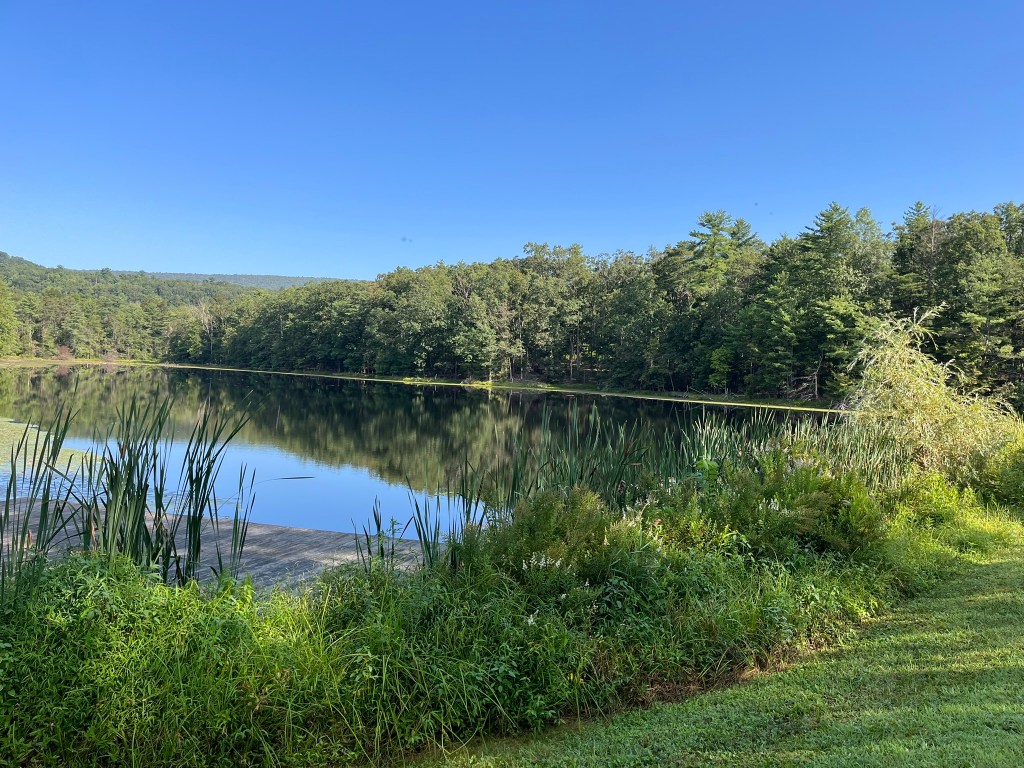
Lake Louise at Camp Golden Pond

Saturday morning dawned bright and hot- the temperatures would later peak in the high 80s. After breakfast, we took a group photograph before heading off for our initial collecting walks. Everyone was worried about what we would find. Centre County had had several weeks of no rain and high temperatures; a poor recipe for good foraying. However, we were delighted to be proven otherwise. After walking around Lake Louise and up to Unit II, my basket was full of fungi and lichen. We returned to Legacy Lodge for lunch and initial mushroom identification.

This year, CPMC was trying something new with identification. Upon returning from a collecting walk, participants sorted their finds into three categories: pored mushrooms, gilled mushrooms, or “other, not gilled or pored.” Each specimen was given its own paper plate and a slip of paper with a simple form requesting information about the finder, location found, substrate, and general observations. I dutifully filled out the forms to the best of my ability, I am a beginner, after all! Our finds quickly filled the tables and the lodge with the subtle scent of the forest.
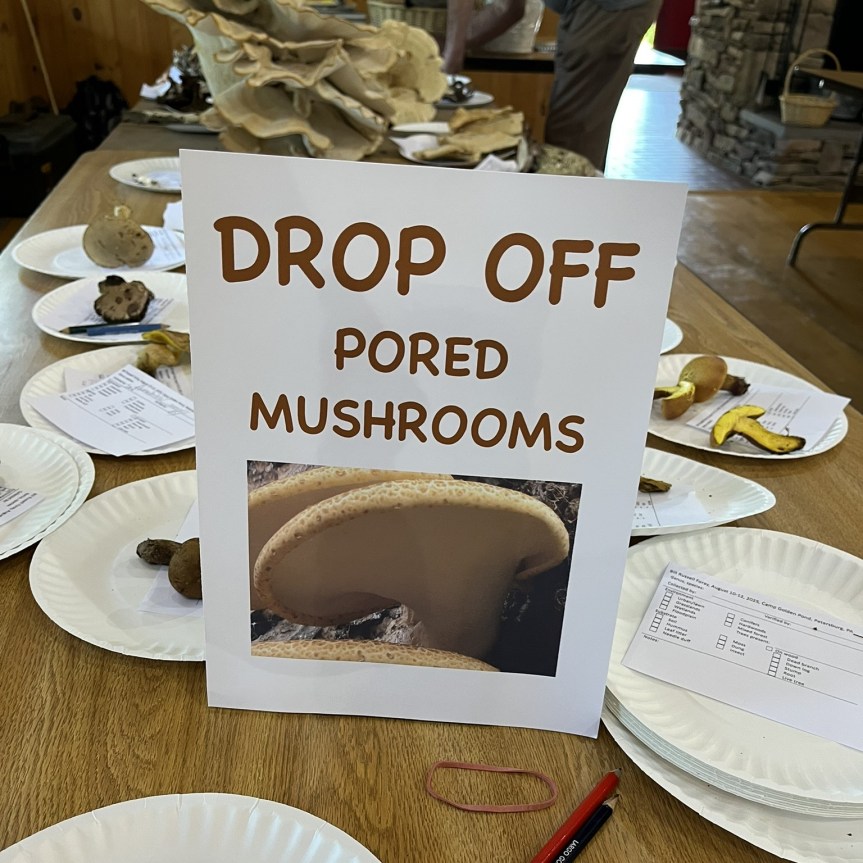
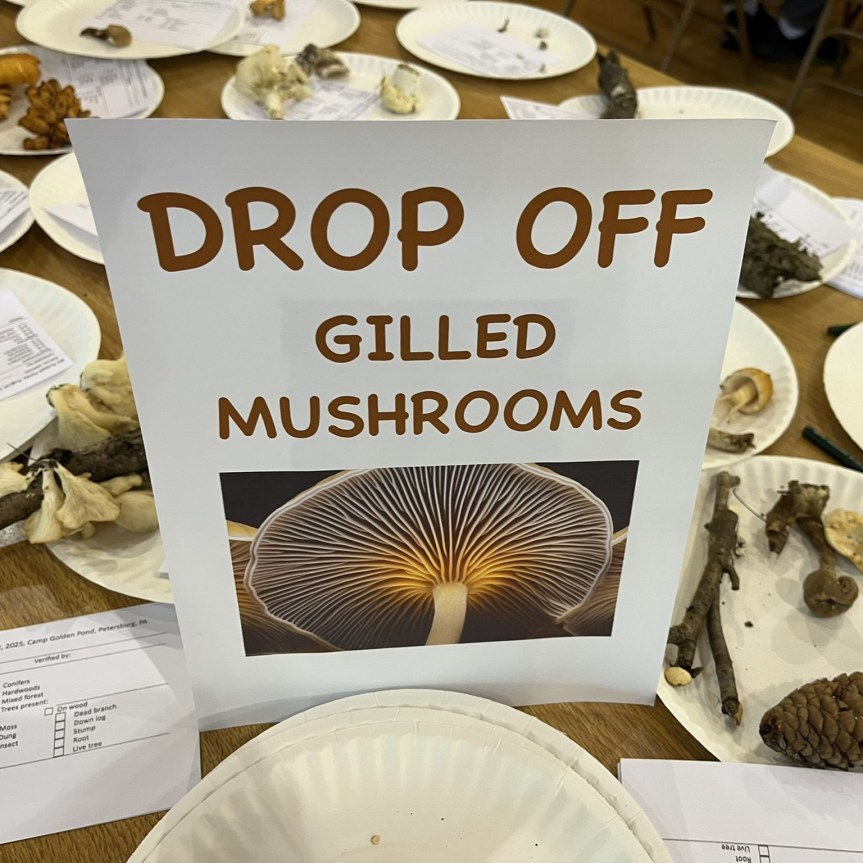
After lunch, we broke off into small groups for different activities. Some went to nearby Natural Areas for more collecting, others to a mushroom cultivation demo, or to a fabric dyeing activity. I chose to attend the fabric dyeing activity, which turned out to be loads of fun.  

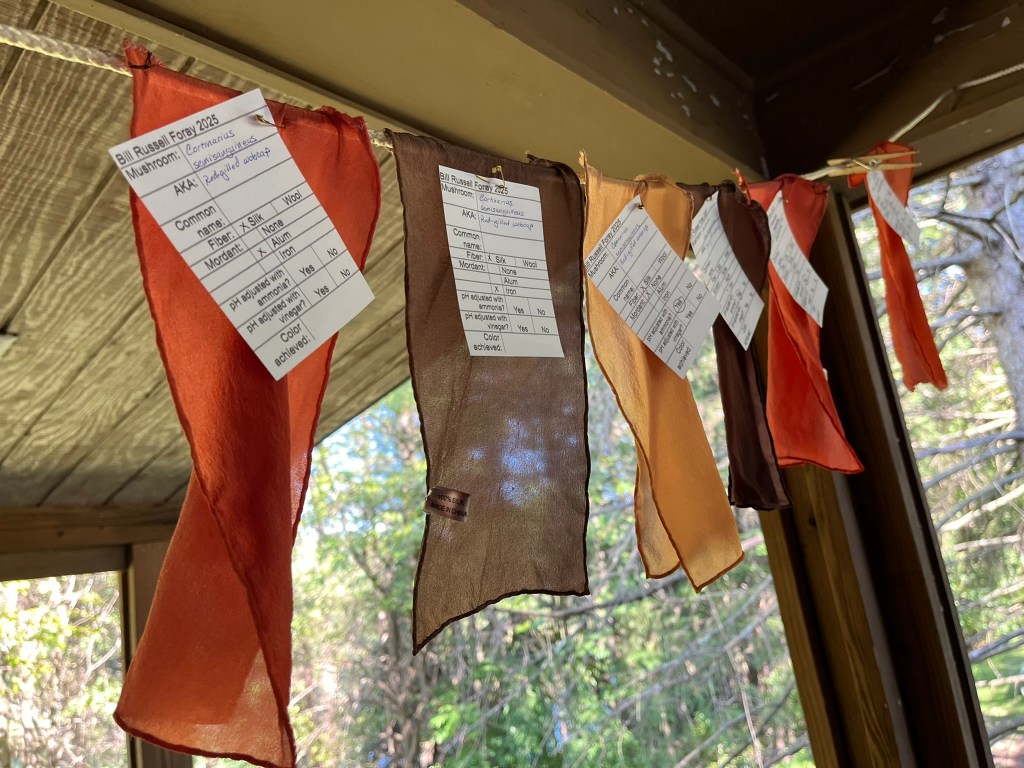
Over the ensuing hours, I learned that mushrooms and lichens can be used to dye natural fabrics and to make paints. As a small group, we worked together to dye silk squares with different types of mushrooms. We had our most striking results from using blood red webcap, dyer’s polypore, and artist’s conk. The breeze on Palmer Lodge porch kept us from being too hot as we checked water temperatures, steeped mushrooms, and soaked fabrics. In the middle of the activity, I rushed back up to Legacy Lodge to make a commemorative print of an Old Man in the Woods fungus, carved by artist Allan Sutley. With my print drying on my car’s dashboard, I rushed back to the porch to help tidy up and prepare the dyebaths for wool yarn. Colorful silk squares fluttered in the breeze as we returned to Legacy Lodge for dinner and our keynote speaker.
Our speaker for Saturday evening was Bolete Bill. His presentation, “Slugs, Bugs, and Other Mushroom Thugs” focused on connections in nature- how mushrooms are an integral part of habitats across the globe. I was really interested in all the different insects Bill introduced to us. Many different species of insects utilize mushrooms as nurseries for larvae, habitat for adults, and food supply for all phases of life. Some even carry mycelium with them to cultivate fungi to feed its larvae! I could have listened to Bolete Bill speak all night.

After breakfast the following morning, we split into two groups: one focusing on completing mushroom identification, and the other at a cooking demonstration in the kitchen. My sister was teaching us to prepare mushroom tartlets- an hors d’oeuvre of savory sauteed mushrooms secured to puff pastry with herbed cream cheese. While we waited for the tartlets to finish in the oven, she shared with us her pre-made loaded mushroom dip- equally delicious and easy to prepare.

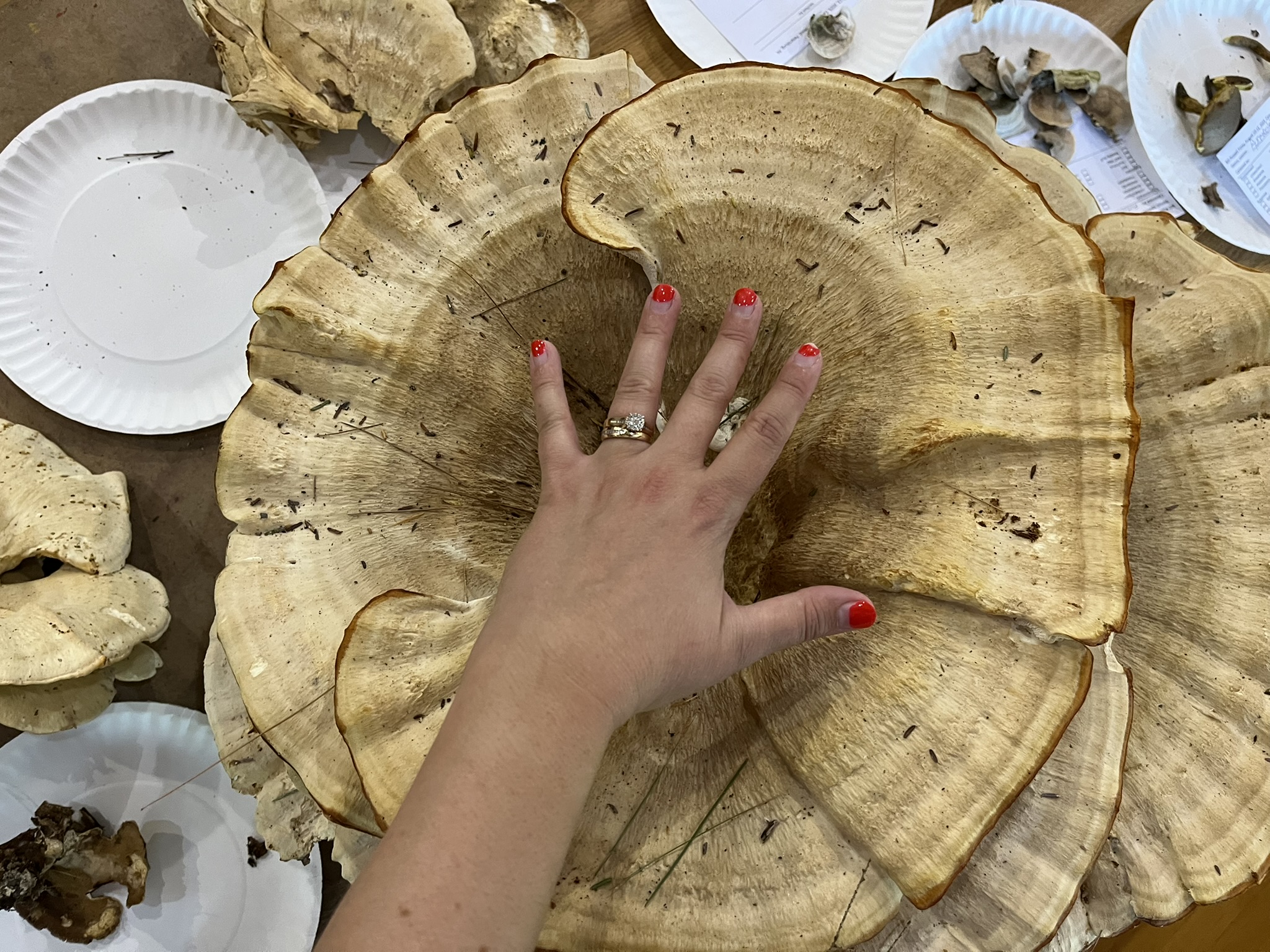
This gigantic polypore was found by a club member before the Foray started

With the cooking demonstration over, and Legacy Lodge cleaned, it was time for us to depart. I was exhausted, but happy- I had spent the whole weekend surrounded by other amateur and professional mycologists, people who care as deeply about fungi, lichen, and nature as myself. With plans to attend next year and participate in leading group activities, my sister and I jumped in the Jeep and headed home.

If you are interested in participating in the 2026 Bill Russell Foray, pay close attention to the website and social media (Facebook and Instagram) of the Central Pennsylvania Mushroom Club. I have covered an example of our regular meetings in the past, and more are still on the schedule for this coming Fall. I look forward for next year’s Bill Russell Foray and for continuing my journey through mycology with my friends in CPMC!

High Summer at the Arboretum

Margery Enes Smith Soaring Waters

The sun beat onto my back as I crossed Park Avenue and into the Arboretum at Penn State. By the time I reached the wetland bridge, I felt thawed from a long morning spent working in a chilly office. I last shared a visit to the Arboretum with you in February, when the gardens lay dormant. In August the gardens hum with life- plants, animals, and insects.

Several construction workers perched on the wall near the Margery Enes Smith Soaring Waters fountain, sharing their lunches away from their jobsite. I took a seat on the bench and snacked on a granola bar, tucking the trash in my pocket before entering the Oasis Garden.

Bird and Pollinator Garden

At this time of year, the Lotus Pool was full of flowers. Several different types of lotuses are planted in the pool, and one looked like the American Lotus. Nelumbo lutea is a member of the water-lily family that grows in still waters and blooms from June through September. According to the Lady Bird Johnson Wildflower Center, it is native to the continental United States. Mississippi State University Extension shares that the roots, leaves, and seeds are edible when properly harvested and prepared. As I’m not inclined to forage from public gardens, I continued my walk.

I passed quickly through the Rose and Fragrance Garden and into the Pollinator and Bird Garden. Glorious native plants shone in the sunlight; a variety of goldenrod species and asters fluttered in the light breeze. I walked in circles for a while, waiting for a seat to open in the Birdhouse, but none came available, and instead I went into Childhood’s Gate Children’s Garden.

Cave with Barn Swallow

There were a few families packing up after an event, and I kept my distance and went into the artificial cave. The call of a Barn Swallow echoed in the small, cool space. I found the swallow perched on one of the cave ledges. I thought about Aristotle and this quote from Nichomachean Ethics – “For as one swallow or one day does not make a spring, so one day or a short time does not make a fortunate or happy man.” In this moment, Aristotle was wrong… one swallow makes me a happy woman. I enjoyed the cool cave for a few minutes more and watched the swallow take flight and soar out the entrance.

I stopped to admire the bronze buffalo on my way out of the Children’s Garden. This piece is in honor of the American Buffalo, which once had a range nearly covering the entire continental United States. By the dawn of the 17th century, Bison bison had been hunted to extinction in Pennsylvania and effectively relegated to the American West. This lone buffalo rests as a testament to its ancient range.

Overlook Pavilion

The steps of the Overlook Pavilion were shrouded in vibrant flora. I refilled my water bottle at the water fountain and took a few moments to gaze out over the rolling landscape. According to maps of the Arboretum, this area could eventually be converted into further botanic gardens, but for now is kept as open grasslands and seasonal tailgating.

I followed the path of the Kathryn Bower Smith Strolling Garden, admiring hydrangeas and trying to stay mindful of my time. My lunch break was quickly ending, and I needed to visit one last place in the Arboretum before I returned to my desk.

Poplar Court

The Poplar Court, once my favorite spot to read at the Arboretum, felt sad and empty. Recently, arborists needed to cut down the cultivated Black Poplars. The cultivar kept by the Arboretum are like the Lombardy Poplar, which has an elegant shape but potentially short life cycle. The trees needed to be cut down- while they were declining in beauty, they were becoming increasingly a hazard to visitors. In the shrinking court, I rested on the bench and gave quiet thanks to the trees that remained. Their shade and whispering leaves were a comfort to me in troubled times, and I hoped that the Arboretum could do something to re-imagine the area while keeping the same feeling of the towering trees.

After a few moments, I left the Poplar Court and headed back to work. Unlike the hot sun beating on me at the beginning of my visit, a cool breeze floated by. I took this as a sign of the changing seasons and marking the point on which I needed to prepare for incoming freshmen. For the next few months, there will be more visitors to the Arboretum as students study and relax during the school year. I won’t mind- even when the Arboretum is busy, I can find quiet pockets to slow down and notice the nature all around me.

Walking the Lower Trail

I participated in this event as part of my commitment to Centred Outdoor’s Outdoor Leadership Cohort. I recommend participating in their events throughout the Summer and Fall seasons. You can check out their schedule on their website. Please consider supporting Centred Outdoors and Clearwater Conservancy today.

Sunday dawned bright and happy, perfect for a mini-road trip to Williamsburg. Our plan was to take the scenic route to meet up with Centred Outdoors at the Lower Trail. For 17 miles, this rail-to-trail connects Canoe Creek State Park with Alexandria, PA. Centred Outdoors guided us for a 1.5-mile walk, where we explored the nature and history of this old railway.

Beebalm or Bergamot, Genus Monarda

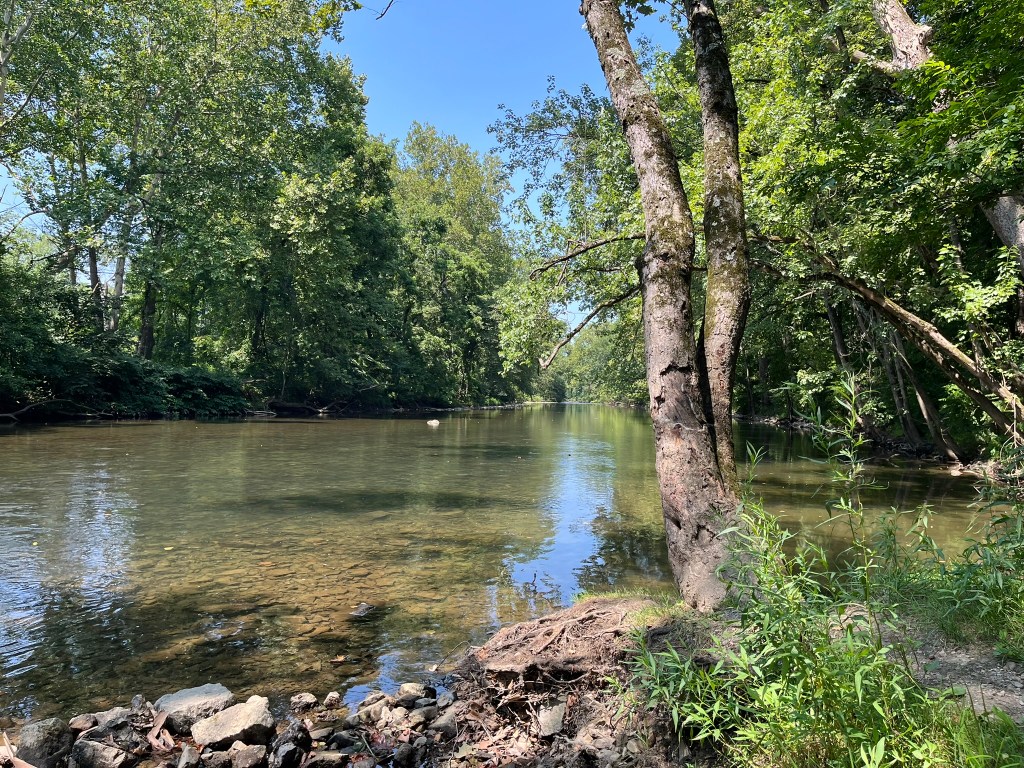
Long before colonists settled the Pennsylvania frontier, indigenous people travelled Morrisons Cove, an ancient eroded anticlinal valley. This path followed the Frankstown Branch of the Juniata River and has experienced many transformations since the colonization of Pennsylvania. In the canal era, the path of the Lower Trail was the towpath for the Pennsylvania Main Line Canal. This canal led to the Allegheny Portage Railroad, which traversed the Allegheny Front.

As the industrial revolution swept across America, the canal towpath was purchased by the Pennsylvania Railroad and converted into the Petersburg Branch. This branch line connected Altoona with Petersburg on the way to Mifflin County. Petersburg Branch barely survived the merger of the Pennsylvania Railroad and New York Central companies to create Penn Central Transportation Company. The corridor of line that makes up the Lower Trail was abandoned in 1979, scrapped out, and put up for sale.

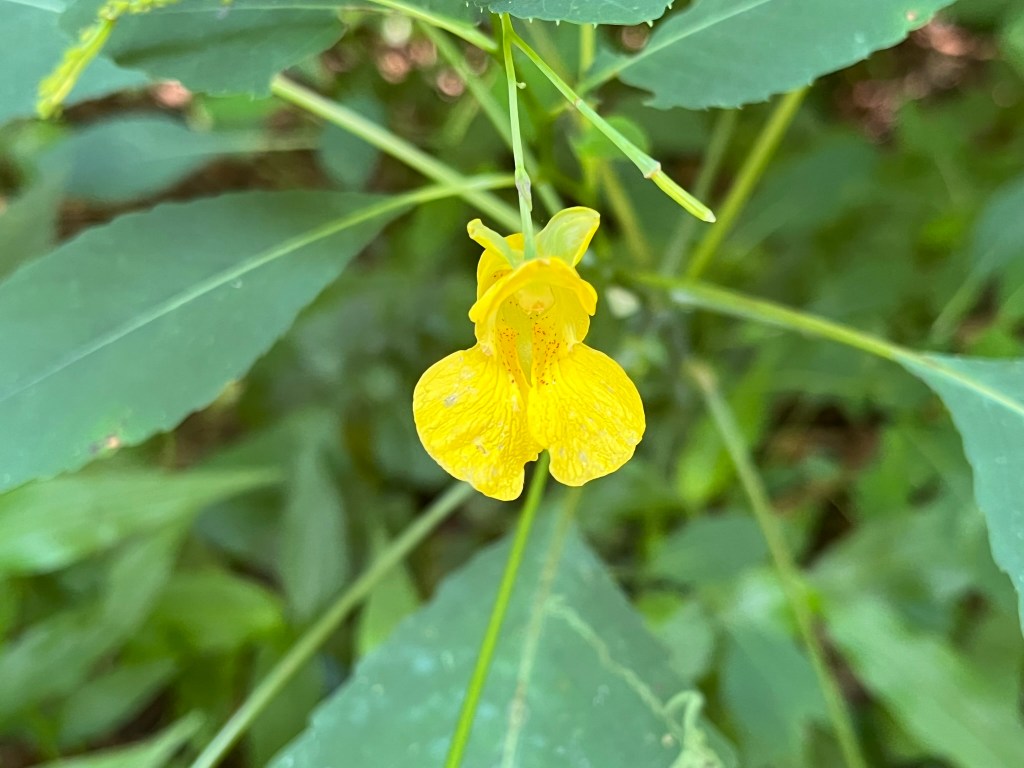
Pale Jewelweed, Impatiens pallida

1989 marks the beginning of the current chapter of the Lower Trail. Rails To Trails of Central Pennsylvania, Inc. purchased the first 11 miles of rail corridor, which stretched from Williamsburg to Alexandria. In 2004, another 5.5 miles was added, forming the trail as we know it today.  Rails to Trails of Central Pennsylvania has additional projects, including the Bells Gap Trail, and an extension of the Lower Trail which will connect to Hollidaysburg.

 On this Sunday, Centred Outdoors met us at Williamsburg Station. This spot was once an actual railway station, the perfect spot to hop on the trail and start walking. A big pavilion near the trail has picnic tables and a bike repair station, where trail users can make minor repairs on their bicycles. The trail near Williamsburg Station is paved and has wide grassy shoulders on either side, perfect for walkers to step to the side when bikers whizz by.

Olivia served as our guide for the day, stopping periodically to point out interesting historical and natural facts about the Lower Trail. She noted lots of tree and shrub species, drawing our attention to some replanting efforts made along the waterside. As a group, we admired the towering American Sycamores holding up the bank of the Frankstown Branch. Opposite the river, the bank was coated in Pale Jewelweed, a Pennsylvania native wildflower. We took turns touching the ripe fruit of the jewelweed, which shivered and exploded to the touch.

Meandering back from our turning point, our group took in the sights and sounds of the Frankstown Branch flowing below us. One of our stops was at canal ruins, the location of the keeper’s home and canal lock. Only the foundation and some rubble remain, but we climbed around, taking plenty of pictures. Carefully we navigated the shrubbery past the grassy path shoulders, taking care to avoid brushing up against poison ivy or tree of heaven.

All too soon, our walk was finished for the day. Fortunately, the Lower Trail Creamery was open. Just a few bucks later, I had a hot fudge sundae, and my husband had a milkshake. We enjoyed our snacks and watching bicyclists on the trail. We spotted all kinds of bikes- mountain, racing, and recumbent. It felt like all of Blair County was out on the trail, speeding along on two wheels.

If you are interested in visiting the Lower Trail, I highly recommend starting your trip at Williamsburg Station. With the trail paved for some distance in both directions, it makes for easy and shady walking. If you wear good bug spray and give bicyclists right-of-way, you will have a relaxed hike. Choose to have a snack at the Creamery before you go, and you’ll find yourself having a perfect Central Pennsylvania summer day.

Exploring Bilger’s Rocks

I participated in this event as part of my commitment to Centred Outdoor’s Outdoor Leadership Cohort. I recommend participating in their events throughout the Summer and Fall seasons. You can check out their schedule on their website. Please consider supporting Centred Outdoors and Clearwater Conservancy today.

On the last Saturday in July, I loaded up the Jeep and headed up the mountain to Bilger’s Rock in Clearfield County. My Mom and sister were tagging along to enjoy a picnic and explore the outcrop with Centred Outdoors. According to some of my Clearfield County friends, visiting Bilger’s Rock is a local rite of passage. For me, living just over an hour away, I hadn’t had an opportunity to visit the rock city.

The night before, I checked my trusty 1990 copy of Roadside Geology of Pennsylvania for any information it could provide to geologically prepare myself for the visit. The entry for Bilger’s Rock was brief- “This rock city developed in highly cross-bedded sandstones of the Pottsville group. The sandstone is a single bed 20-25 ft. thick, broken along widely separated joints” (Van Diver, 1990).

I also read about Bilger’s Rock in Pennsylvania Caves & Other Rocky Roadside Wonders. The author, Kevin Patrick, had much more to say, covering a rough outline of the development of Bilger’s Rock. Initially deposited at least 300 million years ago, the outcrop was eventually exposed to the elements. The large “streets” are from frost wedging, specifically from a periglacial climate which has long since passed.

In more recent human history, the property on which Bilger’s Rock is located was once owned by homesteader Jacob Bilger. The acreage was later purchased in a sheriff sale by a company that quarried and mined in Clearfield County. Miraculously, Bilger’s Rock was left alone and became a local tourist spot, its popularity waning until the 1980s, when it was purchased by the Bilger’s Rock Association and lovingly transformed into a park.  

After our arrival and family picnic, our guide led us down a gravel path, descending from the top of the rocks into the city below. We passed by the Rock House; a facsimile of the shelter Roland Welker made in Alone season 7. Despite its small appearance, the Rock House was large inside… no wonder he became the 100 Day King!

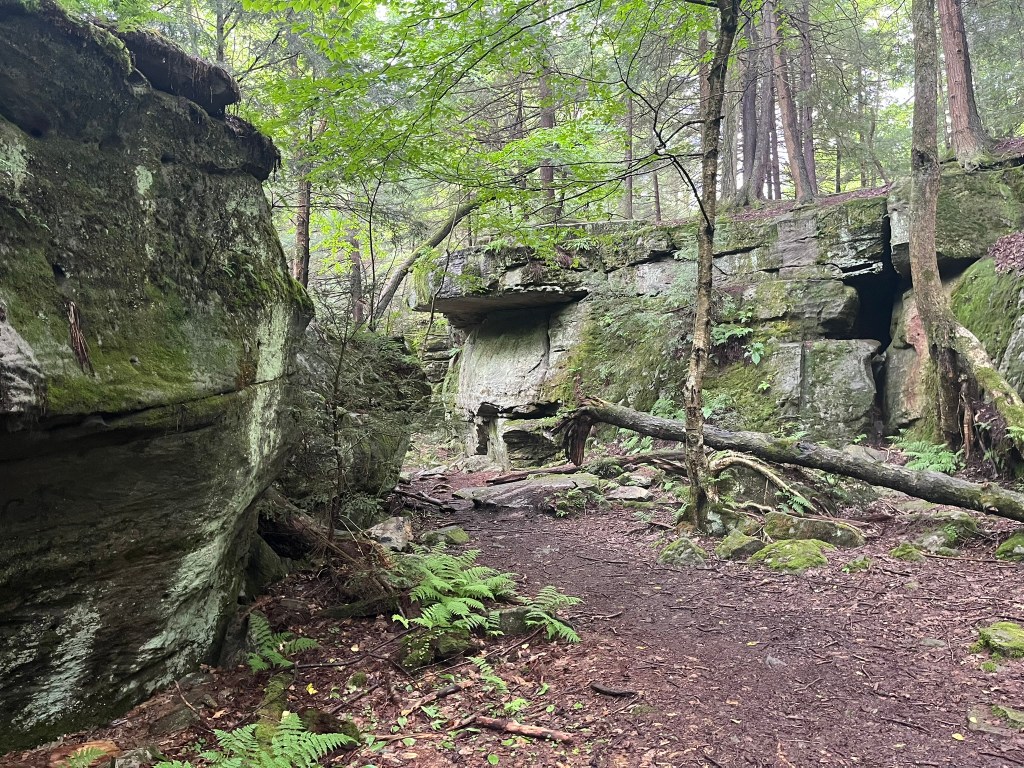
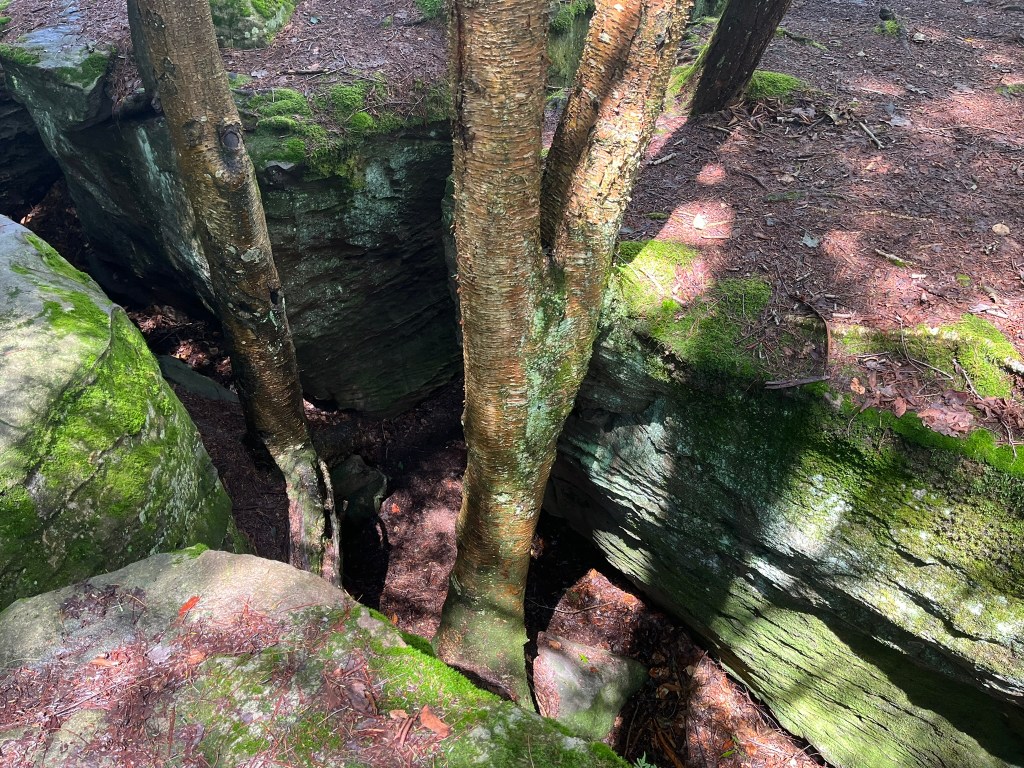
When the rocks came into view, I was speechless. Bilger’s Rock has a presence– something that words and pictures can’t capture. The 25-foot-tall walls towered over our heads, dark and glossy with a recent rain. Mosses and ferns draped over the rocks and trees sprouted in nooks too small for children. Our guide presented us with different opportunities to traverse the rocks, either ducking down to crawl under passes, or climbing up and over to the next spot.

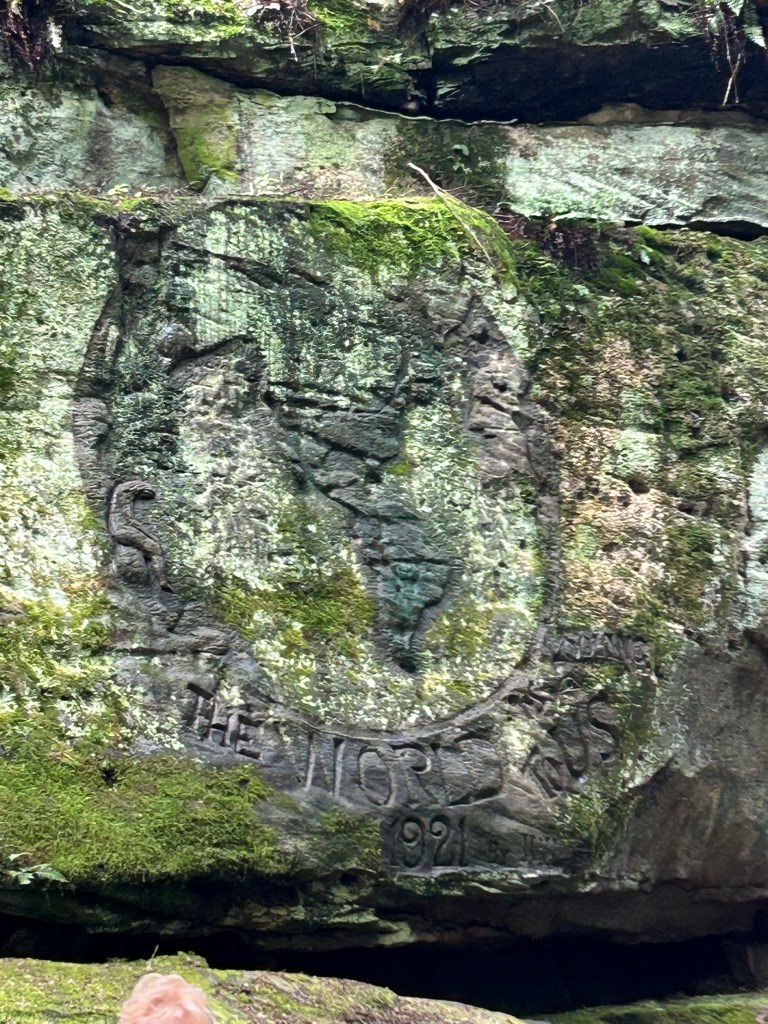
Time didn’t feel real while we were exploring Bilger’s Rock. The hour and a half we had with our guide zipped by. During that time, we explored the Devil’s Dining Room as a large group and broke off into smaller pairs to slip into the Devil’s Kitchen or Ice Cave. Eventually, we emerged at the “entrance” to Bilger’s Rock, the site of a large carving.

The rock art, “The World is Looking to Us” was completed by John W. Larson in 1921. Thought to be inspired by the U.S.’s role in World War I, it is now over 100 years old and showing signs of age. We took our time to look at the carving, and I thought about how even now, the world is looking to us… people that love the Earth and care for each other. In the moment, I felt very fortunate to be surrounded by a group of people that felt equally as curious and delighted by nature as me. For the remaining walk back to the top of the rocks, I dwelled on how I could help others feel the same.

Meeting the rest of the group at the top of the rock city, we carefully walked around the cracks and joints, exploring its mossy roof. I now thought about the ancient seas that deposited the original sediments. At the time, a jungle of spectacular plants dominated the land above, and new, bony fish swam in the seas below. Pennsylvania was covered by shallow seas which rose and receded to create Bilger’s Rock… and the plethora of coal beds which were mined as Jacob Bilger bought the property in the 19th century.

Once our guided tour was over, our group gathered for the weekly Sock Sunday giveaway- which my sister won! With her prize in hand, and my gear safely stowed, we loaded back up in the Jeep for the long ride home. While we were a little muddy from clambering on the rocks, we were energized by our time in the cool microclimate down inside. All the way home we talked about the different little things we noticed… and made plans for returning with our full family sometime in the future.

Mushrooming at S.B. Elliott State Park

On the last Saturday in July, my family and I attended a Central Pennsylvania Mushroom Club meeting at S.B. Elliott State Park. Throughout the Spring, Summer, and Fall months, CPMC meets at various locations throughout Central Pennsylvania to hunt, talk, and teach about mushrooms. This meeting was my first time visiting S.B. Elliott State Park and hunting for mushrooms in July!

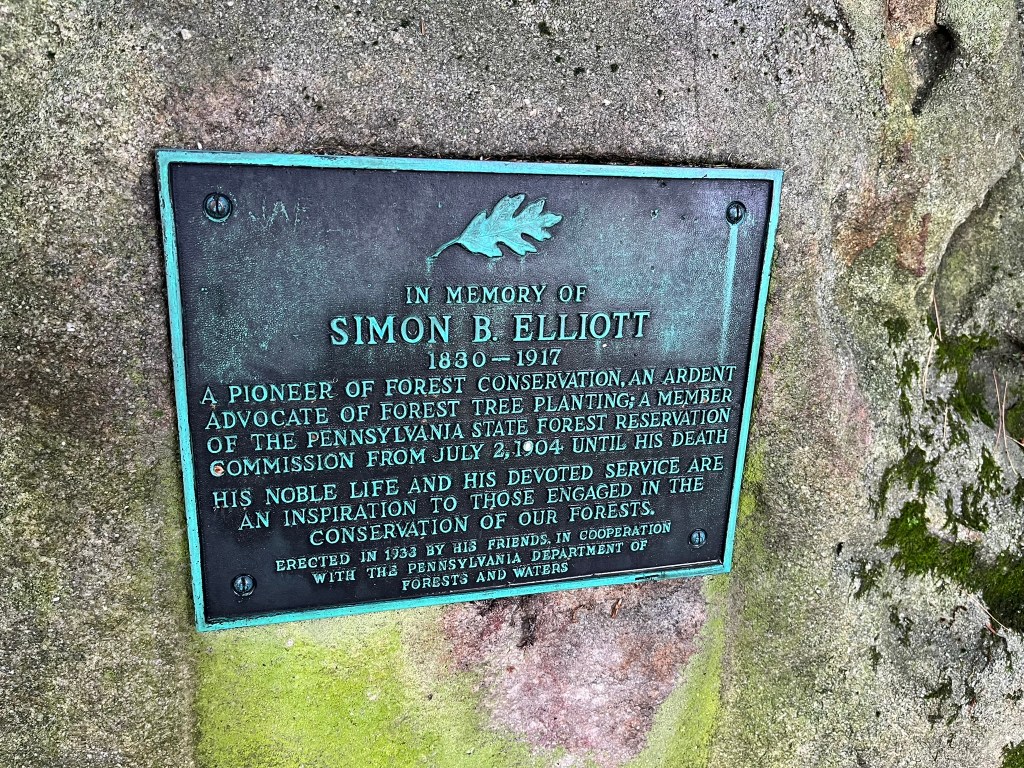
In the same year the Civilian Conservation Corps established Camp S-116-PA, 1933, the Department of Forests and Waters created S.B. Elliott State Park. A memorial plaque to Simon B. Elliott, a dedicated conservationist, was erected to commemorate the park. This heartfelt memorial is now shrouded by trees, which, I imagine, Simon B. Elliott would have liked. The CCC Lodge, outbuildings, and pavilions remain, which looked magnificently historical and mysterious.

Crown-Tipped Coral Fungus

Promptly at 1:00pm, our meeting divided into three groups. One group headed in the direction of the bog, which may be either the “Wallace Sphagnum Bog” or “Crystal Springs Bog.” I didn’t have the time on this trip, so I noted it for future exploration. Another followed Crystal Springs Road to walk up the snowmobile trails. The last group, which we followed, headed towards the wooded area between our pavilion and the old Dague Nursery. This area was composed of second-growth woodland, with lots of oak, beech, and evergreen trees. I also spotted plenty of Christmas Fern and New York Fern. Some trees had naturally fallen, but a small handful had been cut down and left to rot.

Just as we set out on our hunt, a light rain passed through our area. For a brief time, the rain cooled us off, but the humidity quickly ramped up again, and the bugs emerged. For a while, we found slugs and snails before seeing any mushrooms! I identified Western Dusky Slugs, but the snails escaped me. I was so focused on mushrooms that I forgot to take pictures of them.

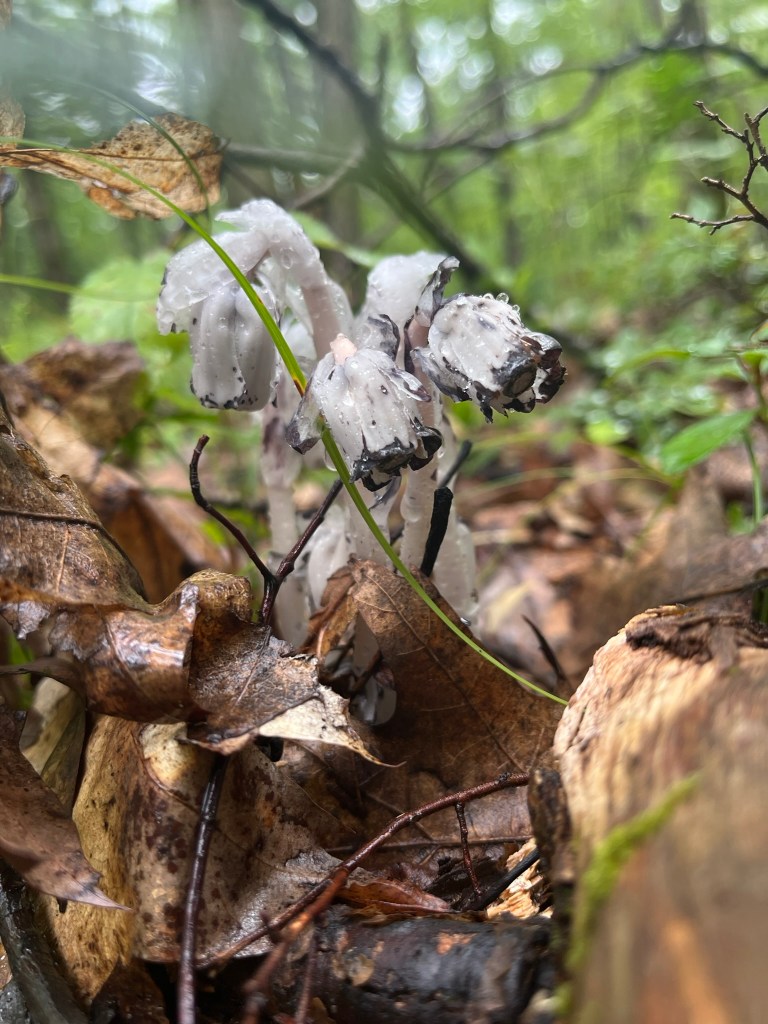
After the slugs and ferns, we spotted Monotropa uniflora, Ghost Pipes. These perennial wildflowers are found all throughout Pennsylvania. The plants are a mycoheterotroph, a parasitic flower hosted by fungi in the Russulaceae family. Ghost Pipes are known to be the favorite flower of Emily Dickinson. I hadn’t seen any in person for many years. I couldn’t take a single step without nearly crushing a bunch of Ghost Pipes!

As the humidity settled over us, we finally started spotting mushrooms. We were on the hunt for a Russula aeruginea, the Green Russula, which my sister spotted and took to our walk leader. I found some Crown-Tipped Coral Fungus sprouting in a large clump on a rotting log. I reached the point where I felt like every glance was full of mushrooms. We counted more than ten species from our small group alone. Favorites of mine were Oak Mazegill, Crowded Parchment, and Berkeley’s Polypore.

Jack-o’lantern Mushroom

Towards the end of our walk, our group stumbled upon a large growth of Omphalotus olearius, the jack-o’lantern mushroom. These poisonous mushrooms fruit at a similar time to Chantarelles, and look eerily alike. Jack-o’lantern mushrooms possess true gills, a feature Chantarelles lack. Plus, jack-o’lantern mushrooms are vivid orange, and are the same color throughout. While I know scientifically these mushrooms are poisonous enough to cause harm to human beings, I can’t imagine ever being tempted to eat them. There is a certain something in their appearance and smell that sets off my primitive instinct to leave them alone.

After we finished our walk, all the groups gathered at a pavilion to begin identifying all the mushrooms found. Quickly the plates of identified specimens filled two picnic tables, and the heady scent of fresh fungi filled the air. Club leaders walked us through the species and families one by one. One of the best parts of the club is that there is a mix of ages and experience, creating a wealth of knowledge. I love to simply listen to them discuss different specimens or trade stories.

All too soon, my family and I packed up our foraging baskets and backpacks. Tired and sweaty, we loaded in my Jeep and headed east on I-80. Mushrooms were on the mind as we discussed our plans for mushrooming in August. Soon a copy of Field Guide to Wild Mushrooms of Pennsylvania and the Mid-Atlantic will be on my doorstep, ready for more mushrooming adventures.

If you are interested in joining a local mushroom club, please check out NAMA, the North American Mycological Association. A database of mushroom clubs throughout the United States is on their website at https://namyco.org/clubs/. The schedule of events for the Central Pennsylvania Mushroom Club is on their website at https://centralpamushroom.club/events/.