Catch Me Outside for 1,000 Hours

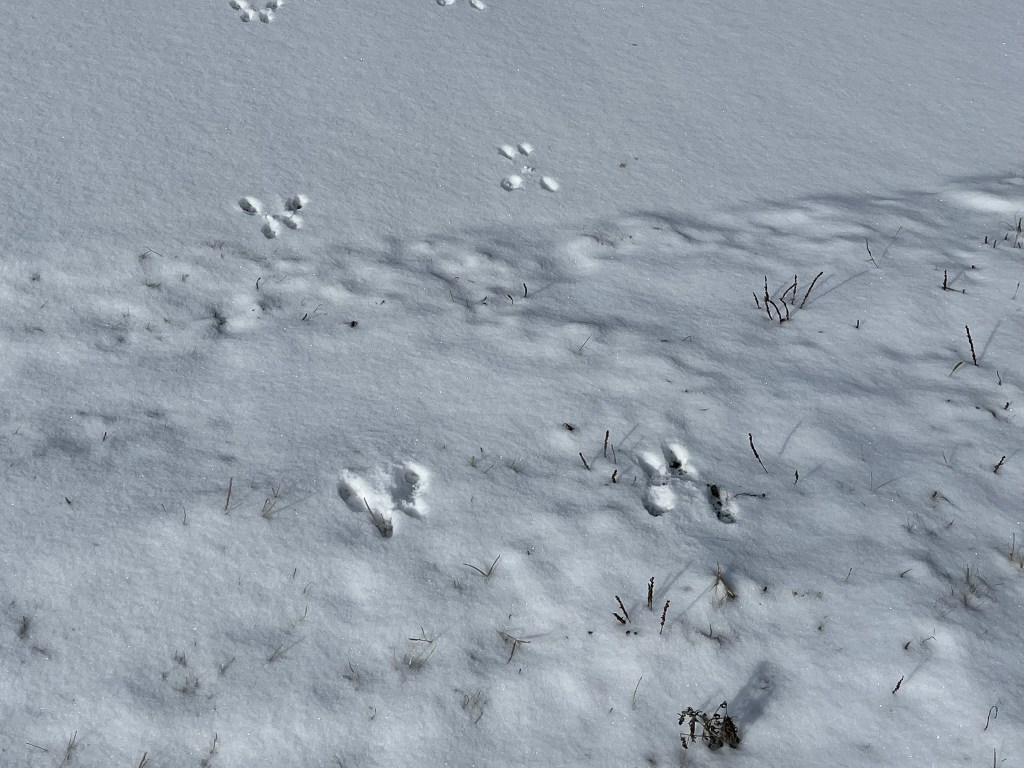
Animal tracks in the snow

On the first 40-degree day of February, I went on a long walk. It was my first walk as part of my 2025 goal: spend 1,000 hours outside by December 31st.

I don’t choose traditional resolutions. Instead, I pick one big goal for the year, and work hard to achieve it. Past goals have been reading 100 books, folding 1,000 paper cranes, and going on a book-buying ban. This year, my mom recommended that I try to spend 1,000 hours outside in a calendar year.

This goal aligns with my belief that everyone should be spending more time outside. The founder of 1,000 Hours Outside suggests that children who spend many hours outside per day have improved health and wellness. I disagree with the founder’s other beliefs, but have found evidence to support this claim. A review found that outdoor play is a practical method for improving children’s health (McCurdy, 2010). Another article suggests that exposure to many different bird species outdoors can improve mental health (Methorst, 2024). Birding is an excellent vehicle for improving health on the sly (Dresser, 2024). As I’m working on improving my health, spending more time outside should help.

I also chose this goal with the hope of breaking a screen addiction. On average, I spend about 4 hours per day on my iPhone. I know I spend at least 8 hours per day working on my laptop. Even with a little overlap, this amounts to almost 70 hours of screentime per week! When I’ve spent long periods of time spending 90 minutes or less on my iPhone per day, I have improved mental health. Sure, this is anecdotal evidence, but it is my experience. I want to replace this non-work-related screen time with time spent in nature.

As odd as this may sound, I also chose this goal to help me reconnect with the outdoors. After a tough winter, I’m disconnected from the natural world around me. I admit that in January, I was getting out 1 to 2 times per week. I’m craving spending time outdoors to explore and enjoy the natural world.

Stereum complicatum (Crowded Parchment)

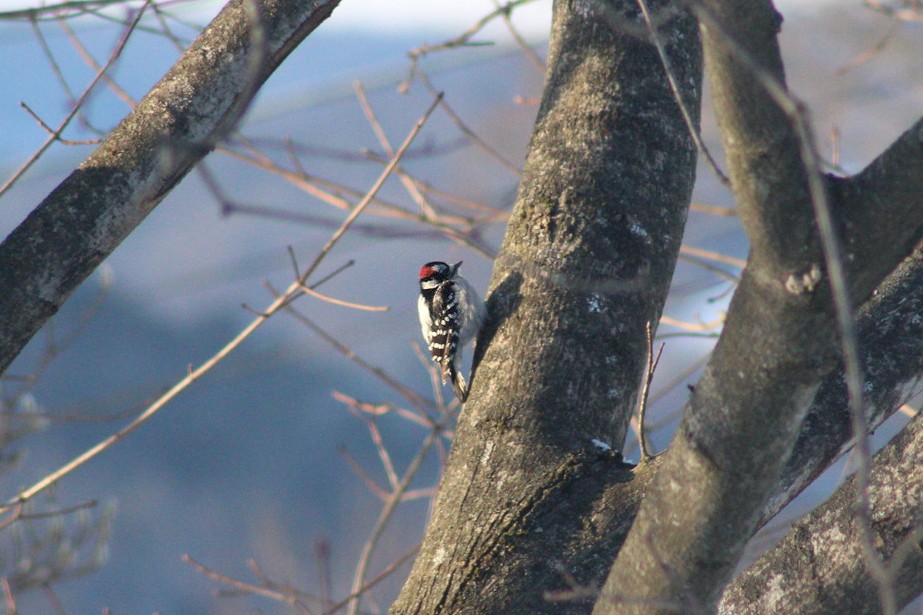
I started tracking on Monday, and got an hour in right away. I let myself meander through the park and enjoy myself rather than hustle to achieve a step goal. I was able to take notice of some mosses and lichens, and found a fresh woodpecker hole in a tree. I felt refreshed, and had a super productive afternoon afterwards.

While I’m starting out a little behind, I know I’ll catch up soon. I’m counting down the days to when I can go hiking and kayaking at the park. I’ve squirreled away the pennies for a hammock rack to put in my yard for reading outdoors. Our grilling station is set up and ready for when it’s not snowing or raining. I’ve been making plans for spring hikes with my siblings. I’m very energized and excited about finishing this goal- and I’ll bring you along with me!

Have you attempted a 1,000 hours outside challenge?

Exploring Local Lichens

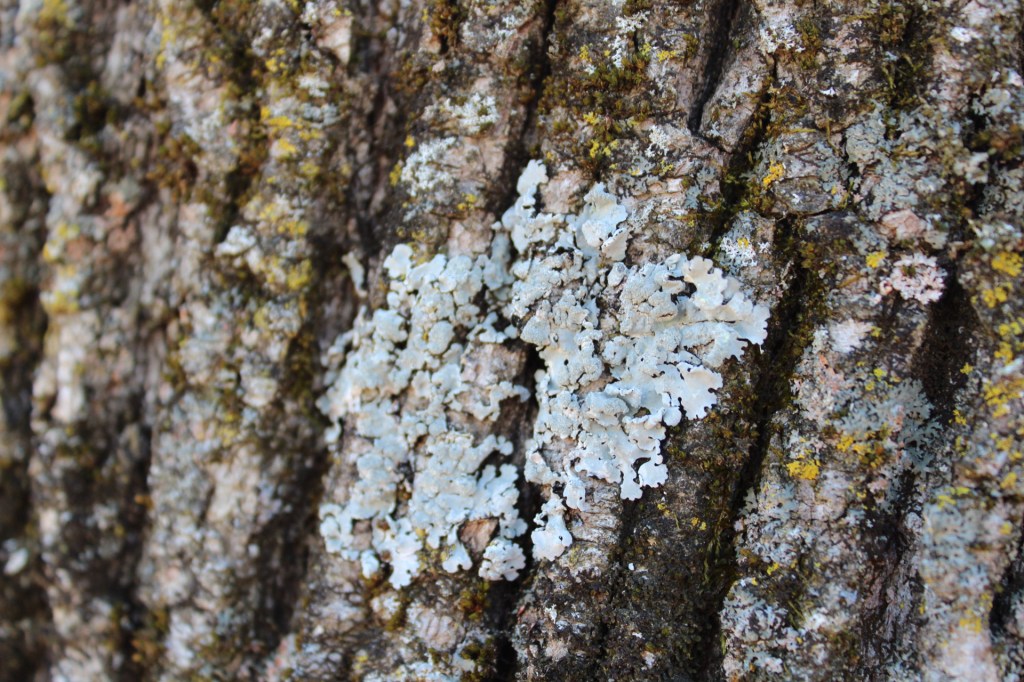
Foliose lichen found on a Norway Maple tree

Despite my interest in mushrooms, I know little about lichens. At the January Community Nature Journaling meeting, Stephen Bucklin introduced us to lichens. I learned a little on their ecology, physiology, and reproductive systems. Since then, I’m noticing lichens a lot more, especially in my own backyard.

I first noticed some lichens growing on the Norway Maple tree in my front yard. On the eastward side of the tree were many lichens, and I took a couple of snaps of the largest ones. The majority of them appear to be at least be Parmelioideae; typical shield lichens. To the touch, the lichens were cold and a little leathery.

The Norway Maple also had many small yellow lichens, which my camera and I struggled to capture. They grew in many small spots, some smaller than a pencil tip. Most were between the size of a pencil eraser to bottle cap. If I touched them, they brushed right off the tree. In the picture above, you can see the abundance of the yellow lichen all around the big shield lichen.
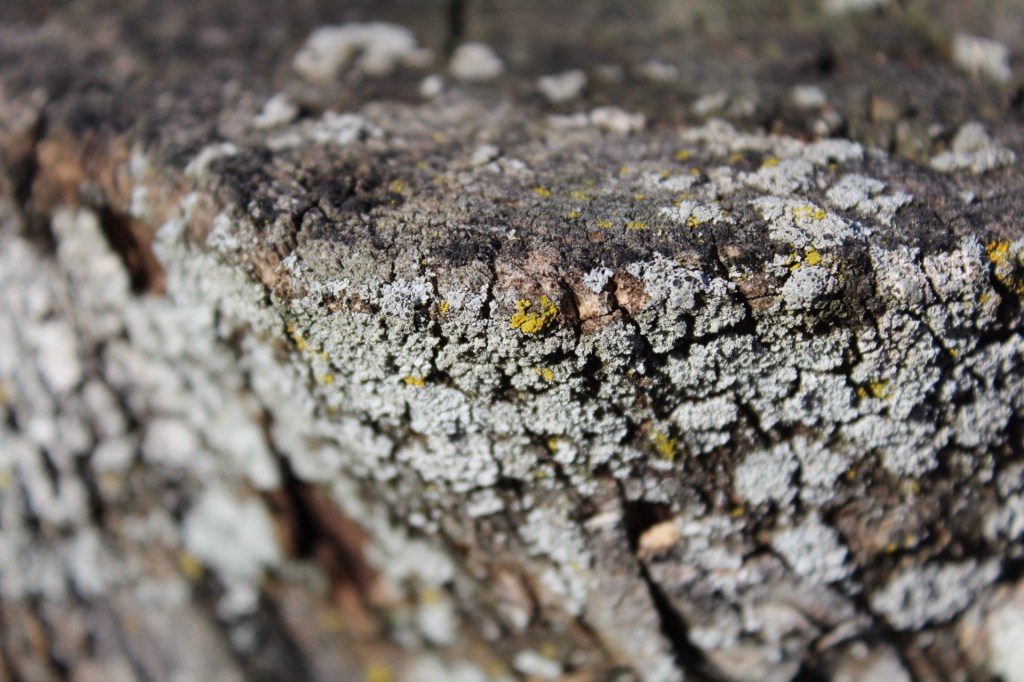
Crustose lichen found on a post

On the post that holds my CoCoRaHS rain gauge, a crustose lichen appears on all sides. It didn’t brush off using my finger pad or nails- the medulla of the lichen anchors it to the substrate. In this case, the substrate is a post of unknown origin. Looking close, I could see little black dots- the mycobiont’s reproductive structures.

Foliose lichen found on same post

Near the ground, the post had another species, a foliose lichen. Yet again, iNaturalist suggested that it hailed from the typical shield lichen family. I’m waiting for more species suggestions from experts now. These felt cold and leathery to the touch, too. I liked how bright and green they were in comparison to the grey-green of the crustose lichen at the top of the post.

Foliose lichen and Ulota crispa competing for habitat

On a dead snag in my yard, I found an example of a lichen and a moss competing for habitat. The foliose lichen spread all over the trunk of the snag, in groups roughly the size of my hand. In one spot, Ulota crispa, crisped pincushion moss, was growing over and up through the lichen. Lichens take anywhere from tens to hundreds of years to grow and develop. On the flip side, a moss can grow in spread in a year and a half or less. The moss is out-competing the lichen on this tree. I’m going to keep an eye on its development in the future.

I’m surprised that my yard had so many examples of lichens. I only have three trees, a snag, a forsythia bush, and a single post. I didn’t see any lichens growing on my house or garage. With such little habitat, the lichen has found its niche and is growing. Considering how long it takes for a lichen to develop, I can say that they may have been “born” at the same time as me. Thinking about it, some of these lichen may be older than me!
Hope & Wild Things

“Hope” is the thing with feathers –
That perches in the soul –
And sings the tune without the words –
And never stops – at all
Emily Dickinson

The first stanza of Emily Dickinson’s poem on hope rings true- especially in this past week. My despair over the state of our nation’s leadership swelled in its intensity. Coupled with the below-zero temperatures, I drifted through the weekend. I struggled to stay warm and hold up against the news and my fear of the furnace breaking down. I needed to find some peace, and some hope.

While out walking, I thought of Wendell Berry, finding peace among the wild things. Over my head fluttered European Starlings, calling to each other. In spite of the cold, they squawked and screamed, carrying on in their raucous ways as if it were any other day. Back in my yard, birds of many species fed on the seed I had scattered. While usually the Dark-Eyed Juncos and House Finches would fight- they did not. All were too focused on survival to slip into argument.

Birdwatching always brings me peace. When I was a teen, I would keep up my parents’ feeders in the winter, filling each one after caring for my goats. I would sit on the bench in the kitchen with my tea and watch as Blue Jays and Northern Cardinals swept into the yard. Black-Capped Chickadees would follow me during my midday water check. When dusk would settle over the mountain, the birds would roost in the trees, waiting for morning.

The quiet routine of cleaning feeders and stocking suet help the days pass. One day, it’s October, and the last of the fall migrants disappear. The next, it’s December, and established flocks of songbirds are floating in and out of the yard. At last, it’s March, and the early spring migrants are taking a pit-stop on their journey north. Spring inches forward at the rate of one minute per day.

For me, the creep from winter solstice to spring equinox is laden with long periods of thought. At this moment, I’m consumed by my worries for our lands’ future. Already the Arctic National Wildlife Refuge has lost its protection from oil drilling. I fear for a renewal in fracking in Pennsylvania, an industrial pursuit I despise. There is only so much angry complaining I can do- only so many strongly-worded letters and emails I can write. There are only so many aggressive phone calls I can make.

Even if fighting is natural for all animals, it is not the option I want to choose. Caring for my community, both human and wild, is the path I want to follow. I can start in my yard, tending to the birds as I always do. I can carry on with bringing nature journaling to my community… Giving my time and effort to support educational experiences in public settings. I do believe I am not alone- there are hundreds, if not thousands, of similar people in Pennsylvania.

I cannot, and will not despair. There are wild things, feathered things, counting on me. Birds don’t know of human politics and maneuvers. I cannot lie in my bed to rot when there are creatures that need me to break the ice in their watering dish. I cannot retreat inside of myself when there are decisions to make in my community. Spring will come again, one day at a time.

Green Linings

Snow floated down around me as I walked across the parking lot to Lakeside Trail. The trail, a 5.6 mile loop at the base of Bald Eagle Mountain, is a favorite of mine. American Robins chittered in the trees overhead, flying off when I whistled in return. The trail was snowy and undisturbed, perfect for some time alone in the winter woods.

Along the trail ranged a dense, berry-dotted shrub, obscuring my view of the lake. Little grey-blue berries clustered on branches… privet. Privet renders any habitat into a tangle of branches with its reproductive cycle. The invasive plant species will out-shade low-lying native plants. Once established, privet is an aggressive enemy, and here, the battle is already lost.

Interspersed throughout the privet is multiflora rose, another invasive species in Pennsylvania. Multiflora rose is a “Class B” noxious weed, as it is very prolific and difficult to control. An established plant will produce up to 500,000 seeds in a single year. Shade-tolerant and hardy, it’s taking over the base of Bald Eagle Mountain.

I can’t help but feel sad watching these species consume my favorite places. Japanese stiltgrass threatens my yard. Shrubs like privet edge out the mountain laurel, and English Ivy coats the ground in thick waves. These are not the scenes we should be seeing in Pennsylvania, but they are our reality.

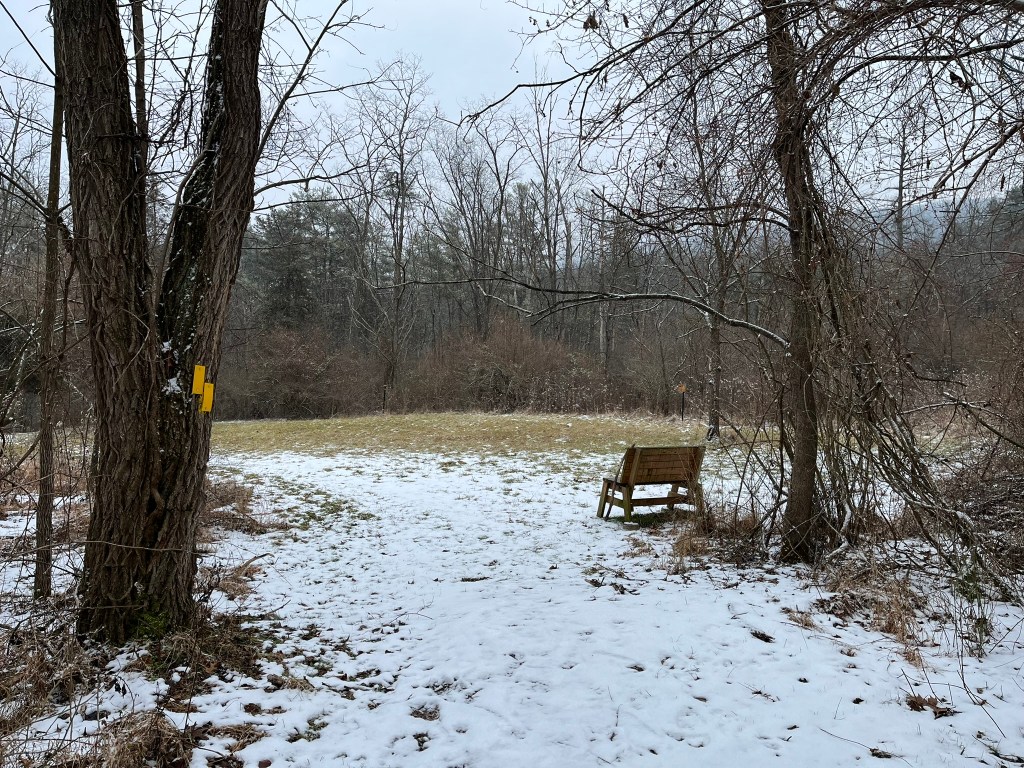
As I continued my walk, the dense shrubs gave way to a small clearing- the remains of an apple orchard. A bench sits near the trail, and I stopped for a moment to admire a common greenshield lichen on the bench. This native fungi species shone bright lime-green against the white snow. Typically found on bark, this lichen will grow on wood products if conditions are right. Upon my touch, it was not warm, but wet and floppy like lettuce leaves. After dwelling on invasive species, I felt better to know a native one was thriving here.

This orchard is one of my favorite places at Bald Eagle State Park. In my first year of living here, I would bring a book here to read on the bench or lay on a blanket in the meadow. I wondered what this meadow would look like if the privet or multiflora rose took over. The thought was too depressing- how could I only imagine a bad outcome for this scene?

A term popped into my mind as I strolled around- recency bias. Witnessing the fires in Los Angeles, and knowing the role invasive species had in them, had been on my mind all week. Our minds will often overemphasize recent experiences when thinking about the future.. Combating recency bias takes a concentrated effort, as all pessimistic thoughts do.

Instead, as I walked back home, I imagined what Lakeside Trail would be like if the invasives were managed. Reducing the invasive shrubs would open the understory, helping low-lying plants grow. Promoting the growth of native berry-bearing species would provide forage for wildlife. This type of project is intense, and in some cases, impossible. Yet, I didn’t feel daunted. The lichen gave me hope, proof that even in a space troubled with invasive species, with a little help, native ones may find a way.

Nature Walk Diary, 1-11-25

Saturday dawned with three-quarters of an inch of fresh, new snow. After my coffee, I bundled up to take a walk to the dock and do some birding. At 28 degrees with a soft breeze, the day felt warmer than the week before. A blue, sunny sky stretched overhead as I set off, first noticing some bird tracks on my front stoop.

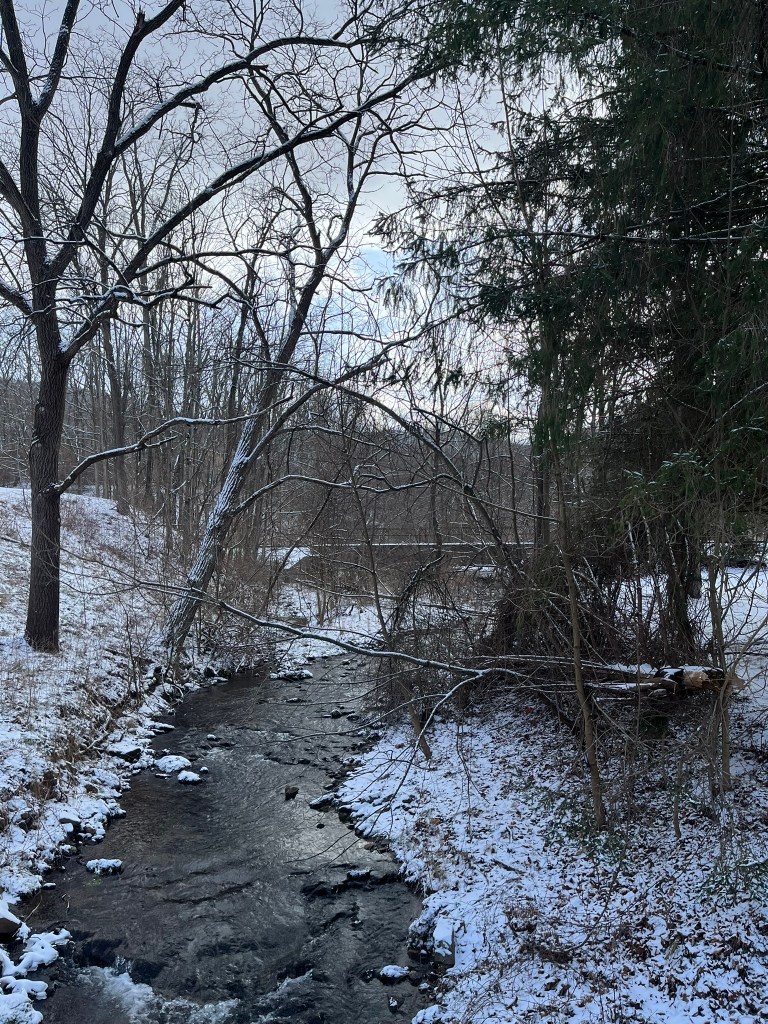
A light wind pushed at me while I noted the birds in a neighbor’s yard: Dark-eyed Juncos, House Finches, and a Blue Jay. The dulcet tones of Lick Run overpowered any bird song. The groundwater-fed stream was free-flowing and ultra clear. I love the look of the creek flowing under the railroad bridge… I swear I have a thousand shots of that sight alone!

I continued on my walk, ambling up the hill. To my left, the thick briars on the steep hillside was full of birds. I let some cars pass and sidled up the guardrail to take a sound recording with Merlin. Merlin recognized Carolina Wrens, Tufted Titmice, Northern Cardinals, and American Robins. Before I turned off the recording, a new call broke out, one I was not familiar with.

A high, sharp repeating cheep rung out and paused before starting over. Merlin claimed it was a Golden-Crowned Kinglet. It continued to call after I closed Merlin and started looking for the bird in the thicket. Near the top of a bush was a small, darting bird with a shock of yellow on its head. A bright dark eye flashed under a white stripe… the Kinglet! The bird was here and gone before I could raise my camera. Dejected, I continued on my walk to the dock.

The closer I approached the lake, the more quiet the brush became. I ended my checklist with 12 species, the typical bunch of feeder birds plus the Kinglet. Once in the dock’s parking lot, I appreciated the beauty of the frozen lake. From my spot, I could see all the way to the breast of the dam, complete with a white velvet carpet of snow.

Rabbit tracks crossed the path to the dock platform. At least two rabbits had been dashing back and forth in the new snow. One rabbit had ventured out on the ice, crossing from the peninsula to the shore once. I had heard the ice was almost 3 inches thick at the Hunter Run Cut, but I wasn’t stupid enough to step out. Ice ought to be 4 inches or more thick before it’s acceptable to walk upon.

I dawdled a little longer, collecting two seed pods and a mushroom to draw back at home. I had seen the mushroom earlier this fall and wanted to explore its shape on paper. One of the seed pods was from the sycamore tree near the shore. I suspect a rushing squirrel broke the brittle tip of the branch.

As a cloud floated across the sun, I turned for home. The walk back to the house was slow- I stopped a few times to take more Merlin recordings. I strained to listen for the Kinglet back along the hillside, but I didn’t catch a single note or feather. Despite my disappointment, I did feel pleased at heart- I started off the new year with a new bird on my life list!