Despite my interest in mushrooms, I know little about lichens. At the January Community Nature Journaling meeting, Stephen Bucklin introduced us to lichens. I learned a little on their ecology, physiology, and reproductive systems. Since then, I’m noticing lichens a lot more, especially in my own backyard.
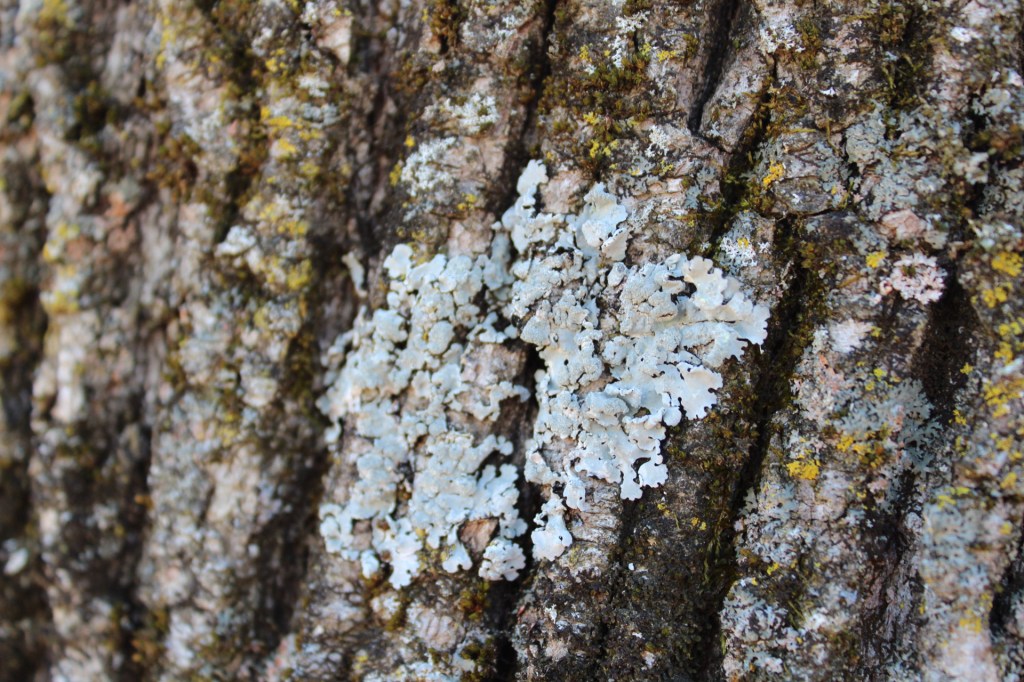
I first noticed some lichens growing on the Norway Maple tree in my front yard. On the eastward side of the tree were many lichens, and I took a couple of snaps of the largest ones. The majority of them appear to be at least be Parmelioideae; typical shield lichens. To the touch, the lichens were cold and a little leathery.
The Norway Maple also had many small yellow lichens, which my camera and I struggled to capture. They grew in many small spots, some smaller than a pencil tip. Most were between the size of a pencil eraser to bottle cap. If I touched them, they brushed right off the tree. In the picture above, you can see the abundance of the yellow lichen all around the big shield lichen.
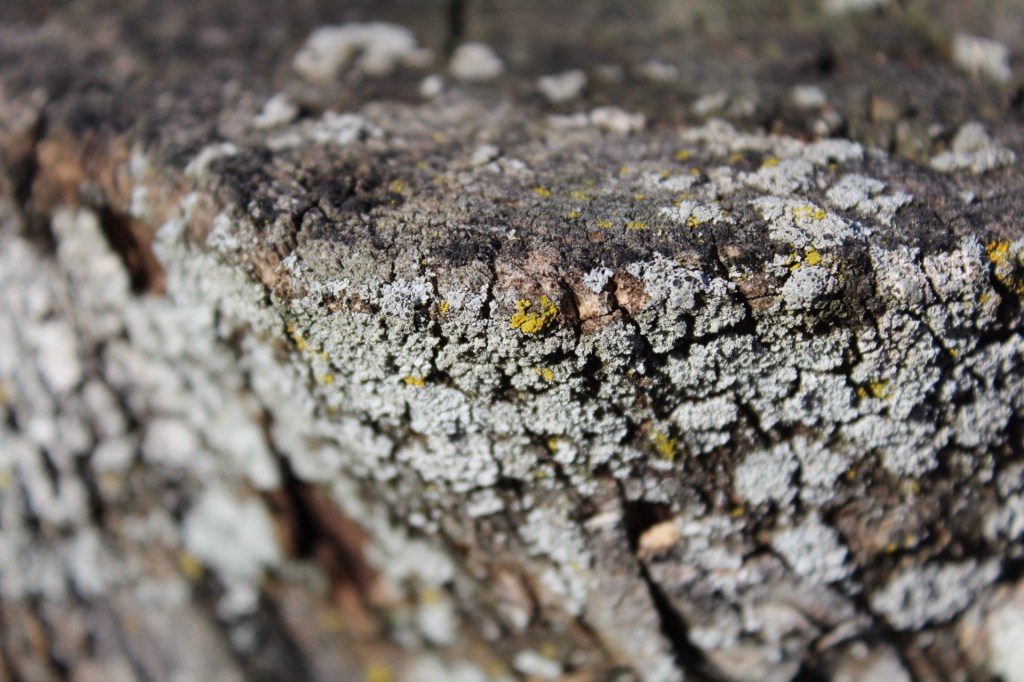
On the post that holds my CoCoRaHS rain gauge, a crustose lichen appears on all sides. It didn’t brush off using my finger pad or nails- the medulla of the lichen anchors it to the substrate. In this case, the substrate is a post of unknown origin. Looking close, I could see little black dots- the mycobiont’s reproductive structures.

Near the ground, the post had another species, a foliose lichen. Yet again, iNaturalist suggested that it hailed from the typical shield lichen family. I’m waiting for more species suggestions from experts now. These felt cold and leathery to the touch, too. I liked how bright and green they were in comparison to the grey-green of the crustose lichen at the top of the post.

On a dead snag in my yard, I found an example of a lichen and a moss competing for habitat. The foliose lichen spread all over the trunk of the snag, in groups roughly the size of my hand. In one spot, Ulota crispa, crisped pincushion moss, was growing over and up through the lichen. Lichens take anywhere from tens to hundreds of years to grow and develop. On the flip side, a moss can grow in spread in a year and a half or less. The moss is out-competing the lichen on this tree. I’m going to keep an eye on its development in the future.
I’m surprised that my yard had so many examples of lichens. I only have three trees, a snag, a forsythia bush, and a single post. I didn’t see any lichens growing on my house or garage. With such little habitat, the lichen has found its niche and is growing. Considering how long it takes for a lichen to develop, I can say that they may have been “born” at the same time as me. Thinking about it, some of these lichen may be older than me!







 Autumn Knepp