The Curious Lives of Red Efts

Hurricane Helene was passing over as we searched for terrestrial amphibians. Despite the humidity, the air was chill, and the rain cold. My friend and I flipped log after log, searching for some sign of life other than fat earthworms and moss. When we least expected it, my friend found a tiny amphibian- a red eft.

With gloved hands, she gently moved the eft into a container with a moist paper towel, careful to not squish it. We admired its brilliant color- cheerful against the decaying leaves and muck. The newt was smaller than my thumb, its tail narrowing to a pencil tip in width. The newt curled up on the towel, as if to show off the red dots on its back.

Red efts are an interesting creature- part of the life cycle of red-spotted newts. These newts have four life stages: egg, larvae, eft, and adult. Adult female newts will lay eggs in submerged vegetation, which will hatch into eggs in 3-8 weeks. The incubation period depends on water quality. The better the water, the less time an egg needs to incubate.

After hatching, the newts will be larvae for 2-5 weeks. Yet again, the higher the water quality, the less time the larvae will need to metamorphose into an eft. An important factor now is food availability- the larvae will consume anything that can fit into their mouths. At this point in its life cycle, the newts have never touched land.

When the conditions are right, the larvae will metamorphose into an eft. Its external gills disappear and develop into lungs, and stubby legs erupt from the sides of its body. During the red eft stage, the newts do not need water to survive. Efts will haul themselves out of the water and into upland habitats. These habitats range from dry to wet, woodlands to meadows. When we were searching in the field, we were finding red efts under logs and flat rocks close to a stream.

Efts will remain as terrestrial sub-adults for 1 to 3 years. Yes, years! Efts will delay metamorphosis until conditions improve. Some newts have remained in the eft stage for 7 years. By remaining as efts, newts are able to survive drought in this manner. Until development into an adult, efts secrete a poison which makes them distasteful to predators. Their bright coloration serves as a warning: don’t eat me!

Once the eft has determined there is enough clean water and food, it will metamorphose to its final form. The adult newt is green and yellow with red spots, and lives in water. It has a long tail with a caudal fin, which helps it navigate in the water. After a complex mating ritual, the adult will lay eggs and begin a new generation of red-spotted newts.

I have yet to see a red-spotted newt in real life. I have seen many red efts- their bright bodies are easy to spot as they move from one habitat to another. I have seen red efts between the high outlook at Leonard Harrison State Park to the low streams of Bald Eagle. PARS has verified sightings of red-spotted newts in every county in Pennsylvania!

As the distribution of red-spotted newts is so wide, they are still at risk by changes in their habitat. Red-spotted newts absolutely need high-quality clean water to breed and grow. Protecting the health of Pennsylvania’s waterways will assist in protecting red-spotted newt populations. When looking for red efts, hunters must take utmost care to not crush the efts with their hands, logs, or rocks. It is best to look with eyes alone- try not to touch the efts at all! If it were not for our class, we would have left the newt my friend found completely alone.

After taking a few photographs, my friend released the eft back to its “home” log. It soon vanished into the leaves. Without a doubt, it would hide even deeper to escape detection from other curious people. I hoped it would live a long life, free of predation and making its final transition from land to water.

Works Cited

Connecticut Department of Energy & Environmental Protection. “Red-Spotted Newt.” Connecticut Department of Energy & Environmental Protection, Connecticut’s Official State Website, 11 Oct. 2016, https://www.portal.ct.gov/DEEP/Wildlife/Fact-Sheets/Red-Spotted-Newt. Accessed 30 Sept. 2024.

Poston, Jason, et al. “Red-Spotted Newt.” PA Herps, https://www.paherps.com/herps/salamanders/eastern_newt/. Accessed 30 Sept. 2024.
Summer Osprey Sightings

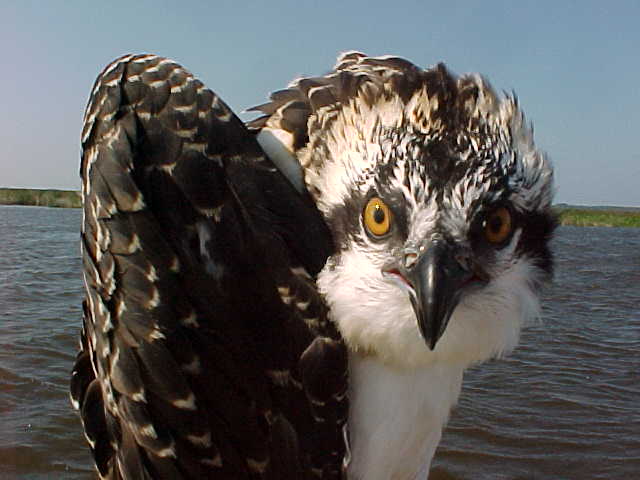
Photo of the Week – Osprey at Back Bay National Wildlife Refuge (VA)” by U. S. Fish and Wildlife Service – Northeast Region is marked with Public Domain Mark 1.0.

Near the intersection of Rt. 26 and Rt. 150, the Bald Eagle Overlook faces out over Foster Joseph Sayers Lake. Here, I watched a pair of Osprey dominate the northern bank of the lake all summer.

Considering the nearby Bald Eagle State Park, watching Osprey feels traitorous. I see at least one Bald Eagle per day while on my lunch walks- this is a gift I will never take for granted. Yet every time I spot an Osprey, I become transfixed, waiting for their yellow glare to pass over me.

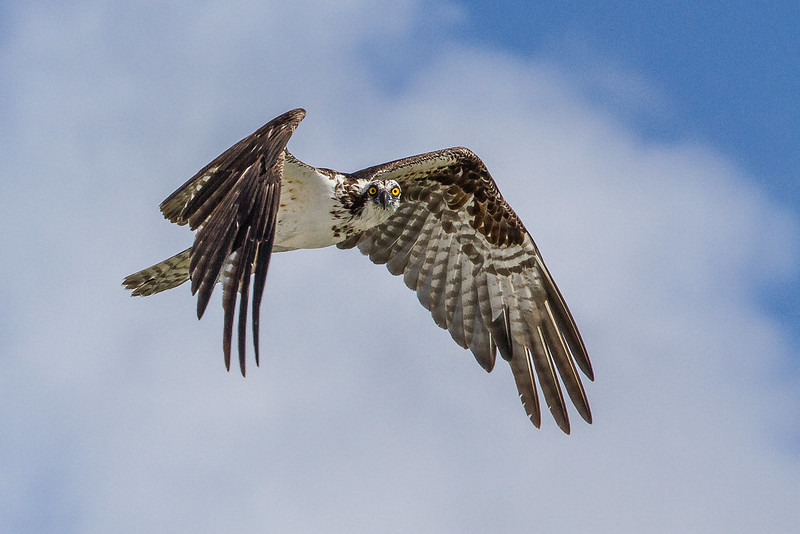
The thing I like most about Osprey is their look; always torn between bewildered or cool. At the right angle, with ruffled feathers and wide eyes, Osprey have the same visage of a mad scientist. In flight, Osprey are every inch a predator with their long wings spread over the skies.

I usually find the osprey pair situated in a snag between Bald Eagle Overlook and the Rt. 26 causeway. Before the Osprey, this area had a fluctuating cast of characters. A normal day for me would be to spot Bald Eagles next to crows, next to starlings or even mourning doves. Aside from Double Crested Cormorants, no other birds appear here with any regularity.  

Ospreys prefer areas close to open water, with no overhead forest canopy. Perching on snags gives the birds a long view up and down the lake. Fish are their preferred prey and will live-catch every meal. Rarely did I ever see another species in the snags while the Osprey were nearby. Even the Cormorants would stay quiet while the Osprey glided by.

As I kept an eye on the Osprey all summer, gears turned in my mind. Osprey nest in Pennsylvania from March to August, with nests as close as Clinton County. Nests occur up to 1600ft away from open water. Additionally, nests are large, made of sticks and twigs. In Pennsylvania, many nests are on man-made structures, like buildings and telephone poles.

Osprey in Flight” by Andy Morffew is licensed under CC BY 2.0.

Knowing this, I started looking for a nest. My search was in vain- I never saw a single stick. Bald Eagle State Park rangers searched the whole park for a sign, and never had anything to report. The Rangers told me that age and inexperience may prevented the Osprey from nesting.

Despite our searching, Osprey nests can be difficult to find. This difficulty has led to many states enacting nest surveys. The Pennsylvania Game Commission enacted the Osprey Nest Survey program in the 1980s. The program relies on volunteers to follow a protocol and report to the Commission via email. The Commission uses the reports to update the Pennsylvania Natural Heritage Program databases.

In addition to nest surveys, some organizations build and erect nesting platforms. These platforms encourage Osprey to nest away from infrastructure and in safer areas. Many platforms are also equipped with cameras, which livestream nest activities.

Now that Fall has arrived, the Osprey have moved on to their wintering grounds in South America. I doubt I will see another Osprey until they decide to return to Bald Eagle State Park. I hope the excellent habitat draws them to return and nest in an accessible area!

Works Cited

Hawk Mountain Sanctuary. Osprey. Hawk Mountain Sanctuary, 2014, www.hawkmountain.org/raptors/osprey. Accessed 13 Sept. 2024.

Morffew, Andy. “Osprey in Flight.” Flickr, Digital Photograph, 4 Dec. 2012, www.flickr.com/photos/66020093@N03/8244633979. Accessed 4 Dec. 2024.

Pennsylvania Game Commission. Osprey Nest Survey. Pennsylvania Game Commission, 2019, www.pgc.pa.gov/InformationResources/GetInvolved/Pages/OspreyNestSurvey.aspx. Accessed 13 Sept. 2024.

—. “Osprey Species Profile.” Osprey Species Profile, Pennsylvania Game Commission, www.pgc.pa.gov/Wildlife/EndangeredandThreatened/pages/osprey.aspx. Accessed 13 Sept. 2024.

United States Fish and Wildlife Service. “Photo of the Week – Osprey at Back Bay National Wildlife Refuge (VA).” Flickr, Digital Photograph, 14 Apr. 2010, www.flickr.com/photos/43322816@N08/4520680333. Accessed 13 Sept. 2024.

Our Wild Neighbor, the Red-tailed Hawk

Red-tailed Hawk” by Becky Matsubara is licensed under CC BY 2.0.

A Red-tailed Hawk swooped down through the trees, lighting a branch to watch who passed by. I was there- walking through Hort Woods after lunch with my colleagues. It’s been a while since I saw a hawk on campus, and years since I’ve been near to my favorite bird.

In medieval folklore, witches had a familiar, a type of supernatural companion. In a way, Red-tailed Hawks are my familiar, appearing at unusual moments to direct my attention. When I was fifteen, I had a close call with a hawk while refilling bird feeders. As I was shimmying the barrel of a feeder up its string, a soft whump sounded behind me. A chill crept up my neck as I turned- only to find a Red-tailed Hawk deep in the snow. It had likely seen prey in the yard and dived, not minding the teen bumbling around in a snowsuit.

When I was nineteen, I saw a Red-tailed Hawk crash-land on the road, bleeding and injured. I called the bird in to the Game Commission, and waited with it until the warden rescued and toted it off. Again, when I was twenty-six, I was talking on the phone in a courtyard when a Red-tail decided to take a seat on a brick wall. It enjoyed its lunch while I chatted with my Mom. The Red-tailed Hawks showed no fear of me, or of our surroundings.

Fear doesn’t appear to be part of a Red-tailed Hawk’s vocabulary. When mated, Red-tailed Hawks will guard their territory together. If a human strays too close, the hawks will take no qualm in scaring them away. The Red-tailed Hawks in my area will dive across I-99 traffic to hit prey in grassy medians. They’ll perch while a PennDOT mower rumbles past, surveying for new-exposed food.

Red-tailed Hawk” by U. S. Fish and Wildlife Service – Northeast Region is marked with Public Domain Mark 1.0.

On my daily commute, I see at least two hawks per day. Road warriors, hunting the hills between Bellefonte and State College. A huge swath of I-99 passes by SCI Rockview and Penn State research farms, excellent habitat for prey. Plus, the cultivated fields help form the thermals Red-tailed Hawks use to travel. Interspersed are WMUs, permitting wildlife to live with little human interference.

I’m not the only person with a love of wild raptors. I recently learned about HawkCount, which records the data collected from raptor watches. Over 300 sites dot North America- with 5 located near me. Right now, Fall watches are occurring at Jacks Mountain and Stone Mountain. I was able to sign up for daily email updates tallying the number of birds observed. I’m fascinated by how many raptors pass through my area during their migration. I’ve been more observant in the field, now that I have a better understanding of what I’m looking for.

I marked my sighting in eBird, delaying our march back to the office. Yet, as soon as I had seen the hawk, it was gone again. None of my colleagues had the chance to look up into the eyes of our wild neighbor. I explained to them the importance of my stop and eBird, but they continued as if nothing was out of the ordinary. I spent the rest of the day wondering what else my wild neighbor had wanted me to see.

Works Cited

Aucker, Jeff. “Hawkwatch Site Profile – Bald Eagle Mountain – Port Matilda.” HawkCount, 2023, www.hawkcount.org/siteinfo.php?rsite=635. Accessed 13 Sept. 2024.

Bohn, Mark, and U.S. Fish and Wildlife Service. “Red-Tailed Hawk.” Flickr, Digital Photograph, 20 Dec. 2010, www.flickr.com/photos/43322816@N08/5277662783. Accessed 13 Sept. 2024.

Bolgiano, Nick. “HawkWatch Site Profile – Bald Eagle Mountain – Eagle Field.” HawkCount, 2019, www.hawkcount.org/siteinfo.php?rsite=809. Accessed 13 Sept. 2024.

—. “HawkWatch Site Profile – Tussey Mountain HawkWatch.” HawkCount, 2024, www.hawkcount.org/siteinfo.php?rsite=438. Accessed 13 Sept. 2024.

Grove, Greg. “HawkWatch Site Profile – Stone Mtn.” HawkCount, 2015, www.hawkcount.org/siteinfo.php?rsite=436. Accessed 13 Sept. 2024.

Matsubara, Becky. “Red-Tailed Hawk.” Flickr, Digital Photograph, 26 Jan. 2017, www.flickr.com/photos/130819719@N05/32406640251. Accessed 13 Sept. 2024.

Pennsylvania Game Commission. “Hawks and Falcons.” Wildlife Note, Pennsylvania Game Commission, www.pgc.pa.gov/Education/WildlifeNotesIndex/Pages/Hawks-and-Falcons.aspx. Accessed 13 Sept. 2024.

Smith, Darrell. “HawkWatch Site Profile – Jacks Mountain.” HawkCount, 2023, www.hawkcount.org/siteinfo.php?r=on&rsite=104&go=Go+To+Hawkwatch+Profile. Accessed 13 Sept. 2024.

Birding at Fisherman’s Paradise

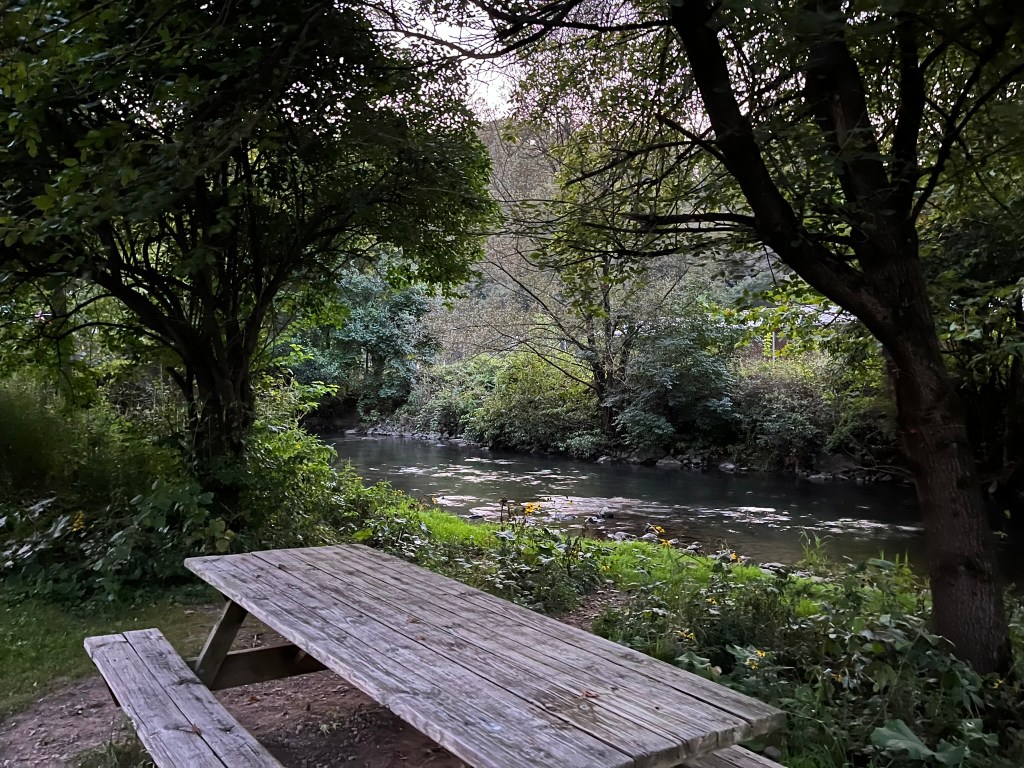
I turned left off Rt. 150 and started down Paradise Road as the sun faded behind low clouds. Driving slower than I should, I admired a small limestone outcrop and continued on. Soon after, I turned on Spring Creek Road and headed upstream to Fisherman’s Paradise.

At first, I missed the meeting spot for the State College Birding Club. I turned around at the gate to Fisherman’s Paradise and headed back to a lot near the gate to the Bellefonte State Fish Hatchery. A few cars were there, and I lingered by my Jeep so I could introduce myself to the person unloading their chair.

Introductions over, we walked along the bridge to the gate and set up our chairs. Already herons were perching on evergreens across the facility, with more flying in. An awkward, shrill call of a Bald Eagle echoed the narrow valley. At first glance, I counted 11 Great Blue Herons, scattered through the canopy.

Across my vision came the calling Bald Eagle- a juvenile on the cusp of adulthood. While its head and tail were white, a smattering of white feathers down its back shown its age. As it wrangled with a fish on a snag, a younger Bald Eagle soared in, perching on a branch nearby.

Juvenile bald eagle” by USFWS/Southeast is licensed under CC BY 2.0.

One of our members arranged a scope at the pair, and as we watched them, another eagle rang out. Agitated, the herons started rearranging themselves, calling amongst themselves. As I was watching a heron pick on a neighbor, an adult Bald Eagle landed in the upper story of an evergreen. I watched as it threw its head back and called, cackling over the herons.

At this point, the herons started blending with the trees as the sun set in earnest. The eagles were easier to watch, with their white heads flashing against the shadows. A fourth Bald Eagle dropped out of the sky to land in another tree, causing a ruckus among herons. Their guttural croaks floated across the valley, much like an old man’s groan of dismay.

Since the sun was dipping closer to the tree line, small bugs rose out of the water and fluttered around our group. On cue, cedar waxwings emerged from the trees behind us and started catching the bugs. Mesmerized, I watched the songbirds catch insects on the wing for some time. Not long after the cedar waxwings, tree swallows shot out from behind buildings. Together, the birds drove the insects down, leaving us alone.

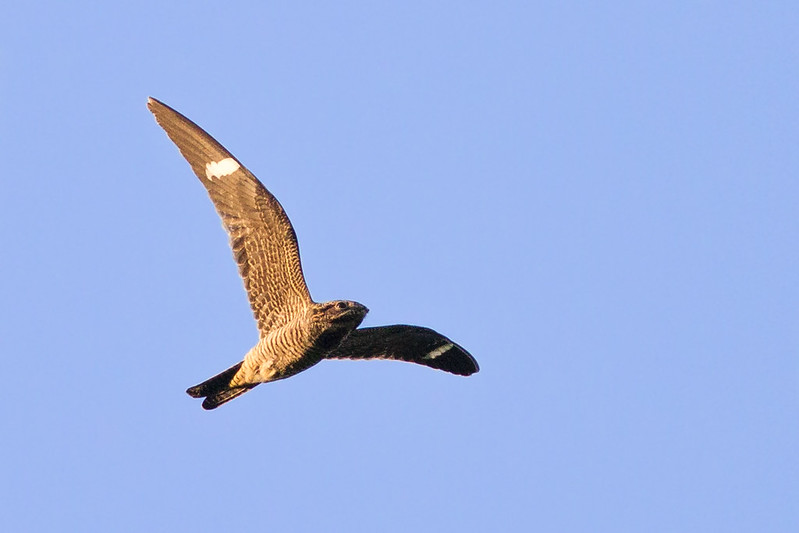
Common Nighthawk” by Fyn Kynd is licensed under CC BY 2.0.

As I was packing up to leave, our group had one more surprise: a pair of migrating Common Nighthawks. To the right side of the valley, the hawks seemed to hover over the treeline. This was my first sighting of Common Nighthawks, and I rushed to note them in eBird before heading off to my car.

For an area renowned for its fishing, the birding was excellent. For 60 minutes, I observed a total of 7 species and 26 birds. Our group observed 14 species and 52 birds. The area is available from sunrise to sunset throughout the year. While a visitor cannot cross into fenced areas, there is space near the gate to set up a chair and observe.

Helping a Wood Turtle

During my drive to the grocery store, I saw an odd grey lump on the road ahead of me. At first, I didn’t think anything of it. I figured that the rainstorm had washed deadfall onto the road. As I was driving closer, I little knob popped out of the side- it was a turtle!

I pulled off and parked, throwing on my 4-ways as the rain started back up again. A driver slowed down and swerved around the turtle, missing it. I dashed up, snapped a quick picture, and took it to the side of the road.

The turtle looked a little different from the ones I usually see. This turtle didn’t resemble from the Eastern Painted Turtle, my favorite. It had large, dark eyes and deeply textured scutes on the carapace. The yellow-orange on its underside was bold in comparison to the humble grey topside. With a little research, I learned it is a species of special concern- the wood turtle!

Wood turtles, Glyptemys insculpta, are a semi-aquatic species of turtle whose range covers the majority of Pennsylvania. Wood turtles are globally endangered according to the International Union for Conservation of Nature (IUCN). In Pennsylvania, wood turtles are under “special concern.”

Wood turtles prefer grassland, forest, and river habitats. I found this turtle near Fishing Creek, an area where many habitat types intersect. The area borders the Clinton County Country Club golf course and a wooded section of Mill Hall. With the stream, forest, and grass all butting up against each other, it is an ideal location for a wood turtle to live.

Once I was home and reading more about the wood turtle, I felt frustrated. Aside from helping one turtle off the road, how can I help more of them?

Enter the the Pennsylvania Wildlife Action Plan (PWAP) by the Pennsylvania Fish and Boat Commission (PFBC). This project was designed to identify and categorize vulnerable/endangered species. Additionally, the project helps Pennsylvanians implement measures to support these species.

PWAP lists the wood turtle as having a stable population over the next 10 years, but is vulnerable in the long run. The state’s priority is to improve knowledge of distribution and population parameters.

PWAP lists several specific threats to wood turtles: poaching, habitat loss, and road collisions. In pet circles, wood turtles are “very tame and friendly.” It was easy to find a site instructing the reader how to care for their wood turtle. With a little more digging, I found websites selling wood turtles! In hindsight, I was glad I found the turtle and moved it off the road before it was killed or poached.

We can support wood turtles by reporting sightings to the Pennsylvania Amphibian and Reptile Survey (PARS). PARS tracks population data and shares data with the PFBC. Reporting sightings will help with the state’s primary goal of increasing population knowledge. As with other endangered species, we can also continue to support the conservation of its preferred habitat. In my area, I plan on spending more time picking up trash around the lake.

After everything I’ve learned, I’m glad I was able to help this turtle cross the road. I’m honored to have interacted with a rare species! While current projections are bleak, with effort, we can change the future. Focusing on habitat preservation near our homes helps support long-term population stability. I hope that the wood turtle will remain in Pennsylvania for many more generations!

Works Cited

Hamilton, Bob, et al. “Wood Turtle.” PA Herps, 2023, www.paherps.com/herps/turtles/wood_turtle/. Accessed 2 Sept. 2024.

Myers, Joe. “Wood Turtle Care Sheet.” Reptiles Magazine, 3 Nov. 2014, www.reptilesmagazine.com/wood-turtle-care-sheet/. Accessed 2 Sept. 2024.

“Species of Greatest Conservation Need Species Accounts Appendix 1.4D-Reptiles.” Pennsylvania Fish and Boat Commission, 4 Nov. 2019.

U.S. Fish & Wildlife Service. “Wood Turtle (Glyptemys Insculpta).” U.S. Fish & Wildlife Service, www.fws.gov/species/wood-turtle-glyptemys-insculpta. Accessed 2 Sept. 2024.

van Dijk, P.P., and J. Harding. “Wood Turtle.” IUCN Red List of Threatened Species, Name, 2011, www.iucnredlist.org/species/4965/97416259. Accessed 2 Sept. 2024.