Rain Meditations

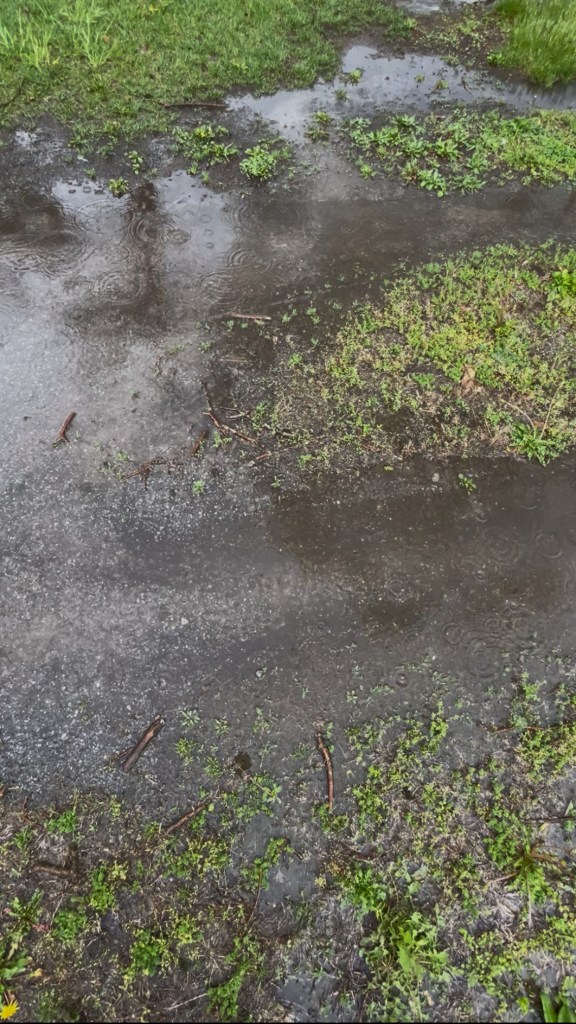
The dry season has given way to days of rain. Almost 2 weeks ago, 36,000 were without power due to a severe storm which swept across Pennsylvania. Last weekend, I went hiking at Bear Meadows Natural Area in the rain, arriving home soaked to the bone. Each day I empty my rain gauge, recording my observations for CoCoRaHS. My coworkers lament the continuous rain in our group chat.

Yet, the rain refreshes me. All my worries from this past winter are being washed away. From my yard, I can trace them. Water flowing to Lick Run, to Bald Eagle, to the Susquehanna, to the Chesapeake Bay, finally to the Atlantic. By the time my worries come back to me, they’re transformed into nourishing rain.

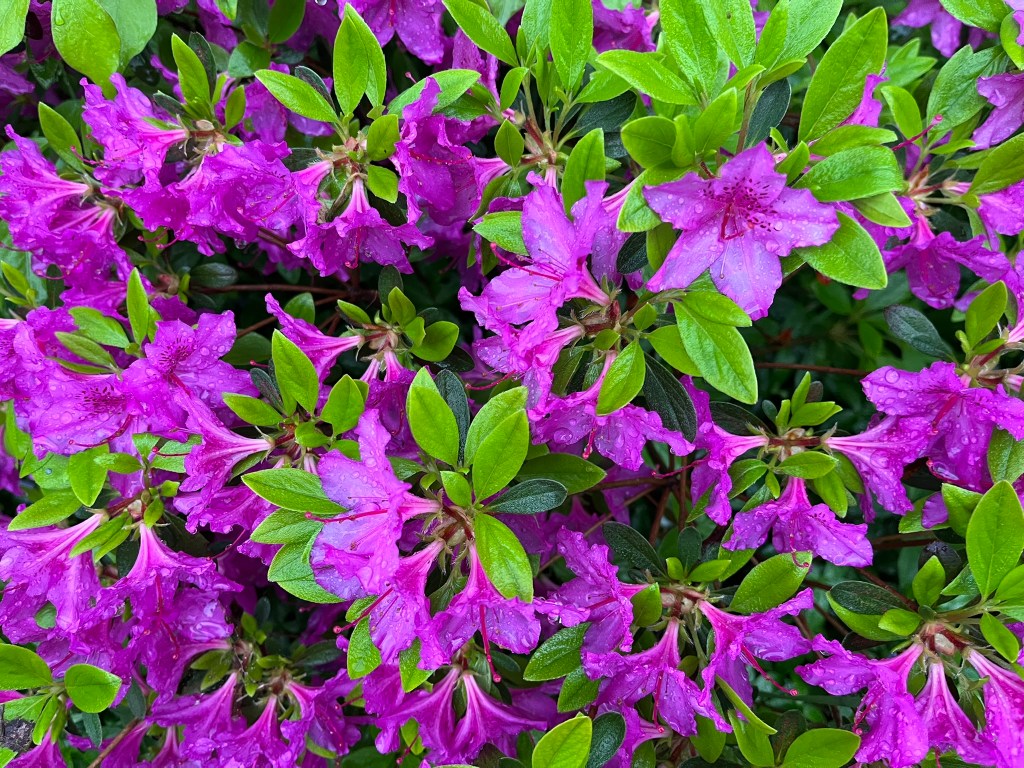
Like me, the plants needed a good, soaking rain to flourish. The sunny azalea has erupted into full color, loaded with magenta flowers. The shaded azalea has buds but is not yet blooming. My neighbor’s lilacs burst forth in frothy bunches of blossoms. The roses are budding, and I’m waiting for the David Austen Poet’s Wife to reveal its first pale bloom.

Despite the rain, I’m still getting outside. Armed with my raincoat, umbrella, and knee-high boots, I look more like the Morton’s Salt Girl than woman. As the Finns say- no such thing as bad weather, only bad clothes. I’m on the hunt for a new coat, something lighter than the vintage PVC one I wear today. My initial eBay searches have been unsuccessful, but I know I’ll find one soon.

My lunch break walks have a different flavor in the rain. Unlike sunny days, the sidewalks are emptier and quieter, but I’m never alone. There are always others out, like me, dressed in gaudy jackets and umbrellas. Some are galloping along for their step counts, most are moseying along. We all enjoy the break from our desks to soak in the fresh, cleaned air.

 I know that soon the rain will give way to another long, hot, Pennsylvania summer. In our post-industrial, climate-changed world, cool summers are a thing of the past. I remember summers so cool I wasn’t allowed swimming, lest I caught a cold. Now, I sweat on the back porch and plan to jump in the lake the moment I’m through with work.
Azalea

Dwelling on climate change is difficult. On days like today, climate change feels like a distant enemy hovering on the horizon. The reality of our fluctuating jet stream and unpredictable conditions is harsh. While the climate in Pennsylvania is still moderate, it is only in comparison to other places. I worry about tornadoes, derecho, and wildfires- all have happened in the past month. The weather wreaks havoc among our native plants, ushering them into a new era of struggle.

While I write and gaze out the window into the inky darkness, adaptation is on my mind. There’s hundreds of articles and videos on what to do to stop climate change. Much of it is things to buy to stop buying things (ironic, right?) or where to spend your money to send a message… instead, I want to focus on things within my ability. I will continue to serve my community in public office, voters be willing. I buy less, and when I do buy, I search for secondhand first. I buy bulk groceries and cook from home, eating fresh veg from my grandfather’s garden. I reduce my driving, choosing not to drive at all on the days I work from home. I’ll wait to put in air conditioners until the last minute, and use LED lightbulbs. Turn off everything when I’m not using it, etc. etc.

Above all, I look for hope. I keep tabs on good climate news and review favorite reads. I note the blooming flowers and migrating birds in my phrenology notebook. I continue to track precipitation and report it daily. I will always walk in the rain. Above all, I will enjoy the outdoors and observe in my nature journal. I capture the world as it is today, and leave a record for those that come tomorrow. I hope, that then, they will know cool summers too.
A Nature Journal Week: Spring 2025

On The Keystone Naturalist Facebook page, I have been sharing my daily nature journal pages. I’ve been loosely following along with The Wild Wonder Foundation‘s monthly nature journaling prompts.

March 20 – Spring Equinox has come and with it a project- a year of exploring the nature at home. Every day (or nearly) I’ll take my journal out and explore my home. Today I drew wild garlic, which grows in my yard. I plucked a handful to bring inside. The pungent smell filled my kitchen. As a little girl, I’d pick this in my parents’ yard until my hands would stink. Mom would give me a hot bath and forbid me from touching it again. Somehow, I’d always end up in it again, stinking all over!

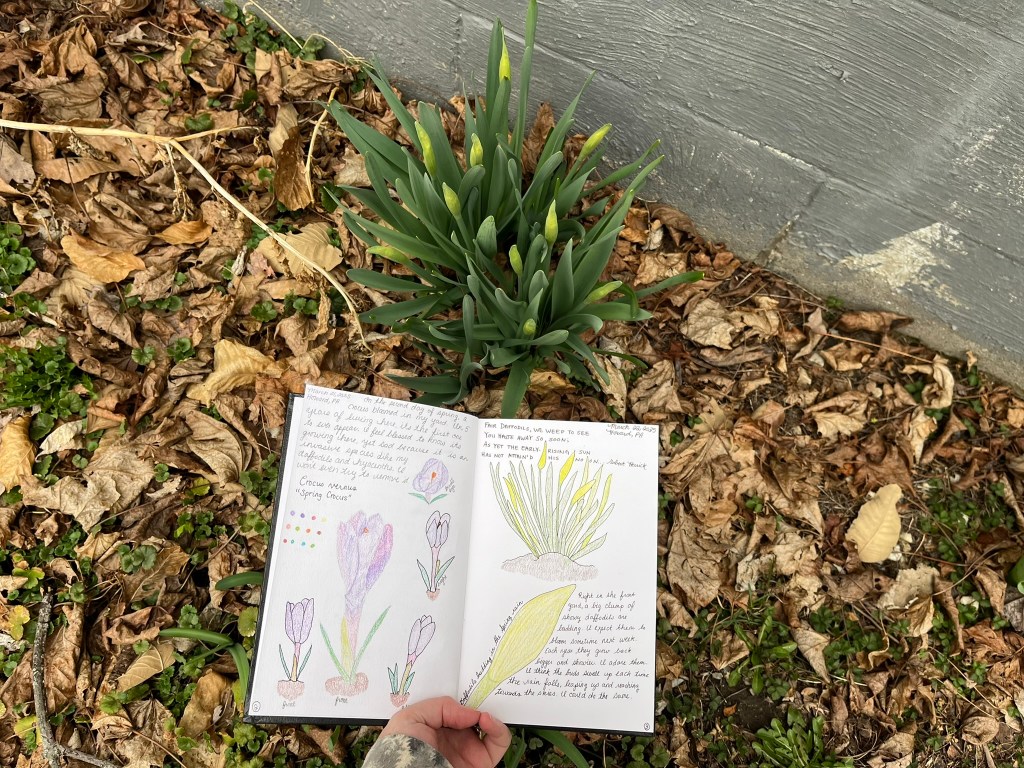
March 21 – On the second day of Spring, a crocus bloomed in my yard. In five years of living here, it’s the first one to ever appear. I feel blessed to know it’s growing here, yet sad because it’s an invasive species like my daffodils and hyacinths. I won’t even try to remove it.

March 22 – Right in the front yard, a big clump of showy daffodils are budding. I expect them to bloom sometime next week. Each year, they grow back bigger and showier. I adore them. I think the buds swell up each time the rain falls, leaping up and reaching towards the skies. I would do the same.

March 23 – I took a walk to the launch today, searching for some peace after a busy weekend. The sycamore trees dominated my thoughts, towering high over me and loaded with seed pods. The water is low, revealing the lake bed. Lots of people are out fishing in the water. Robins are everywhere. I counted thirty on the hill over the parking lot. Song sparrows call incessantly, naming their territory with sweet liquid voices.

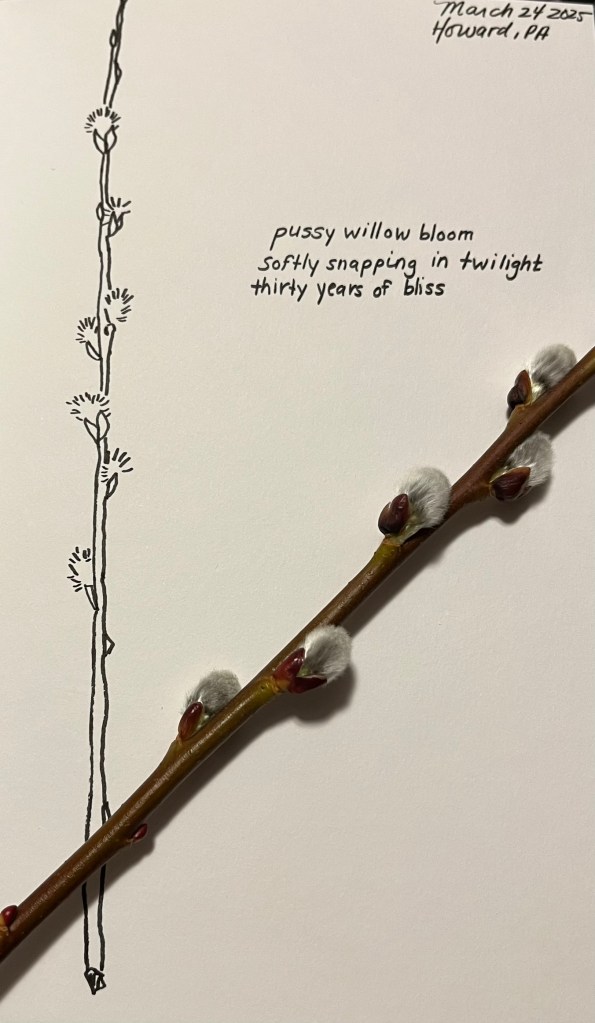
March 24 – Today is my 30th birthday. The pussy willow bush is blooming. As much as this bush perturbs me and obstructs my view of the backyard, it is beautiful in the Spring. The catkins are soft like Oliver’s paws. The weather was beautiful today, and it felt like the whole world was celebrating the season with me.

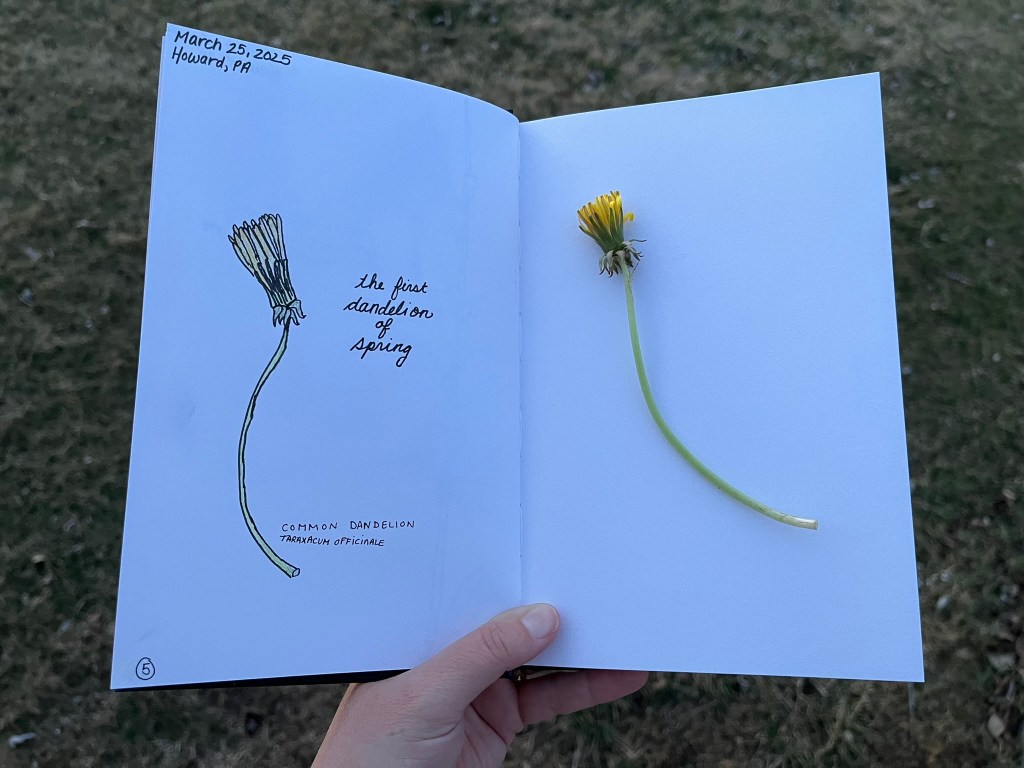
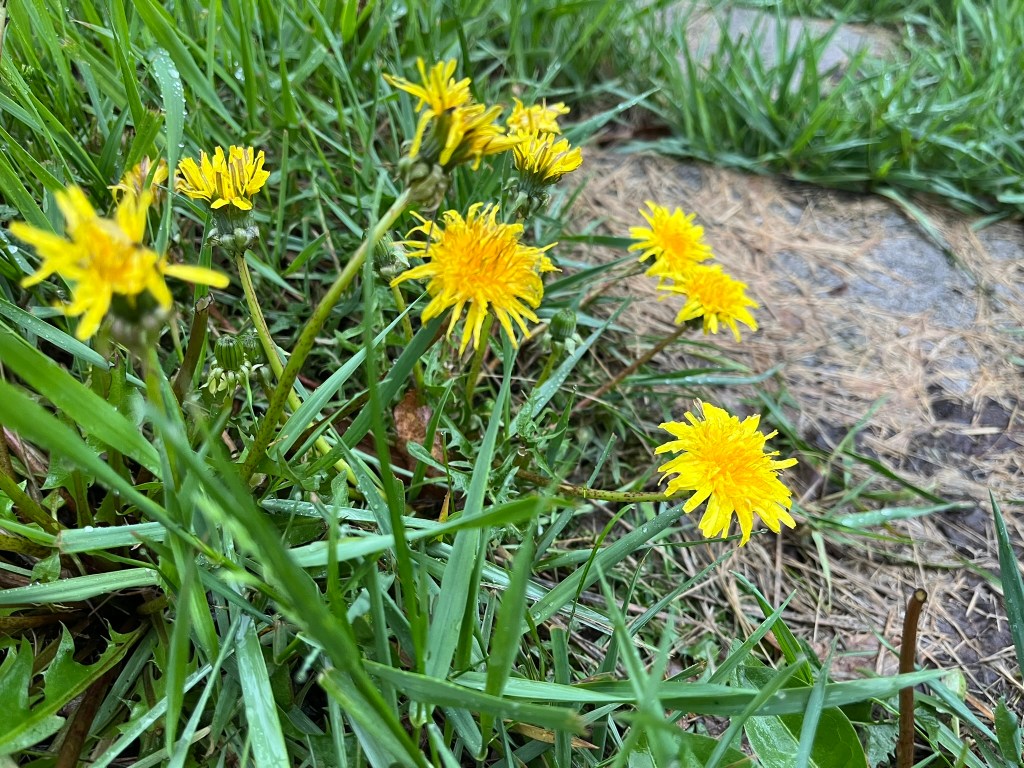
March 25 – As I walked up the sidewalk, I noticed a new flower in the yard, a dandelion. I plucked it and brought it in to draw. Taraxacum officinale, the Common Dandelion, is naturalized to Pennsylvania. Originally from Eurasia, it was brought to our country by early colonists. While I don’t mind them in my yard, I think it’s interesting how this “noxious weed” so many love to hate is the result of the actions of colonists.

March 26 – Rough, cold winds blew and prevented me from journaling outdoors. Instead I sat in my car at Millbrook Marsh Nature Center waiting for the bird club meeting to start. The bark of a Paper Birch tree blew in the wind. Pennsylvania is at the southernmost tip of its natural range. If it continues to warm, will we still have the Paper Birch growing freely in Pennsylvania?

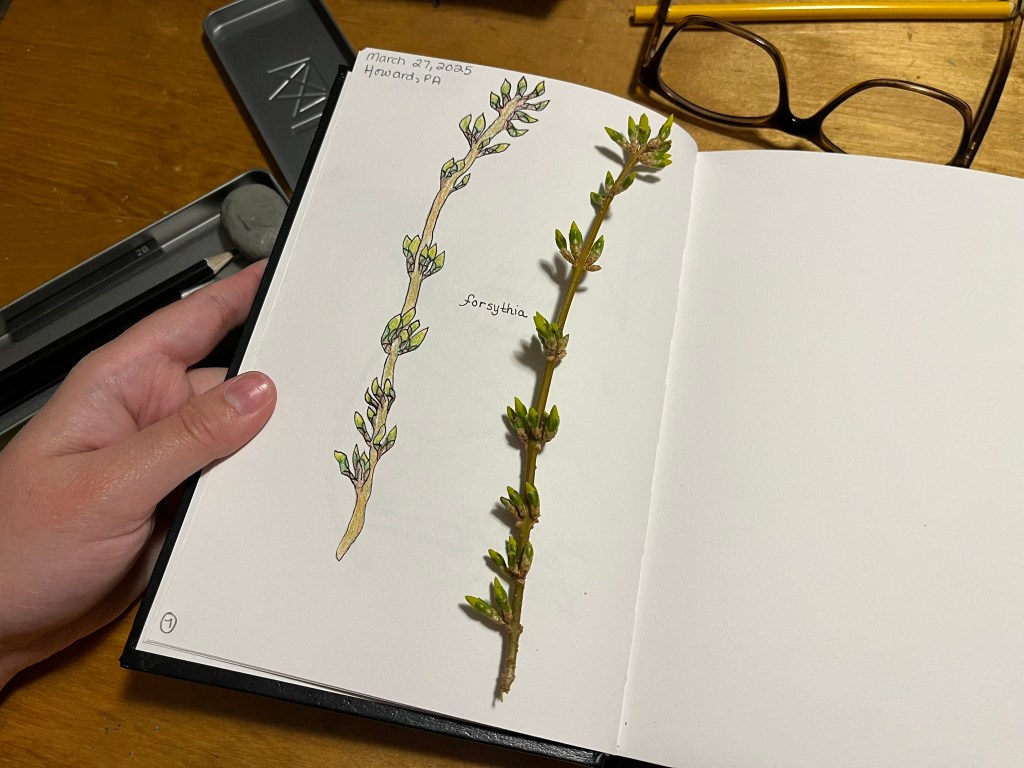
March 27 – The remaining forsythia bush in the yard is close to blooming. This shrub is pretty in the Spring, but an annoyance at any other time. I hesitate to call it horrible, but that’s how I think of it in my heart. I can’t wait to remove this one and burn it to ashes this summer. The current drought is preventing me from burning anything.

Have you been keeping a nature journal this Spring? What changes in the environment around you have you noticed? Please share in the comments!

Catch Me Outside for 1,000 Hours

Animal tracks in the snow

On the first 40-degree day of February, I went on a long walk. It was my first walk as part of my 2025 goal: spend 1,000 hours outside by December 31st.

I don’t choose traditional resolutions. Instead, I pick one big goal for the year, and work hard to achieve it. Past goals have been reading 100 books, folding 1,000 paper cranes, and going on a book-buying ban. This year, my mom recommended that I try to spend 1,000 hours outside in a calendar year.

This goal aligns with my belief that everyone should be spending more time outside. The founder of 1,000 Hours Outside suggests that children who spend many hours outside per day have improved health and wellness. I disagree with the founder’s other beliefs, but have found evidence to support this claim. A review found that outdoor play is a practical method for improving children’s health (McCurdy, 2010). Another article suggests that exposure to many different bird species outdoors can improve mental health (Methorst, 2024). Birding is an excellent vehicle for improving health on the sly (Dresser, 2024). As I’m working on improving my health, spending more time outside should help.

I also chose this goal with the hope of breaking a screen addiction. On average, I spend about 4 hours per day on my iPhone. I know I spend at least 8 hours per day working on my laptop. Even with a little overlap, this amounts to almost 70 hours of screentime per week! When I’ve spent long periods of time spending 90 minutes or less on my iPhone per day, I have improved mental health. Sure, this is anecdotal evidence, but it is my experience. I want to replace this non-work-related screen time with time spent in nature.

As odd as this may sound, I also chose this goal to help me reconnect with the outdoors. After a tough winter, I’m disconnected from the natural world around me. I admit that in January, I was getting out 1 to 2 times per week. I’m craving spending time outdoors to explore and enjoy the natural world.

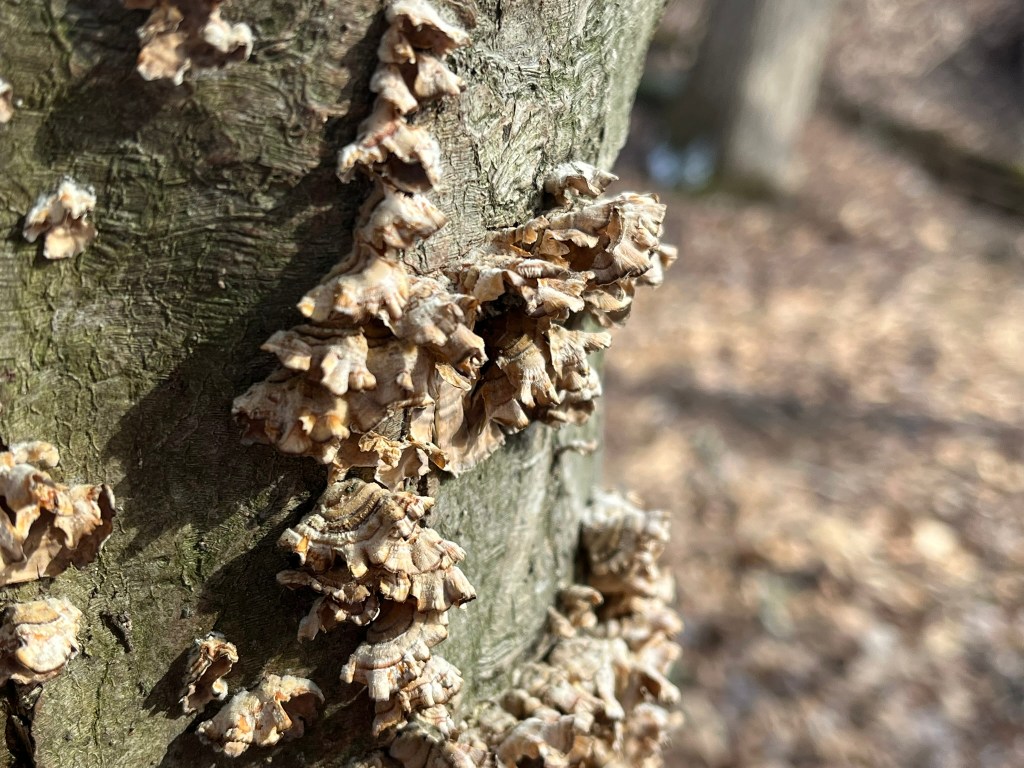
Stereum complicatum (Crowded Parchment)

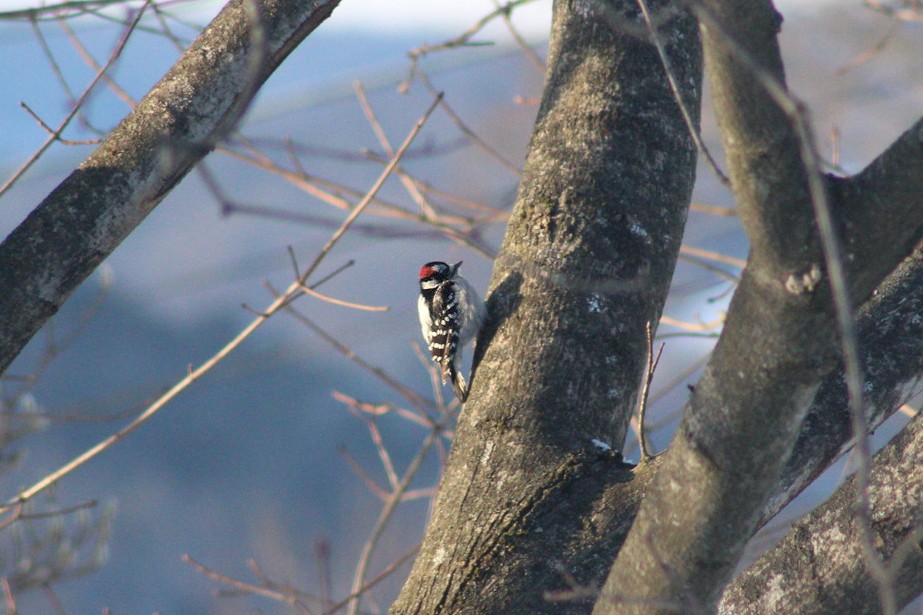
I started tracking on Monday, and got an hour in right away. I let myself meander through the park and enjoy myself rather than hustle to achieve a step goal. I was able to take notice of some mosses and lichens, and found a fresh woodpecker hole in a tree. I felt refreshed, and had a super productive afternoon afterwards.

While I’m starting out a little behind, I know I’ll catch up soon. I’m counting down the days to when I can go hiking and kayaking at the park. I’ve squirreled away the pennies for a hammock rack to put in my yard for reading outdoors. Our grilling station is set up and ready for when it’s not snowing or raining. I’ve been making plans for spring hikes with my siblings. I’m very energized and excited about finishing this goal- and I’ll bring you along with me!

Have you attempted a 1,000 hours outside challenge?

Hope & Wild Things

“Hope” is the thing with feathers –
That perches in the soul –
And sings the tune without the words –
And never stops – at all
Emily Dickinson

The first stanza of Emily Dickinson’s poem on hope rings true- especially in this past week. My despair over the state of our nation’s leadership swelled in its intensity. Coupled with the below-zero temperatures, I drifted through the weekend. I struggled to stay warm and hold up against the news and my fear of the furnace breaking down. I needed to find some peace, and some hope.

While out walking, I thought of Wendell Berry, finding peace among the wild things. Over my head fluttered European Starlings, calling to each other. In spite of the cold, they squawked and screamed, carrying on in their raucous ways as if it were any other day. Back in my yard, birds of many species fed on the seed I had scattered. While usually the Dark-Eyed Juncos and House Finches would fight- they did not. All were too focused on survival to slip into argument.

Birdwatching always brings me peace. When I was a teen, I would keep up my parents’ feeders in the winter, filling each one after caring for my goats. I would sit on the bench in the kitchen with my tea and watch as Blue Jays and Northern Cardinals swept into the yard. Black-Capped Chickadees would follow me during my midday water check. When dusk would settle over the mountain, the birds would roost in the trees, waiting for morning.

The quiet routine of cleaning feeders and stocking suet help the days pass. One day, it’s October, and the last of the fall migrants disappear. The next, it’s December, and established flocks of songbirds are floating in and out of the yard. At last, it’s March, and the early spring migrants are taking a pit-stop on their journey north. Spring inches forward at the rate of one minute per day.

For me, the creep from winter solstice to spring equinox is laden with long periods of thought. At this moment, I’m consumed by my worries for our lands’ future. Already the Arctic National Wildlife Refuge has lost its protection from oil drilling. I fear for a renewal in fracking in Pennsylvania, an industrial pursuit I despise. There is only so much angry complaining I can do- only so many strongly-worded letters and emails I can write. There are only so many aggressive phone calls I can make.

Even if fighting is natural for all animals, it is not the option I want to choose. Caring for my community, both human and wild, is the path I want to follow. I can start in my yard, tending to the birds as I always do. I can carry on with bringing nature journaling to my community… Giving my time and effort to support educational experiences in public settings. I do believe I am not alone- there are hundreds, if not thousands, of similar people in Pennsylvania.

I cannot, and will not despair. There are wild things, feathered things, counting on me. Birds don’t know of human politics and maneuvers. I cannot lie in my bed to rot when there are creatures that need me to break the ice in their watering dish. I cannot retreat inside of myself when there are decisions to make in my community. Spring will come again, one day at a time.

Green Linings

Snow floated down around me as I walked across the parking lot to Lakeside Trail. The trail, a 5.6 mile loop at the base of Bald Eagle Mountain, is a favorite of mine. American Robins chittered in the trees overhead, flying off when I whistled in return. The trail was snowy and undisturbed, perfect for some time alone in the winter woods.

Along the trail ranged a dense, berry-dotted shrub, obscuring my view of the lake. Little grey-blue berries clustered on branches… privet. Privet renders any habitat into a tangle of branches with its reproductive cycle. The invasive plant species will out-shade low-lying native plants. Once established, privet is an aggressive enemy, and here, the battle is already lost.

Interspersed throughout the privet is multiflora rose, another invasive species in Pennsylvania. Multiflora rose is a “Class B” noxious weed, as it is very prolific and difficult to control. An established plant will produce up to 500,000 seeds in a single year. Shade-tolerant and hardy, it’s taking over the base of Bald Eagle Mountain.

I can’t help but feel sad watching these species consume my favorite places. Japanese stiltgrass threatens my yard. Shrubs like privet edge out the mountain laurel, and English Ivy coats the ground in thick waves. These are not the scenes we should be seeing in Pennsylvania, but they are our reality.

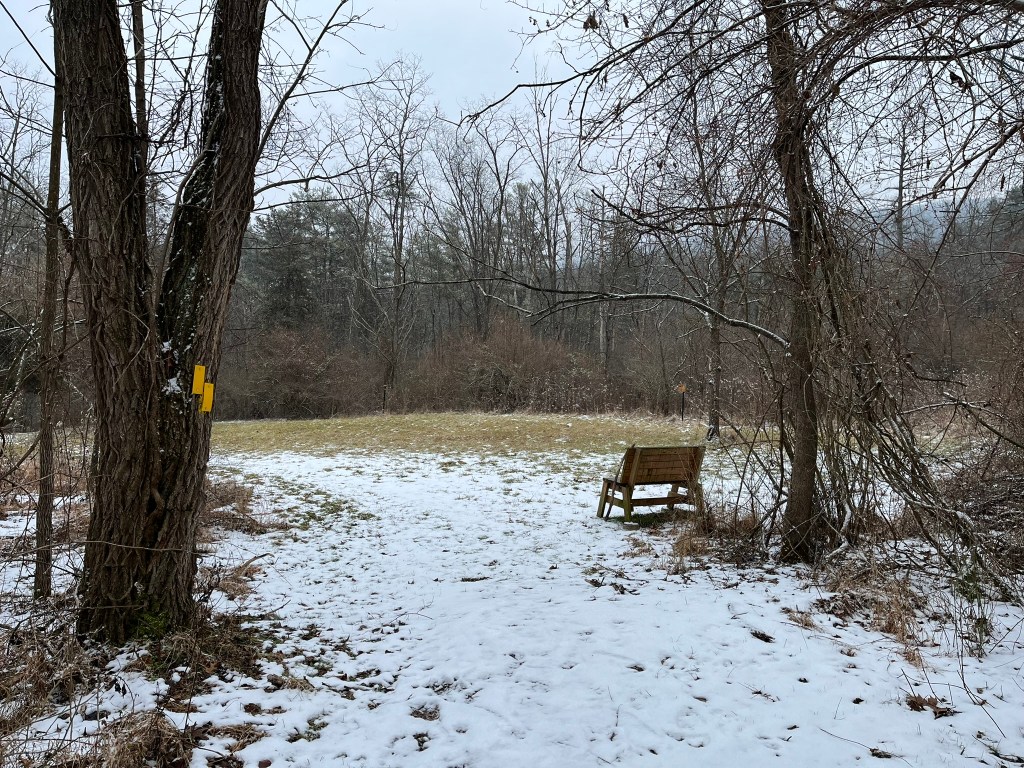
As I continued my walk, the dense shrubs gave way to a small clearing- the remains of an apple orchard. A bench sits near the trail, and I stopped for a moment to admire a common greenshield lichen on the bench. This native fungi species shone bright lime-green against the white snow. Typically found on bark, this lichen will grow on wood products if conditions are right. Upon my touch, it was not warm, but wet and floppy like lettuce leaves. After dwelling on invasive species, I felt better to know a native one was thriving here.

This orchard is one of my favorite places at Bald Eagle State Park. In my first year of living here, I would bring a book here to read on the bench or lay on a blanket in the meadow. I wondered what this meadow would look like if the privet or multiflora rose took over. The thought was too depressing- how could I only imagine a bad outcome for this scene?

A term popped into my mind as I strolled around- recency bias. Witnessing the fires in Los Angeles, and knowing the role invasive species had in them, had been on my mind all week. Our minds will often overemphasize recent experiences when thinking about the future.. Combating recency bias takes a concentrated effort, as all pessimistic thoughts do.

Instead, as I walked back home, I imagined what Lakeside Trail would be like if the invasives were managed. Reducing the invasive shrubs would open the understory, helping low-lying plants grow. Promoting the growth of native berry-bearing species would provide forage for wildlife. This type of project is intense, and in some cases, impossible. Yet, I didn’t feel daunted. The lichen gave me hope, proof that even in a space troubled with invasive species, with a little help, native ones may find a way.