Nature Journaling Sit-Spots

My break lasted longer than planned. As our wedding approached, time sped up, punctuated by frequent thunderstorms. The periodical cicadas came and went in their screaming glory. Pennsylvania has slipped into the dog days of summer, and Sirius rises high over us in the nighttime sky. The lake calls me, and I resist the urge to swim all day, every day.

When I first moved here in the summer of 2020, I worked from home each day. During my lunch breaks I would dash to the dock and slip into the water. I could take a dip at the boat launch and crawl out on the bank at the other side, undisturbed. I’ll never know if the park rangers let me have fun or chose to ignore my small-town antics.

While visiting earlier this week, the launch was quiet enough for me to sit at the end of the dock to nature journal. The sparkling summer lake was a fun challenge to capture in a pencil drawing. Beneath my feet, bluegill hovered around the dock pilings, their fins glinting gold. One snuck up to my foot to check me out, sucking in water through its nostrils to detect my scent. I drew the scene in my journal, delighted as the fish gathered near me.

Other delights found themselves in my journal. Several bass were jumping out of the water- from predation or delight, I won’t ever know. I captured the blue-fronted dancer that rested on my knee, and a green dragonfly that swept around my face. Tufts of algae floated by me, caught in the wake of a speedboat and my nature journal. After filling the page with pencil drawings, I packed my journal away to lay on the dock and watch the clouds.

Having a sit-spot, a place to sit and journal at many times over a period, is a common practice. Sit-spot recommendations include spaces that are at home, or if not, very close to home. My first sit-spot was on my porch, a safe and secluded spot where I could experiment with my journal in peace. Soon after, I started taking my journal on lunch break walks, and I developed a second sit-spot.

Bald Eagle Launch, where I was earlier this week, is my second and favorite sit-spot. I can sit anywhere on the property to journal… on the dock floating in water, under the pavilion, perched on the trail bench, or draped on the grassy hill. Every angle is beautiful, every corner of the area holds some fascinating bit of nature. Long before I kept a nature journal, I wrote in my diary here- and many, many pages of daily nature observations.

I’m not alone in having multiple sit-spots. One of my nature journal inspirations, Clare Walker Leslie, journals at several places. In her books, she shares pages from her spot at Mount Auburn Cemetery, her country home, and her city home. As she cycles through locations, the seasons pass and she captures snippets of time all over.

I know Bald Eagle Launch will remain as my most favorite sit-spot. Yet, I’m always on the hunt for a new spot- a place for me to visit every so often and witness nature throughout the seasons. The rest of this summer, I plan to attend Centred Outdoors events and journal my way through every outing. You can check out the schedule online and make a plan to join me!
Summer Osprey Sightings

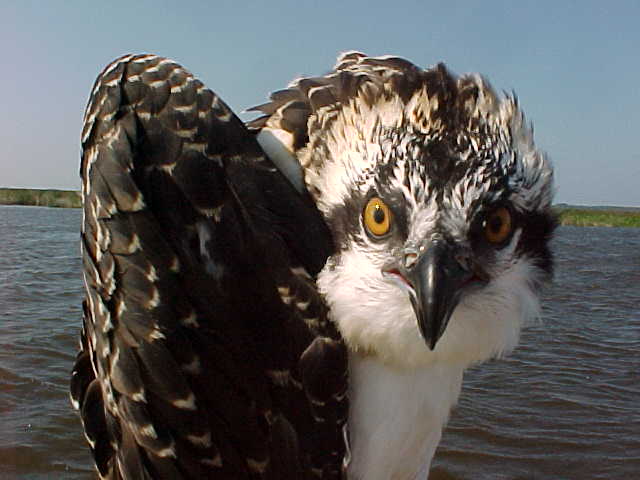
Photo of the Week – Osprey at Back Bay National Wildlife Refuge (VA)” by U. S. Fish and Wildlife Service – Northeast Region is marked with Public Domain Mark 1.0.

Near the intersection of Rt. 26 and Rt. 150, the Bald Eagle Overlook faces out over Foster Joseph Sayers Lake. Here, I watched a pair of Osprey dominate the northern bank of the lake all summer.

Considering the nearby Bald Eagle State Park, watching Osprey feels traitorous. I see at least one Bald Eagle per day while on my lunch walks- this is a gift I will never take for granted. Yet every time I spot an Osprey, I become transfixed, waiting for their yellow glare to pass over me.

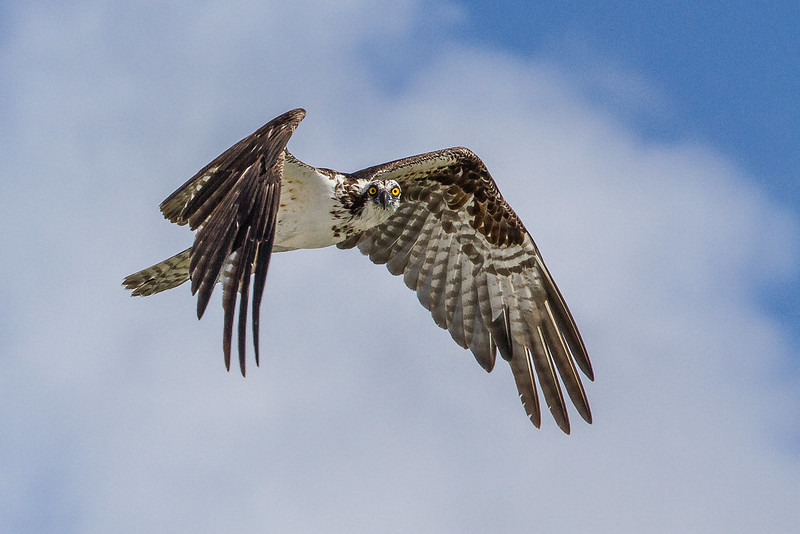
The thing I like most about Osprey is their look; always torn between bewildered or cool. At the right angle, with ruffled feathers and wide eyes, Osprey have the same visage of a mad scientist. In flight, Osprey are every inch a predator with their long wings spread over the skies.

I usually find the osprey pair situated in a snag between Bald Eagle Overlook and the Rt. 26 causeway. Before the Osprey, this area had a fluctuating cast of characters. A normal day for me would be to spot Bald Eagles next to crows, next to starlings or even mourning doves. Aside from Double Crested Cormorants, no other birds appear here with any regularity.  

Ospreys prefer areas close to open water, with no overhead forest canopy. Perching on snags gives the birds a long view up and down the lake. Fish are their preferred prey and will live-catch every meal. Rarely did I ever see another species in the snags while the Osprey were nearby. Even the Cormorants would stay quiet while the Osprey glided by.

As I kept an eye on the Osprey all summer, gears turned in my mind. Osprey nest in Pennsylvania from March to August, with nests as close as Clinton County. Nests occur up to 1600ft away from open water. Additionally, nests are large, made of sticks and twigs. In Pennsylvania, many nests are on man-made structures, like buildings and telephone poles.

Osprey in Flight” by Andy Morffew is licensed under CC BY 2.0.

Knowing this, I started looking for a nest. My search was in vain- I never saw a single stick. Bald Eagle State Park rangers searched the whole park for a sign, and never had anything to report. The Rangers told me that age and inexperience may prevented the Osprey from nesting.

Despite our searching, Osprey nests can be difficult to find. This difficulty has led to many states enacting nest surveys. The Pennsylvania Game Commission enacted the Osprey Nest Survey program in the 1980s. The program relies on volunteers to follow a protocol and report to the Commission via email. The Commission uses the reports to update the Pennsylvania Natural Heritage Program databases.

In addition to nest surveys, some organizations build and erect nesting platforms. These platforms encourage Osprey to nest away from infrastructure and in safer areas. Many platforms are also equipped with cameras, which livestream nest activities.

Now that Fall has arrived, the Osprey have moved on to their wintering grounds in South America. I doubt I will see another Osprey until they decide to return to Bald Eagle State Park. I hope the excellent habitat draws them to return and nest in an accessible area!

Works Cited

Hawk Mountain Sanctuary. Osprey. Hawk Mountain Sanctuary, 2014, www.hawkmountain.org/raptors/osprey. Accessed 13 Sept. 2024.

Morffew, Andy. “Osprey in Flight.” Flickr, Digital Photograph, 4 Dec. 2012, www.flickr.com/photos/66020093@N03/8244633979. Accessed 4 Dec. 2024.

Pennsylvania Game Commission. Osprey Nest Survey. Pennsylvania Game Commission, 2019, www.pgc.pa.gov/InformationResources/GetInvolved/Pages/OspreyNestSurvey.aspx. Accessed 13 Sept. 2024.

—. “Osprey Species Profile.” Osprey Species Profile, Pennsylvania Game Commission, www.pgc.pa.gov/Wildlife/EndangeredandThreatened/pages/osprey.aspx. Accessed 13 Sept. 2024.

United States Fish and Wildlife Service. “Photo of the Week – Osprey at Back Bay National Wildlife Refuge (VA).” Flickr, Digital Photograph, 14 Apr. 2010, www.flickr.com/photos/43322816@N08/4520680333. Accessed 13 Sept. 2024.