Early Fall at Soaring Eagle Wetland

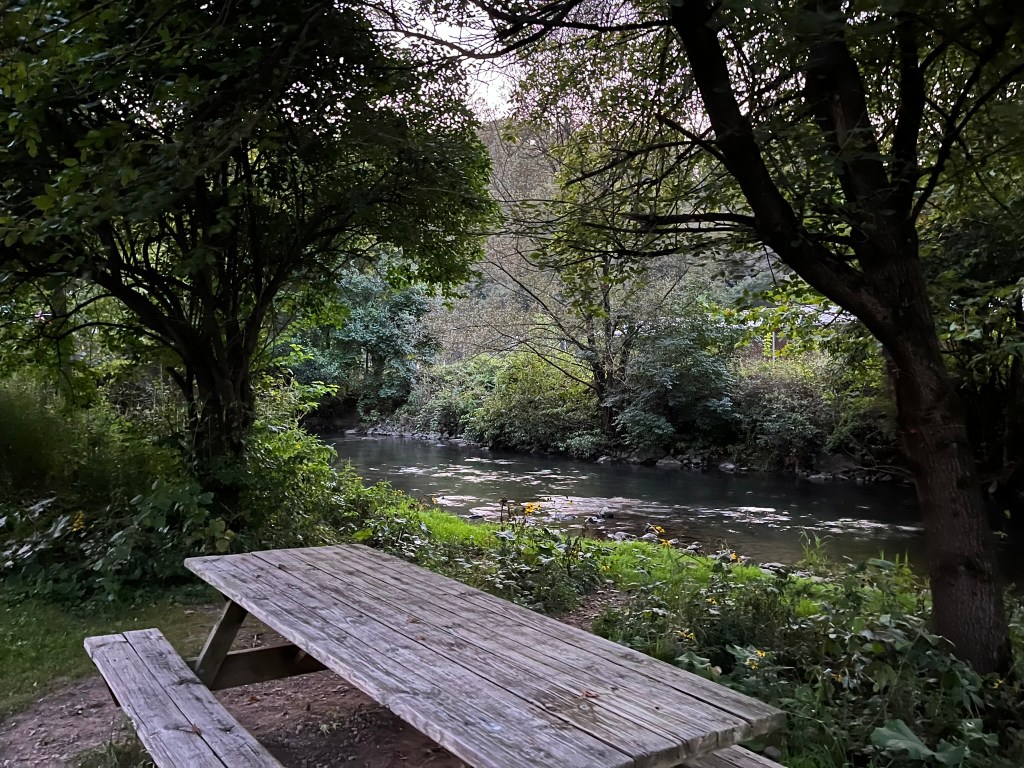
The last full week of September had been misty, each morning starting with light rain and fog. That Thursday was no different, but as I was driving down Rt. 150, the fog started to rise. I continued my journey as the land to my left transitioned from parklands to towns, then to wetlands. I was heading to Soaring Eagle Wetland in Julian, a place long on my list to explore.

The parking lot was half-full with construction equipment, but I paid it no mind. I parked near the ADA parking and hopped out to survey the area. Goldenrod blanketed the lowlands around me, humming with life. A high chorus of insects almost drowned the birdsong, but I could catch the sound of sparrows and finches.
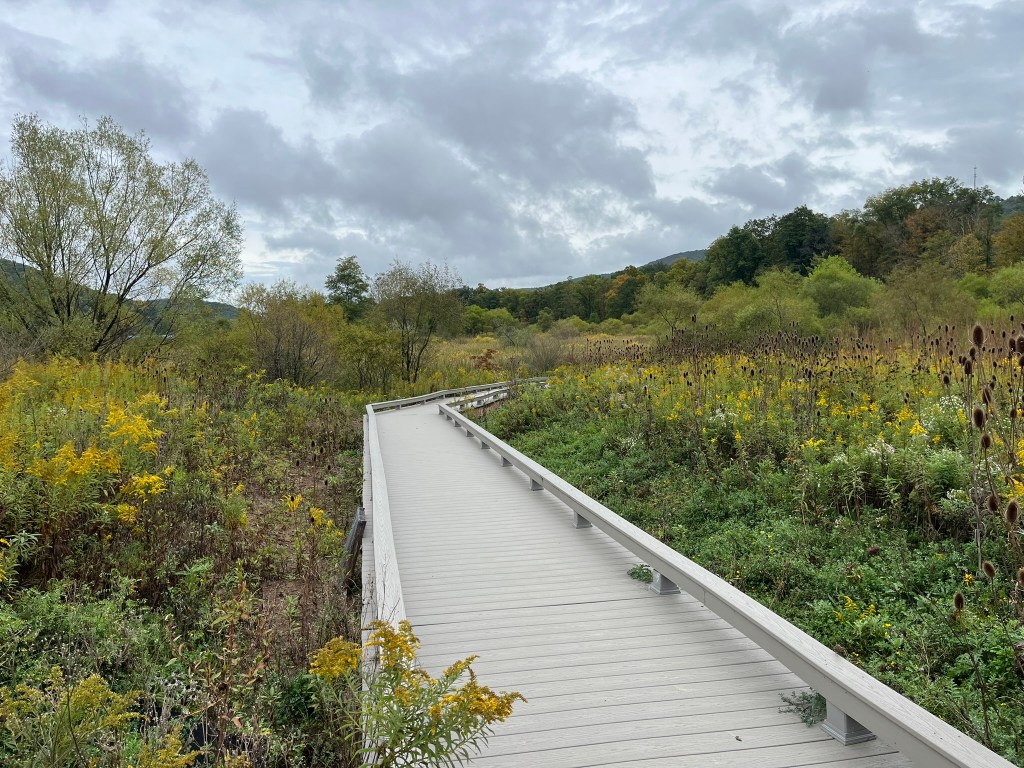
A paved pathway led to a boardwalk, dotted with grasshoppers. A big one caught my eye, and I managed to take a picture before it flung into the grasses. Birdsong grew louder closer to the small trees, dominated by the chips of swamp sparrows. I passed a cute bench and made it to the accessible fishing area.

Bald Eagle Creek rushed by the pier, and I took a break on the bench. Later, I explored down to the water using the accessible ramp, and continued to a worn trail to the water’s edge. I stepped out, and enjoyed the cool flow of water over my boots. Not wanting to disturb a fisherman, I headed back to the trail.

Other trails branched off from the paved section. One path looked new, level and graveled alongside Bald Eagle Creek. A grassy path, named “Long Trail” headed out into the goldenrod. If I had more time, I would have explored Long Trail. I was a little put off as the brochure map was not detailed, not listing a length or difficulty. I can imagine it is an easy trail, but as I was alone with poor cell reception, I was hesitant to depart from my plan.

Heading back to my car, I saw many nesting boxes of all shapes and sizes. Bluebird boxes were close to the paved trail, and larger owl boxes were high in the trees. One of the owl boxes had been in recent use, with sticks and grasses poking out in the seams.
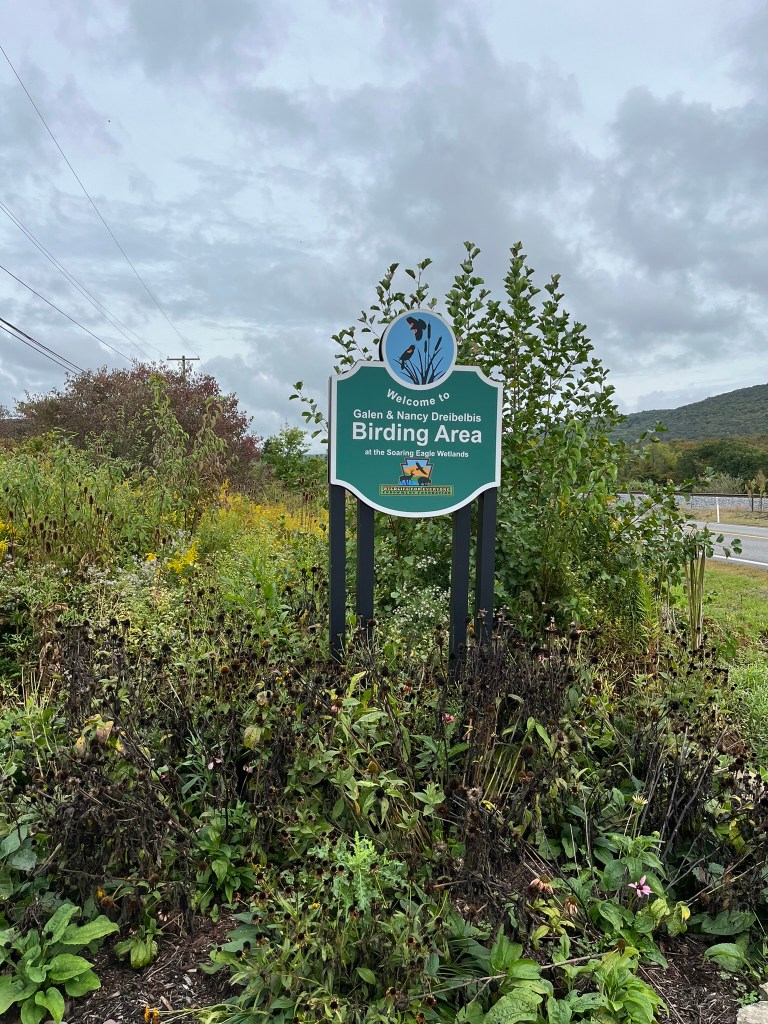
Soaring Eagle Wetlands has a second area- the Galen & Nancy Dreibelbis Birding Area. I went there next, hoping to complete a checklist. I followed a small gravel trail to an accessible viewing pier. A small plaque shared that the platform was a 2022 Eagle Scout project. Immediately below me were many frogs, moving too fast for me to photograph.

While at the platform, I took a sound recording with Merlin. The app heard blue jays, American goldfinches, and grey catbirds. The app struggled to identify birds over the sounds of Rt. 150 and insects. With my binoculars, I spotted some wood ducks landing in the water. They were definitely too far away for Merlin to catch their oo-eek calls.

Before leaving, I checked out the blind by the accessible parking. Yet another beautiful view out of its window- one I would have loved to admire for much longer! Another path branched off from an accessible ramp.

On my drive home, the clouds descended again, and the rain began again. While I was leaving Soaring Eagle Wetland behind, I already knew I would return. Next time I know to plan for more bug spray and time to walk the trails.
Summer Osprey Sightings

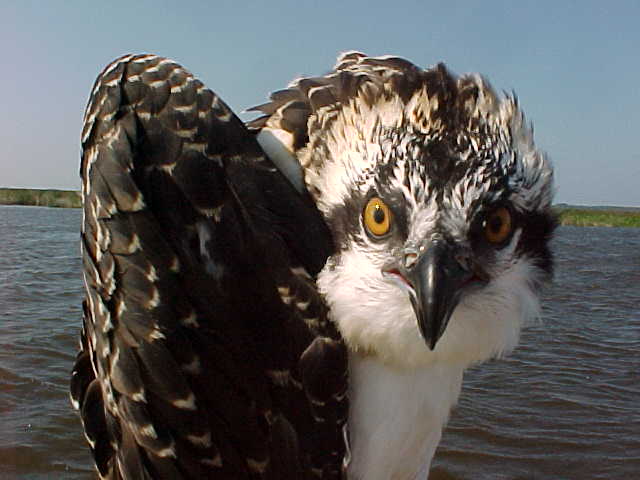
Photo of the Week – Osprey at Back Bay National Wildlife Refuge (VA)” by U. S. Fish and Wildlife Service – Northeast Region is marked with Public Domain Mark 1.0.

Near the intersection of Rt. 26 and Rt. 150, the Bald Eagle Overlook faces out over Foster Joseph Sayers Lake. Here, I watched a pair of Osprey dominate the northern bank of the lake all summer.

Considering the nearby Bald Eagle State Park, watching Osprey feels traitorous. I see at least one Bald Eagle per day while on my lunch walks- this is a gift I will never take for granted. Yet every time I spot an Osprey, I become transfixed, waiting for their yellow glare to pass over me.

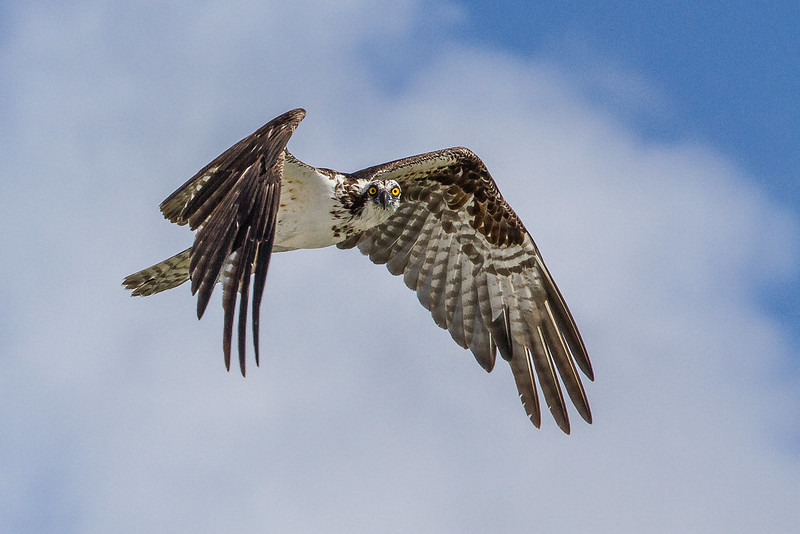
The thing I like most about Osprey is their look; always torn between bewildered or cool. At the right angle, with ruffled feathers and wide eyes, Osprey have the same visage of a mad scientist. In flight, Osprey are every inch a predator with their long wings spread over the skies.

I usually find the osprey pair situated in a snag between Bald Eagle Overlook and the Rt. 26 causeway. Before the Osprey, this area had a fluctuating cast of characters. A normal day for me would be to spot Bald Eagles next to crows, next to starlings or even mourning doves. Aside from Double Crested Cormorants, no other birds appear here with any regularity.  

Ospreys prefer areas close to open water, with no overhead forest canopy. Perching on snags gives the birds a long view up and down the lake. Fish are their preferred prey and will live-catch every meal. Rarely did I ever see another species in the snags while the Osprey were nearby. Even the Cormorants would stay quiet while the Osprey glided by.

As I kept an eye on the Osprey all summer, gears turned in my mind. Osprey nest in Pennsylvania from March to August, with nests as close as Clinton County. Nests occur up to 1600ft away from open water. Additionally, nests are large, made of sticks and twigs. In Pennsylvania, many nests are on man-made structures, like buildings and telephone poles.

Osprey in Flight” by Andy Morffew is licensed under CC BY 2.0.

Knowing this, I started looking for a nest. My search was in vain- I never saw a single stick. Bald Eagle State Park rangers searched the whole park for a sign, and never had anything to report. The Rangers told me that age and inexperience may prevented the Osprey from nesting.

Despite our searching, Osprey nests can be difficult to find. This difficulty has led to many states enacting nest surveys. The Pennsylvania Game Commission enacted the Osprey Nest Survey program in the 1980s. The program relies on volunteers to follow a protocol and report to the Commission via email. The Commission uses the reports to update the Pennsylvania Natural Heritage Program databases.

In addition to nest surveys, some organizations build and erect nesting platforms. These platforms encourage Osprey to nest away from infrastructure and in safer areas. Many platforms are also equipped with cameras, which livestream nest activities.

Now that Fall has arrived, the Osprey have moved on to their wintering grounds in South America. I doubt I will see another Osprey until they decide to return to Bald Eagle State Park. I hope the excellent habitat draws them to return and nest in an accessible area!

Works Cited

Hawk Mountain Sanctuary. Osprey. Hawk Mountain Sanctuary, 2014, www.hawkmountain.org/raptors/osprey. Accessed 13 Sept. 2024.

Morffew, Andy. “Osprey in Flight.” Flickr, Digital Photograph, 4 Dec. 2012, www.flickr.com/photos/66020093@N03/8244633979. Accessed 4 Dec. 2024.

Pennsylvania Game Commission. Osprey Nest Survey. Pennsylvania Game Commission, 2019, www.pgc.pa.gov/InformationResources/GetInvolved/Pages/OspreyNestSurvey.aspx. Accessed 13 Sept. 2024.

—. “Osprey Species Profile.” Osprey Species Profile, Pennsylvania Game Commission, www.pgc.pa.gov/Wildlife/EndangeredandThreatened/pages/osprey.aspx. Accessed 13 Sept. 2024.

United States Fish and Wildlife Service. “Photo of the Week – Osprey at Back Bay National Wildlife Refuge (VA).” Flickr, Digital Photograph, 14 Apr. 2010, www.flickr.com/photos/43322816@N08/4520680333. Accessed 13 Sept. 2024.

Our Wild Neighbor, the Red-tailed Hawk

Red-tailed Hawk” by Becky Matsubara is licensed under CC BY 2.0.

A Red-tailed Hawk swooped down through the trees, lighting a branch to watch who passed by. I was there- walking through Hort Woods after lunch with my colleagues. It’s been a while since I saw a hawk on campus, and years since I’ve been near to my favorite bird.

In medieval folklore, witches had a familiar, a type of supernatural companion. In a way, Red-tailed Hawks are my familiar, appearing at unusual moments to direct my attention. When I was fifteen, I had a close call with a hawk while refilling bird feeders. As I was shimmying the barrel of a feeder up its string, a soft whump sounded behind me. A chill crept up my neck as I turned- only to find a Red-tailed Hawk deep in the snow. It had likely seen prey in the yard and dived, not minding the teen bumbling around in a snowsuit.

When I was nineteen, I saw a Red-tailed Hawk crash-land on the road, bleeding and injured. I called the bird in to the Game Commission, and waited with it until the warden rescued and toted it off. Again, when I was twenty-six, I was talking on the phone in a courtyard when a Red-tail decided to take a seat on a brick wall. It enjoyed its lunch while I chatted with my Mom. The Red-tailed Hawks showed no fear of me, or of our surroundings.

Fear doesn’t appear to be part of a Red-tailed Hawk’s vocabulary. When mated, Red-tailed Hawks will guard their territory together. If a human strays too close, the hawks will take no qualm in scaring them away. The Red-tailed Hawks in my area will dive across I-99 traffic to hit prey in grassy medians. They’ll perch while a PennDOT mower rumbles past, surveying for new-exposed food.

Red-tailed Hawk” by U. S. Fish and Wildlife Service – Northeast Region is marked with Public Domain Mark 1.0.

On my daily commute, I see at least two hawks per day. Road warriors, hunting the hills between Bellefonte and State College. A huge swath of I-99 passes by SCI Rockview and Penn State research farms, excellent habitat for prey. Plus, the cultivated fields help form the thermals Red-tailed Hawks use to travel. Interspersed are WMUs, permitting wildlife to live with little human interference.

I’m not the only person with a love of wild raptors. I recently learned about HawkCount, which records the data collected from raptor watches. Over 300 sites dot North America- with 5 located near me. Right now, Fall watches are occurring at Jacks Mountain and Stone Mountain. I was able to sign up for daily email updates tallying the number of birds observed. I’m fascinated by how many raptors pass through my area during their migration. I’ve been more observant in the field, now that I have a better understanding of what I’m looking for.

I marked my sighting in eBird, delaying our march back to the office. Yet, as soon as I had seen the hawk, it was gone again. None of my colleagues had the chance to look up into the eyes of our wild neighbor. I explained to them the importance of my stop and eBird, but they continued as if nothing was out of the ordinary. I spent the rest of the day wondering what else my wild neighbor had wanted me to see.

Works Cited

Aucker, Jeff. “Hawkwatch Site Profile – Bald Eagle Mountain – Port Matilda.” HawkCount, 2023, www.hawkcount.org/siteinfo.php?rsite=635. Accessed 13 Sept. 2024.

Bohn, Mark, and U.S. Fish and Wildlife Service. “Red-Tailed Hawk.” Flickr, Digital Photograph, 20 Dec. 2010, www.flickr.com/photos/43322816@N08/5277662783. Accessed 13 Sept. 2024.

Bolgiano, Nick. “HawkWatch Site Profile – Bald Eagle Mountain – Eagle Field.” HawkCount, 2019, www.hawkcount.org/siteinfo.php?rsite=809. Accessed 13 Sept. 2024.

—. “HawkWatch Site Profile – Tussey Mountain HawkWatch.” HawkCount, 2024, www.hawkcount.org/siteinfo.php?rsite=438. Accessed 13 Sept. 2024.

Grove, Greg. “HawkWatch Site Profile – Stone Mtn.” HawkCount, 2015, www.hawkcount.org/siteinfo.php?rsite=436. Accessed 13 Sept. 2024.

Matsubara, Becky. “Red-Tailed Hawk.” Flickr, Digital Photograph, 26 Jan. 2017, www.flickr.com/photos/130819719@N05/32406640251. Accessed 13 Sept. 2024.

Pennsylvania Game Commission. “Hawks and Falcons.” Wildlife Note, Pennsylvania Game Commission, www.pgc.pa.gov/Education/WildlifeNotesIndex/Pages/Hawks-and-Falcons.aspx. Accessed 13 Sept. 2024.

Smith, Darrell. “HawkWatch Site Profile – Jacks Mountain.” HawkCount, 2023, www.hawkcount.org/siteinfo.php?r=on&rsite=104&go=Go+To+Hawkwatch+Profile. Accessed 13 Sept. 2024.

Birding at Fisherman’s Paradise

I turned left off Rt. 150 and started down Paradise Road as the sun faded behind low clouds. Driving slower than I should, I admired a small limestone outcrop and continued on. Soon after, I turned on Spring Creek Road and headed upstream to Fisherman’s Paradise.

At first, I missed the meeting spot for the State College Birding Club. I turned around at the gate to Fisherman’s Paradise and headed back to a lot near the gate to the Bellefonte State Fish Hatchery. A few cars were there, and I lingered by my Jeep so I could introduce myself to the person unloading their chair.

Introductions over, we walked along the bridge to the gate and set up our chairs. Already herons were perching on evergreens across the facility, with more flying in. An awkward, shrill call of a Bald Eagle echoed the narrow valley. At first glance, I counted 11 Great Blue Herons, scattered through the canopy.

Across my vision came the calling Bald Eagle- a juvenile on the cusp of adulthood. While its head and tail were white, a smattering of white feathers down its back shown its age. As it wrangled with a fish on a snag, a younger Bald Eagle soared in, perching on a branch nearby.

Juvenile bald eagle” by USFWS/Southeast is licensed under CC BY 2.0.

One of our members arranged a scope at the pair, and as we watched them, another eagle rang out. Agitated, the herons started rearranging themselves, calling amongst themselves. As I was watching a heron pick on a neighbor, an adult Bald Eagle landed in the upper story of an evergreen. I watched as it threw its head back and called, cackling over the herons.

At this point, the herons started blending with the trees as the sun set in earnest. The eagles were easier to watch, with their white heads flashing against the shadows. A fourth Bald Eagle dropped out of the sky to land in another tree, causing a ruckus among herons. Their guttural croaks floated across the valley, much like an old man’s groan of dismay.

Since the sun was dipping closer to the tree line, small bugs rose out of the water and fluttered around our group. On cue, cedar waxwings emerged from the trees behind us and started catching the bugs. Mesmerized, I watched the songbirds catch insects on the wing for some time. Not long after the cedar waxwings, tree swallows shot out from behind buildings. Together, the birds drove the insects down, leaving us alone.

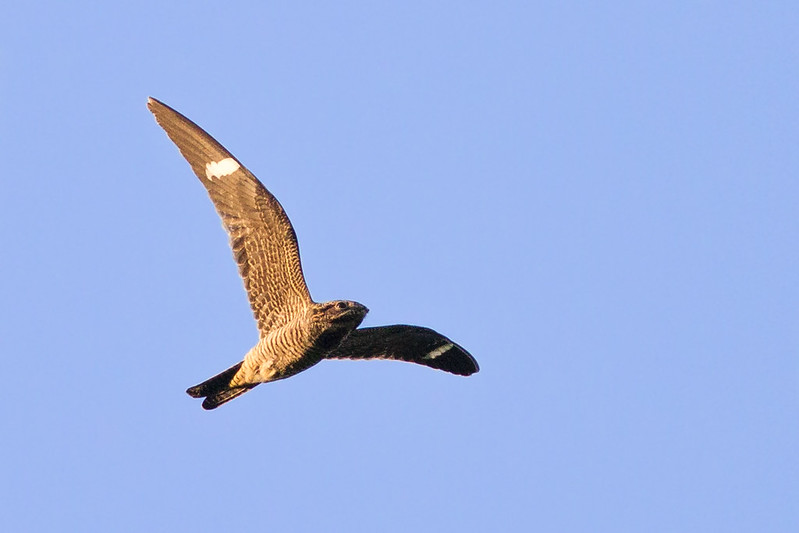
Common Nighthawk” by Fyn Kynd is licensed under CC BY 2.0.

As I was packing up to leave, our group had one more surprise: a pair of migrating Common Nighthawks. To the right side of the valley, the hawks seemed to hover over the treeline. This was my first sighting of Common Nighthawks, and I rushed to note them in eBird before heading off to my car.

For an area renowned for its fishing, the birding was excellent. For 60 minutes, I observed a total of 7 species and 26 birds. Our group observed 14 species and 52 birds. The area is available from sunrise to sunset throughout the year. While a visitor cannot cross into fenced areas, there is space near the gate to set up a chair and observe.