Late Summer at Shaver’s Creek

During the last weekend of August, two of my sisters and I took a trip to Shaver’s Creek Environmental Center to explore. On Saturday morning, we hustled down the road, first stopping at The Naked Egg Café for brunch. About an hour before the Penn State football game kicked off, we were parked and walking into Shaver’s Creek. We were practically alone- it felt like everyone in the Centre Region was at the game!

Established in 1976, Shaver’s Creek Environmental Center is now an integral branch of Penn State Outreach. Shaver’s Creek is more than a “typical” environmental or nature center- in addition to hosting many programs for the public and Penn State students, the Center participates in a number of research projects ranging from citizen science to Appalachian Botany and Ethnobotany. My favorite Shaver’s Creek program is Community Nature Journaling, which has inspired me on my own nature journaling journey.
I was first introduced to Shaver’s Creek when taking my Pennsylvania Master Naturalist training classes in 2024. At the time, our classes were after-hours, and I could only explore small portions of the 7,000+ acres of it and Stone Valley Recreation Area. I have been back many times since exploring or attending programs hosted on its grounds. One of my favorite ways is to visit with family- there is something for everyone at Shaver’s Creek.

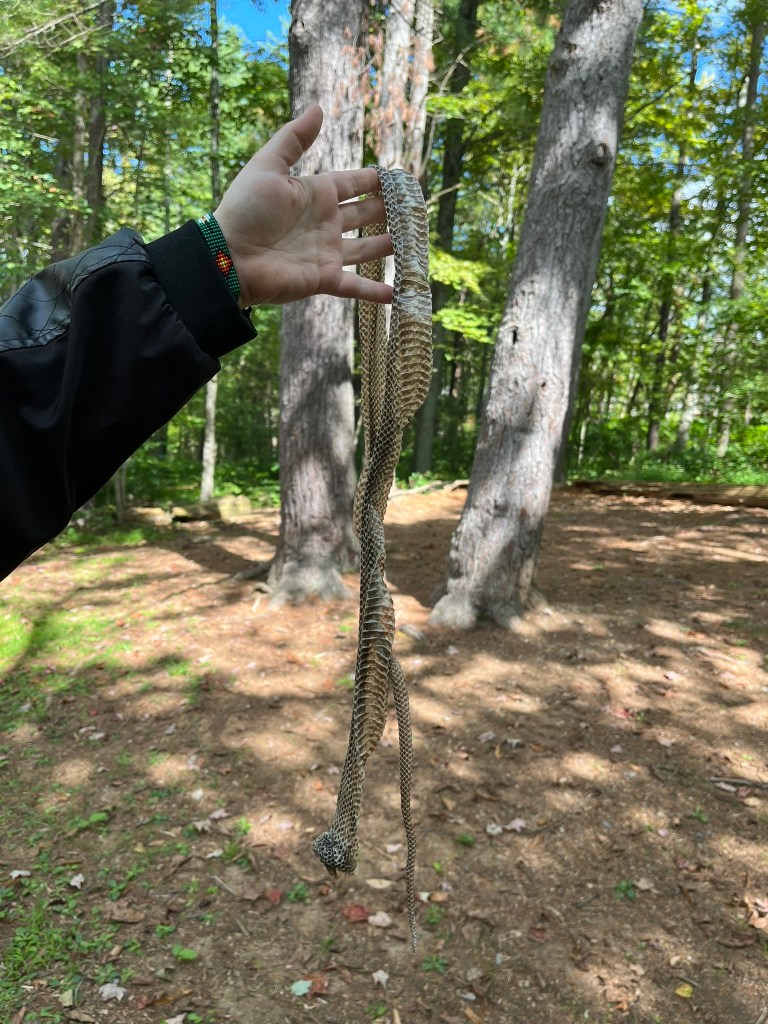
This Saturday, I wanted to share my favorite trail with my sisters. Together, we walked down the Point Trail to Sunset Point Pavilion. We were slow hikers, stopping many times to look at insects, lichen, or flowers. One of my sisters noticed a blacksnake shed- totally in one piece and very fresh. We put it back where she found it, so others could see the shed, too. Besides, if we wanted to find and keep a shed, I’m certain there’s one at home, from the blacksnake living in my garage!
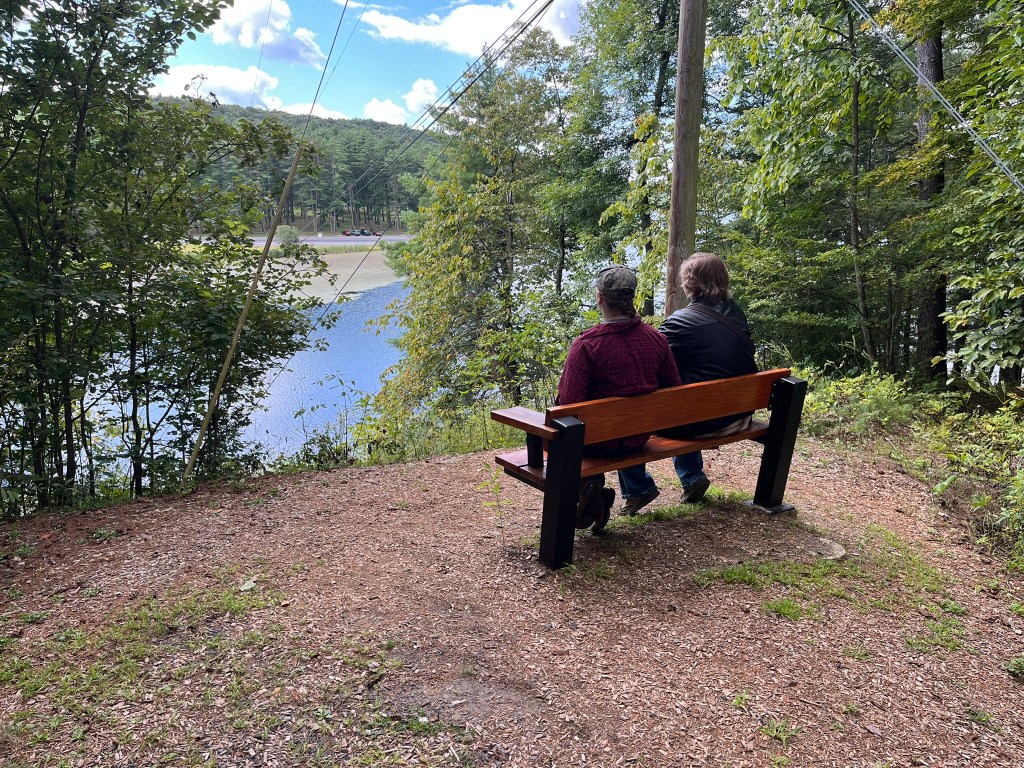
We hung out at Sunset Point Pavilion for a long time, watching a flock of Canada Geese and some kayakers out on Lake Perez. The lake is the key feature of the Stone Valley Recreation Area, and Shaver’s Creek is deeply connected to it. Lake Perez is one of the locations of the Long-Term Ecological Reflections Project, and has experienced massive change over the last 20 years. For some time, the lake was drained, then eventually refilled. Now, Lake Perez is open to fishing and human-powered boating.

While hiking, we stumbled upon a geocache. It was my youngest sister’s first geocache- and my 41st find. It was a little tough to log the cache while out hiking- there is poor cell reception in the area, and only WiFi at the Center. For me, this is another reason why Shaver’s Creek is so wonderful- it’s the perfect place to go for an unplugged day outdoors.

After hiking around, we made a stop at Klingsberg Aviary. This is, by far and large, my favorite part of Shaver’s Creek. Four long buildings, mews, are home to a host of birds that now live in the care of devoted staff. For one reason or another, these birds have found themselves unable to return to life in the wild, and now they serve as avian ambassadors to the public. While Shaver’s Creek is home to a Red-Tailed Hawk, my favorite bird in residence is Jane the Sandhill Crane.

Unfortunately for us (well, me), Jane was not out-and-about in her mew during our visit. Currently, the Aviary is under renovation, and I can imagine it disturbs the birds quite a bit. While we were quietly observing the birds, Rosalie the Bald Eagle was out and surveying us with a sharp eye. As we were visiting her, she let out one of the signature Bald Eagle screeching laughs. Feeling oddly chastised by the bird, we tip-toed out of the Aviary and on to our next destination.

Our last stop at Shaver’s Creek was the Boardwalk. Neither of my sisters had been on the Boardwalk before, which perches over a leg of Lake Perez. While hiking, we found some White Turtlehead, an unusual late summer wildflower. We did a little more birdwatching and checked around for another geocache. Too quickly, it was time for us to head out for the day. As we hiked back to the Jeep, we started making plans for a return trip to Shaver’s Creek later in the Fall to search for geocaches.

If you are interested in visiting Shaver’s Creek Environmental Center, I highly recommend you go. The Center is open daily, from 10:00am to 5:00pm. You will need to be a little prepared before you visit- Shaver’s Creek is working on becoming a zero-waste facility, so you will need to recycle on-site or pack out your trash. Dogs are not permitted in the Aviary but may be at Shaver’s Creek or Stone Valley Recreation Area if they are on a 6-foot leash. Don’t forget lots of water and a trail map!

Have you visited Shaver’s Creek before?

Signs of Spring

Sturnus vulgaris, European Starling

The concrete porch was cold under me, but I paid no attention as I studied the bird on my suet feeder. I watched the glossy bird rip into the suet cake, pause, and gobble down its bite. This bird, a European Starling, is the scourge of my days, devouring pound after pound of seeds and suet. Yet, I can’t deny anything- it, too, is trying to survive in adverse conditions.

In my attempt to spend 1,000 hours outside, I have been doing daily lunchtime birding. At home, I perch on my back porch and at work, I find a sunshine-drenched bench. All I have is my cellphone and binoculars. I keep to one place for about 15 minutes, recording all the birds I see and hear. The list is never very long, but I enjoy the regularity of the community of birds around me.

Zenaida macroura, Mourning Dove

On this afternoon, mine and my neighbor’s yards were full of birds. Mourning doves roosted in the trees, grooming in the sunshine. A Red-Tailed Hawk called from overhead as it flew by. A solitary crow annoyed a flock of European Starlings to my left. House Sparrows and House Finches argued over feeder space. As I wound down my session, a female Northern Cardinal appeared nearby. At last, two Tufted Titmice darted to the maple tree. All the while, a chorus of American Robins called, completing the scene.

As I had my camera on hand, I decided to take pictures of some of the spring buds and shoots. The buds on the roosting tree of the Mourning Dove are already tinged red. Close by, the magnolia buds are fuzzy, growing larger by the day. On my remaining forsythia bush, the yellow buds are plentiful. I regret not ripping it out this past fall; this bush is a pain to care for. That said, I couldn’t rip it out- birds like roosting in its tangled branches.

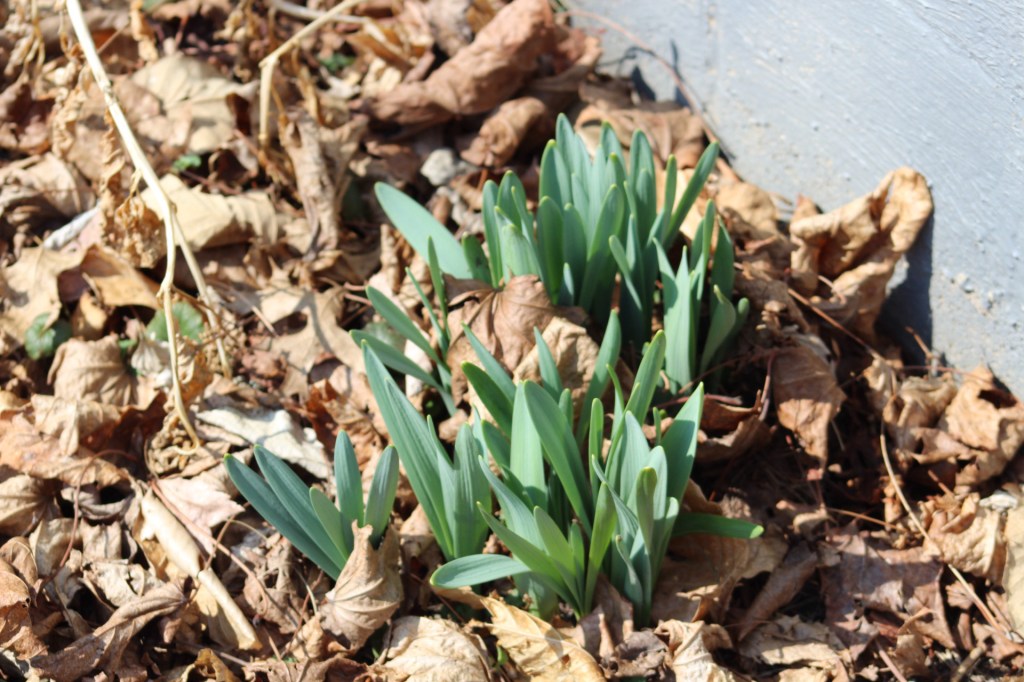
Narcissus, Daffodil

In the front yard, signs of Spring are a little different. Leaves are sprouting for daffodils, tulips, and hyacinths. Over winter, I debated on keeping them. On one hand, I could remove them and plant native flowers. On the other, I planted them before I knew about native flowers. The memory of my younger self prevailed; I decided to keep them. I will need to control spread of these plants. Hyacinths will produce bulblets as off-shoots and spread under the soil. Regular removal will curtail this spread and prevent an invasion in my yard.

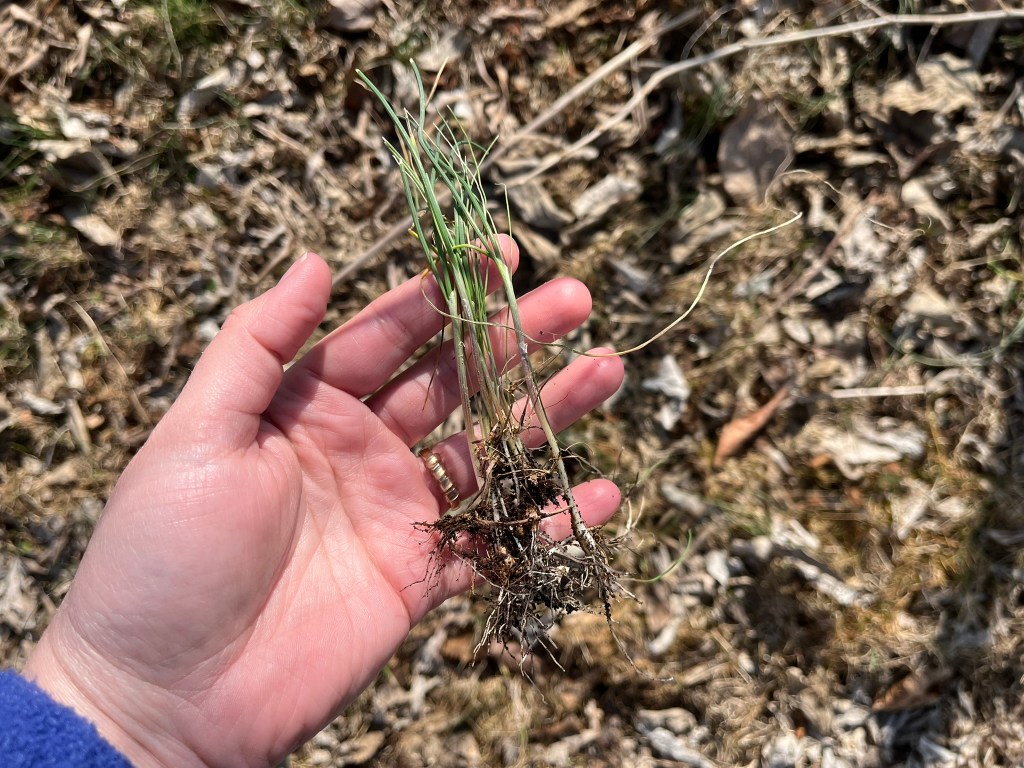
Amongst the returning grasses are the thin rapier-like leaves of wild garlic. Allium vineale is also known as “Crow Garlic” and “Field Garlic.” Introduced in the mid-1800s, wild garlic spread to cover much of the eastern United States. While wild garlic is edible, I wouldn’t eat it. The garlic flavor is pervasive and overrules all others in dishes. The taste is so strong that the flavor will get into the butter and milk of cows that have eaten wild garlic.

Allium vineale, Wild Garlic

I have a few more weeks until the Spring wildflowers start blooming. Some friends have already seen skunk cabbage, the smelly harbinger of longer days. I’m waiting for Virginia Springbeauty and Wild Columbine. The emergence of these two flowers signals true Spring to me. I’m also excited for Yellow Trout Lily and Bloodroot this year. I will need to leave my yard to find these flowers- but it is a trek I look forward to.

These subtle signs of Spring are refreshing to my winter-weary eyes. With a little noticing, the drab landscape burst into life. With returning birds, the plants are emerging from their dormancy. Each day, we’re one step closer to the chirping of nestlings and the leafing-out of trees. Now, if the Purple Martins would simply come back…

What are you noticing about Spring near you? Share in the comments!

Late Winter at Hort Woods

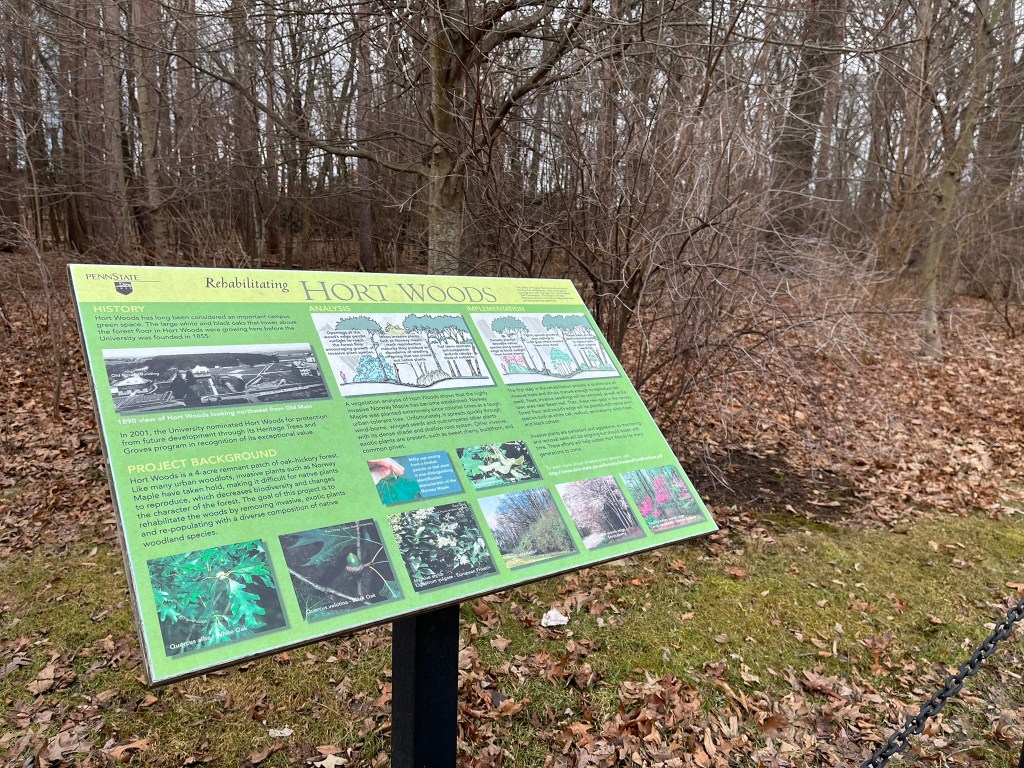
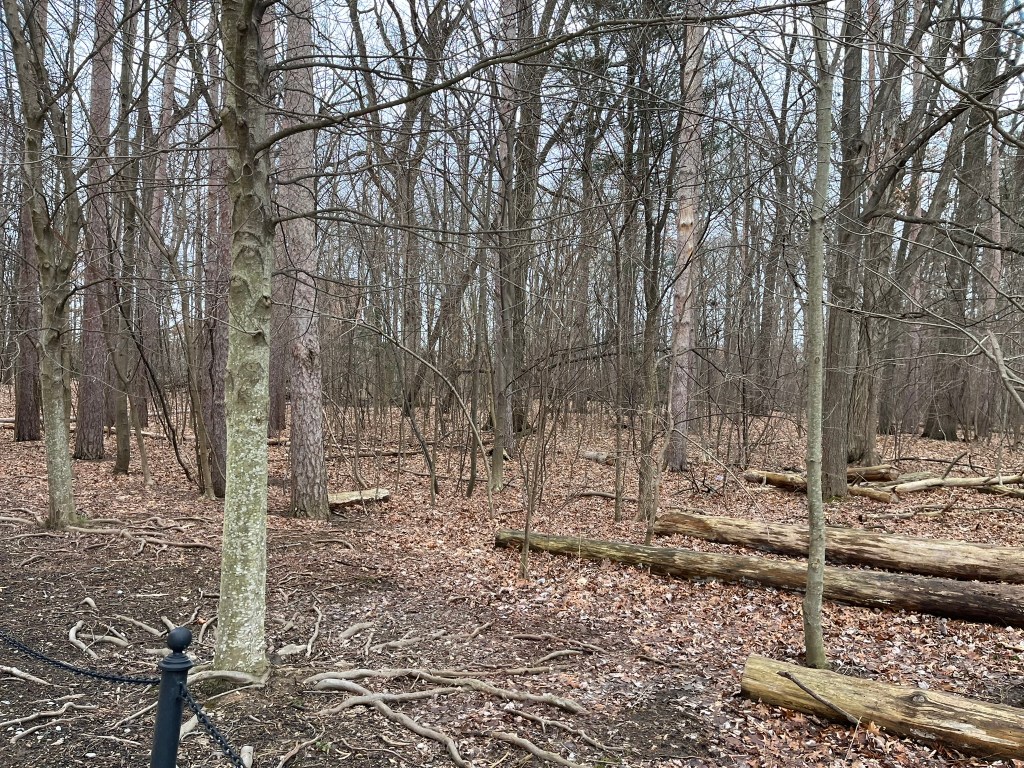
The March winds pushed me as I hurried down the sidewalk to Hort Woods. Traffic zipped by, and students shivered as they ran from dorm to dorm. Even though I’ve taken hundreds of walks on campus, I’ve never taken a dedicated walk through Hort Woods. This past Thursday I spent a half-hour in this historic grove of trees at University Park.

In 2001, Hort Woods earned “Heritage Grove” status at Penn State. In the 1800s, Hort Woods stretched from central campus to the Penn State Arboretum site. The original Hort Woods was cleared for construction. The remaining patch of land contains some surviving trees, or at least their progeny. Yet, by the 2010s, the area had become degraded by invasive plants. The Penn State Eco Action Club partnered with Penn State OPP to rehabilitate Hort Woods. Supplemental funding from the Penn State Student Fee Board helped the project along. Rehabilitation included removing invasive species and replanting with the Miyawaki Method.

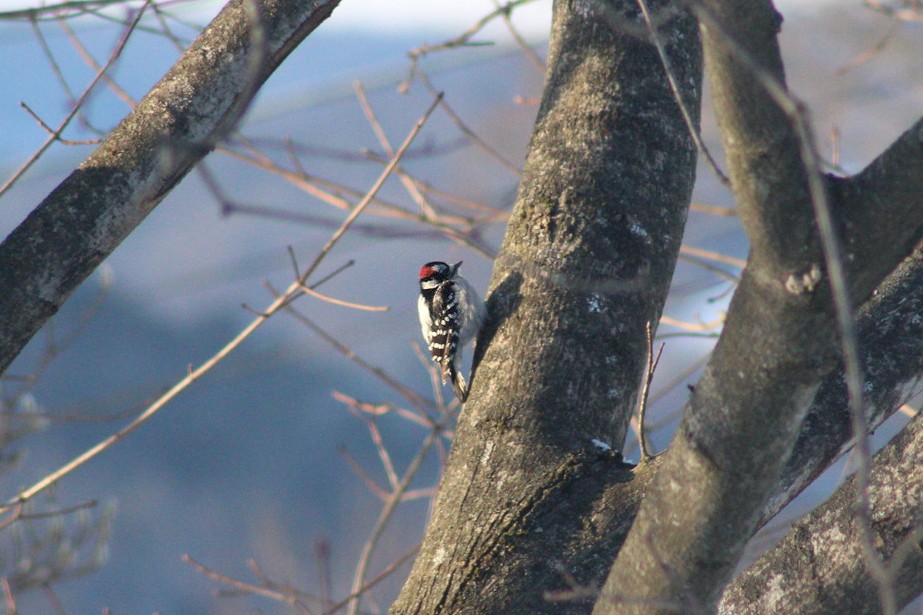
On my walk, I followed the sidewalks surrounding and through Hort Woods. Despite the dormant landscape, the tract of trees was humming with life. I first spotted a Red-Bellied Woodpecker digging through a snag. Right after, a Downy Woodpecker flitted over my head. I heard the high calls of American Goldfinches and House Finches in the canopy. A Merlin recording revealed more species: Black-capped Chickadees, Dark-eyed Juncos, and White-breasted Nuthatches.

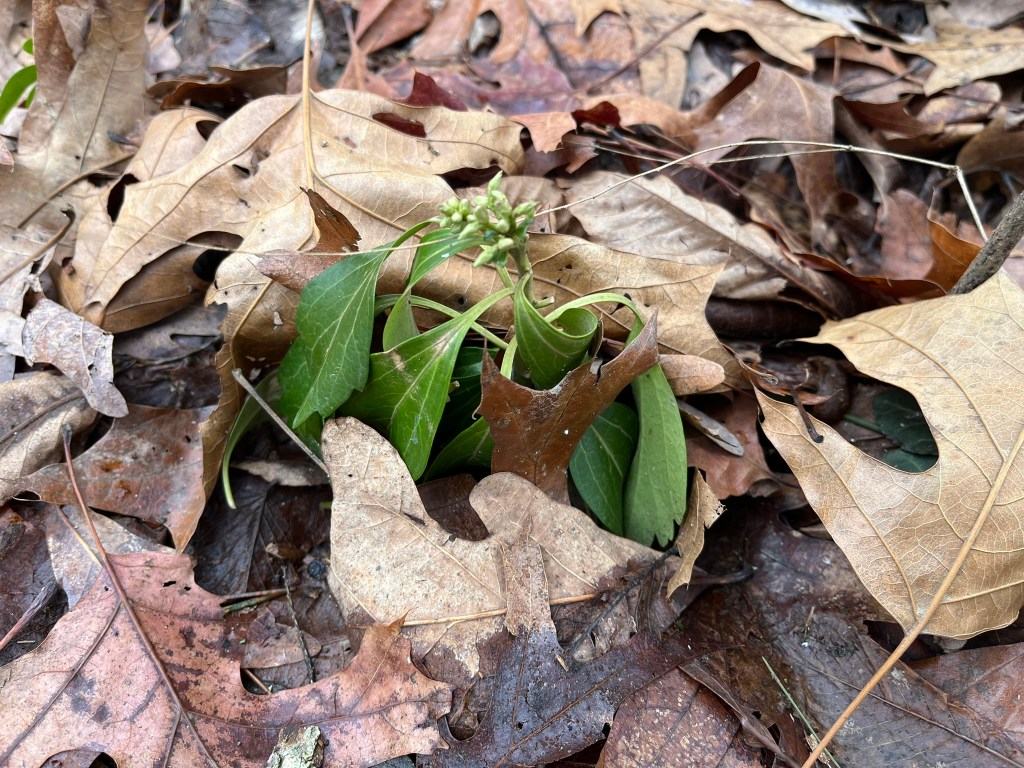
Along the sidewalk in some areas, small green plants were pushing up through the leaf litter. A check with iNaturalist revealed them to be Japanese Pachysandra. In other sections, English Ivy trailed along the ground and up the trunks of trees. English Ivy, while pretty, is difficult to eradicate. The ivy reminded me that eradicating invasive species requires many years of effort. Penn State is making that effort by implementing a sustainable landscape plan.

Derek K., Senior Landscape Architect and Eco Action Club Adviser, shared the University Park Campus Sustainable Landscape Implementation Plan with me via email. The plan mentions “Restoring the Legacy of Hort Woods” as a major action item. The goal of the project is to restore native species and develop the area into a 4-acre swath of healthy habitat. The action plan utilizes straightforward management techniques familiar to non-foresters like myself. Penn State is focusing on soil decompaction, low- or no-till methods, and composting. From my experience, I know these plans will be executed as carefully and thoughtfully as funding permits.

Late winter can be a depressing time of year. My walk tempered this feeling, and I left hopeful for what is in store for Hort Woods. By exploring this one patch of wood, I learned I’m one of many that care deeply for Penn State’s landscapes. Hort Woods is now a part of my walks, and I’m excited to observe the changes as we transition into Spring.

Works Cited

Penn State University. (2014, November 8). Heritage tree groves: G-6. The Pennsylvania State University. https://web.archive.org/web/20141108064008/http://lorax.opp.psu.edu/trees/heritage/groves/hgrove.jsp?ID=G-6

Penn State University. (2012, February 13). Hort Woods rehabilitation project to begin soon. https://www.psu.edu/news/university-park/story/hort-woods-rehabilitation-project-begin-soon

Stephen Stimson Associates Landscape Architects, Inc., Phyto Studio, Climate Positive Design, & The Pennsylvania Horticultural Society. (2024). University Park Campus Sustainable Landscape Implementation Plan. Penn State University.

Midwinter at the Arboretum

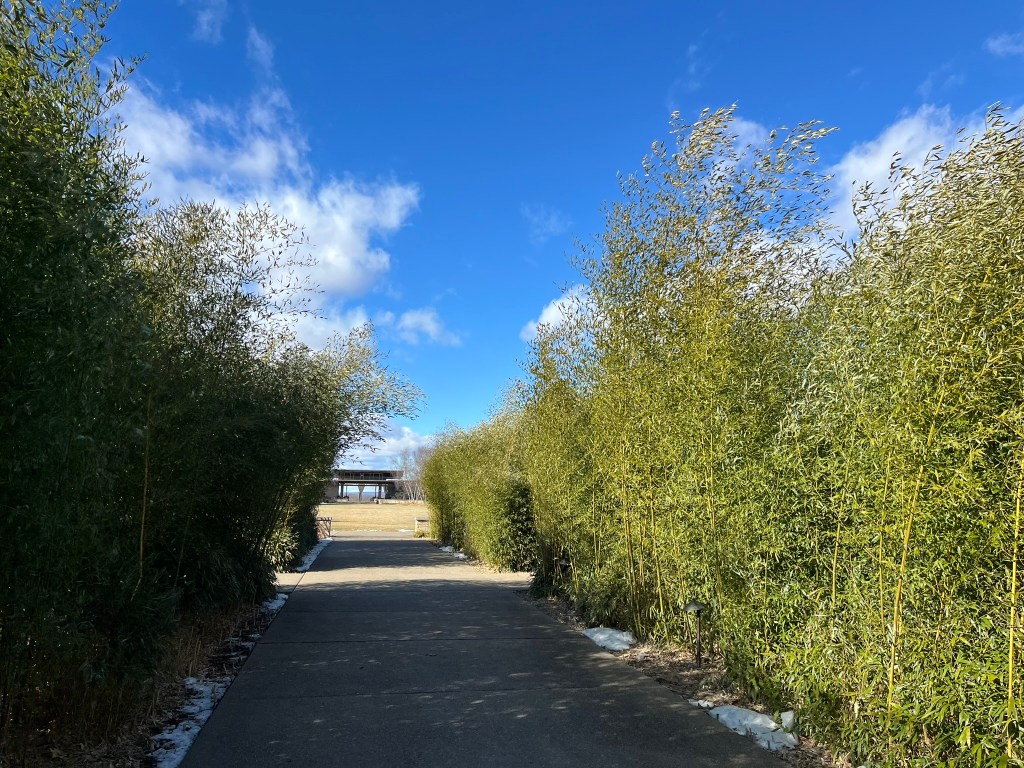
Lime-green stalks of bamboo greeted me as I entered the Arboretum at Penn State. This wonderful, ever-changing botanical garden always captures my attention and imagination. Even at midwinter, I enjoy spending my midday break walking among the dormant plants.

I always start with the Oasis Garden. Taking the first left, I wandered through and spun the ice on the Lotus Pool. The walls protected me from the wind as I poked around the plants. Very little was growing here, with most fading away into the mulch. The Rose and Fragrance Garden was more promising. The little buds peeping from the tips of branches signal oncoming Spring. As I finish looping through, a gust of wind shakes the waxy magnolia leaves, causing them to clack like bones.

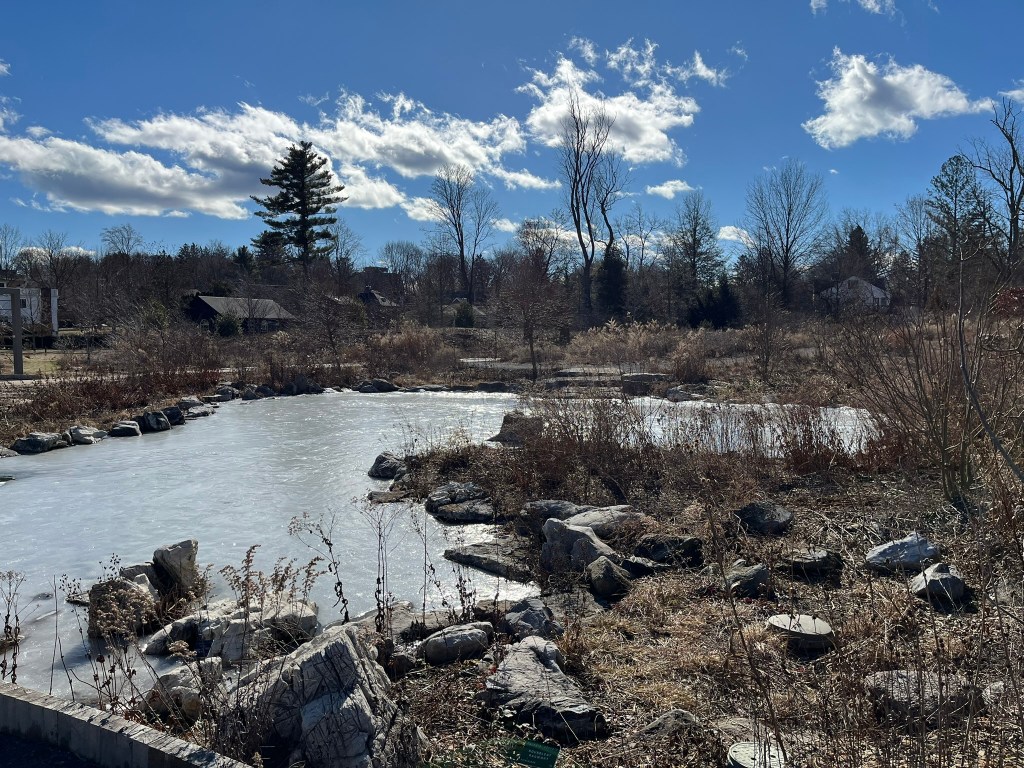
The walled gardens lead into the Pollinator and Bird Garden. Here the wind gusted, unobstructed by trees or hedges. I pull my shawl closer to my neck and continue to the pond by the Pollinator Plaza. From the top of the willow house, a Song Sparrow calls, spinning around on its perch to watch me. Most other birds are flitting overhead, or on a beeline to the Bird House.

The small wooden building is a relief from the wind. Another visitor is sitting on the porch, so I veer to the back and rest on the bench to watch the feeders. Dark-Eyed Juncos were tumbling over each other as they dig through the mulch for seeds. From the tops of the evergreen trees, a Blue Jay crunched a peanut. After a few minutes, a trio of Black-Capped Chickadees swept in to chase House Finches. I could- and I have- spent hours in this exact spot. Yet with my break ticking to a close, I knew I needed to keep going.

The Pollinator and Bird Garden connects to an esplanade with a giant sundial. The sidewalks border the Children’s Garden. I veered left into the Children’s Garden and entered the faux cave. Cold water dripped from the ceiling, most likely ice melting from the roof. The path carved through the cave, then out and behind the Glass House. Grey and black squirrels danced in the trees overhead as I walked. An employee was tending to the garden, and I stayed out of their way as best as I could.

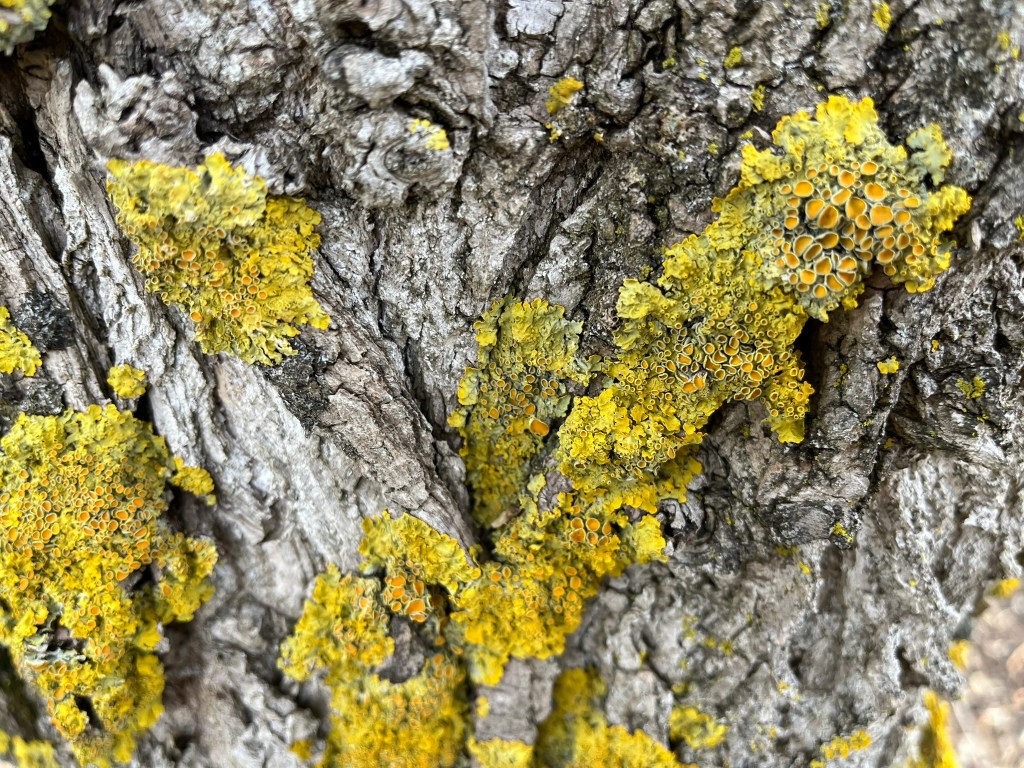
From the Children’s Garden, I followed the the Strolling Garden path to the Poplar Court. The Black Poplars stretched high into the sky over my head. I wove in and out between the trees, admiring the neon yellow and neon orange lichens. Most appeared to be a species from genus Candelaria. (I’m still waiting for some confirmations on iNaturalist now.) I took as many pictures as I could before I hurried back to work.

Xanthoria parietina (Common Sunburst Lichen)

Even though there were few blooming flowers, the Arboretum is still full of life in winter. From lichens to songbirds, there is a little bit of something for everyone. During my walk, I found a pamphlet rack, which had a booklet on trails in Hartley Wood. As I’ve been walking, I’ve been planning the rest of this year’s adventures… which won’t take me very far at all!

Hope & Wild Things

“Hope” is the thing with feathers –
That perches in the soul –
And sings the tune without the words –
And never stops – at all
Emily Dickinson

The first stanza of Emily Dickinson’s poem on hope rings true- especially in this past week. My despair over the state of our nation’s leadership swelled in its intensity. Coupled with the below-zero temperatures, I drifted through the weekend. I struggled to stay warm and hold up against the news and my fear of the furnace breaking down. I needed to find some peace, and some hope.

While out walking, I thought of Wendell Berry, finding peace among the wild things. Over my head fluttered European Starlings, calling to each other. In spite of the cold, they squawked and screamed, carrying on in their raucous ways as if it were any other day. Back in my yard, birds of many species fed on the seed I had scattered. While usually the Dark-Eyed Juncos and House Finches would fight- they did not. All were too focused on survival to slip into argument.

Birdwatching always brings me peace. When I was a teen, I would keep up my parents’ feeders in the winter, filling each one after caring for my goats. I would sit on the bench in the kitchen with my tea and watch as Blue Jays and Northern Cardinals swept into the yard. Black-Capped Chickadees would follow me during my midday water check. When dusk would settle over the mountain, the birds would roost in the trees, waiting for morning.

The quiet routine of cleaning feeders and stocking suet help the days pass. One day, it’s October, and the last of the fall migrants disappear. The next, it’s December, and established flocks of songbirds are floating in and out of the yard. At last, it’s March, and the early spring migrants are taking a pit-stop on their journey north. Spring inches forward at the rate of one minute per day.

For me, the creep from winter solstice to spring equinox is laden with long periods of thought. At this moment, I’m consumed by my worries for our lands’ future. Already the Arctic National Wildlife Refuge has lost its protection from oil drilling. I fear for a renewal in fracking in Pennsylvania, an industrial pursuit I despise. There is only so much angry complaining I can do- only so many strongly-worded letters and emails I can write. There are only so many aggressive phone calls I can make.

Even if fighting is natural for all animals, it is not the option I want to choose. Caring for my community, both human and wild, is the path I want to follow. I can start in my yard, tending to the birds as I always do. I can carry on with bringing nature journaling to my community… Giving my time and effort to support educational experiences in public settings. I do believe I am not alone- there are hundreds, if not thousands, of similar people in Pennsylvania.

I cannot, and will not despair. There are wild things, feathered things, counting on me. Birds don’t know of human politics and maneuvers. I cannot lie in my bed to rot when there are creatures that need me to break the ice in their watering dish. I cannot retreat inside of myself when there are decisions to make in my community. Spring will come again, one day at a time.