Nature Walk Diary, 1-11-25

Saturday dawned with three-quarters of an inch of fresh, new snow. After my coffee, I bundled up to take a walk to the dock and do some birding. At 28 degrees with a soft breeze, the day felt warmer than the week before. A blue, sunny sky stretched overhead as I set off, first noticing some bird tracks on my front stoop.

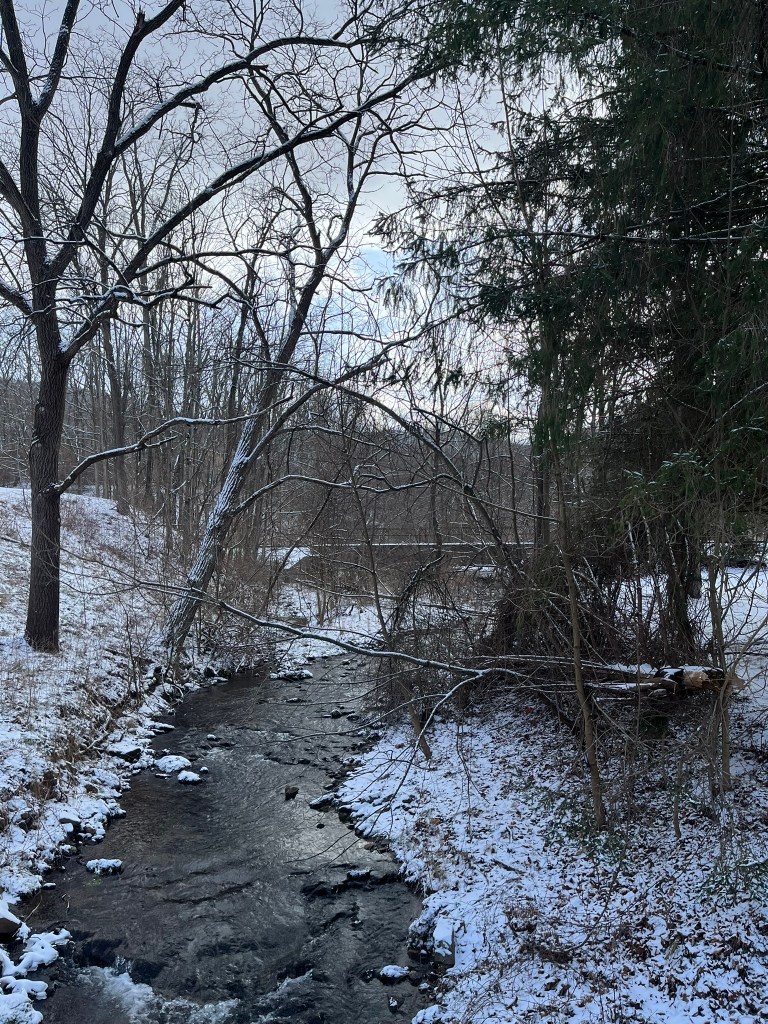
A light wind pushed at me while I noted the birds in a neighbor’s yard: Dark-eyed Juncos, House Finches, and a Blue Jay. The dulcet tones of Lick Run overpowered any bird song. The groundwater-fed stream was free-flowing and ultra clear. I love the look of the creek flowing under the railroad bridge… I swear I have a thousand shots of that sight alone!

I continued on my walk, ambling up the hill. To my left, the thick briars on the steep hillside was full of birds. I let some cars pass and sidled up the guardrail to take a sound recording with Merlin. Merlin recognized Carolina Wrens, Tufted Titmice, Northern Cardinals, and American Robins. Before I turned off the recording, a new call broke out, one I was not familiar with.

A high, sharp repeating cheep rung out and paused before starting over. Merlin claimed it was a Golden-Crowned Kinglet. It continued to call after I closed Merlin and started looking for the bird in the thicket. Near the top of a bush was a small, darting bird with a shock of yellow on its head. A bright dark eye flashed under a white stripe… the Kinglet! The bird was here and gone before I could raise my camera. Dejected, I continued on my walk to the dock.

The closer I approached the lake, the more quiet the brush became. I ended my checklist with 12 species, the typical bunch of feeder birds plus the Kinglet. Once in the dock’s parking lot, I appreciated the beauty of the frozen lake. From my spot, I could see all the way to the breast of the dam, complete with a white velvet carpet of snow.

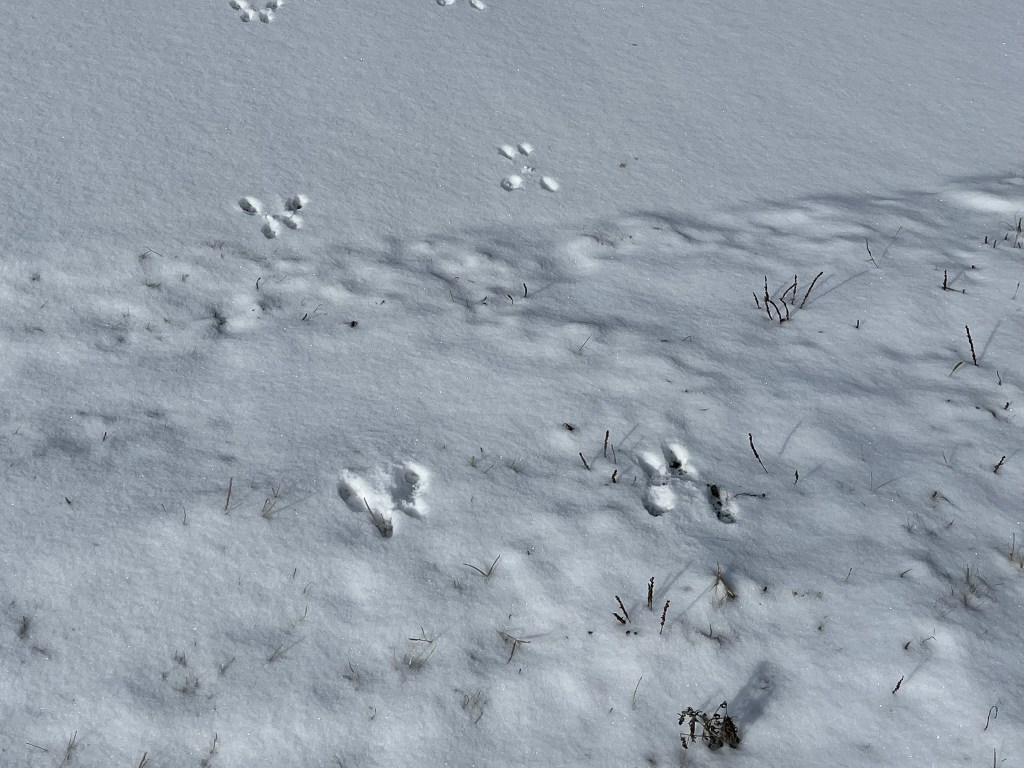
Rabbit tracks crossed the path to the dock platform. At least two rabbits had been dashing back and forth in the new snow. One rabbit had ventured out on the ice, crossing from the peninsula to the shore once. I had heard the ice was almost 3 inches thick at the Hunter Run Cut, but I wasn’t stupid enough to step out. Ice ought to be 4 inches or more thick before it’s acceptable to walk upon.
I dawdled a little longer, collecting two seed pods and a mushroom to draw back at home. I had seen the mushroom earlier this fall and wanted to explore its shape on paper. One of the seed pods was from the sycamore tree near the shore. I suspect a rushing squirrel broke the brittle tip of the branch.

As a cloud floated across the sun, I turned for home. The walk back to the house was slow- I stopped a few times to take more Merlin recordings. I strained to listen for the Kinglet back along the hillside, but I didn’t catch a single note or feather. Despite my disappointment, I did feel pleased at heart- I started off the new year with a new bird on my life list!

Recounting the Christmas Bird Count

Black Vultures

On December 29th, I participated in my first Audubon Christmas Bird Count. Armed with my binoculars and camera, I loaded up in my friend’s Subaru. Four of us set off into the morning mists to cruise through a variety of habitat to find as many species as we could. We had no goals- our only expectation was to explore our corner of the circle and hope for species diversity.

At our first pull-off, a huge flock of thrush-sized birds flew overhead. At first, we thought they were European Starlings, but they didn’t seem quite right. Their flight calls were too cheerful to be the omnipresent nuisances. A long Merlin recording determined them to be American Robins. Throughout the morning we sighted one large flock after another. The Robins were taking advantage of the warm, rainy weather to hunt for earthworms.

In a small development, we crept towards a small group of vultures sunning on a tree branch. At first, we thought they were Turkey Vultures. As our position was okay, we snapped some pictures and realized the birds were Black Vultures. While my photograph is poor, I could see their white primaries spread for the sun. Their behavior was a little ironic- at this point in the day, the mists hung heavy over the fields… a great day for a goth bird!

Hermit Thrush

As our morning wore on, we noted plenty of “standard” winter feeder birds. At almost every stop a Carolina Wren or Northern Cardinal would call out. While we didn’t always see them- there were plenty of Paridae. Black-Capped Chickadees and Tufted Titmice often flock together in the winter. Tufted Titmice are my favorite feeder bird, and I took on the role of counting them at our stops.

A continual delight was the melody of White-Throated Sparrows. Too small and fast for my camera, they danced around the shrubs of every stop. For such a small bird, their voices are loud and carried wherever they went. At one stop, they were the only birds we could hear over an agitated Northern Cardinal. I hadn’t paid much attention to White-Throated Sparrows before, but now they are on my radar for the future.

During an unrewarding trip up a wooded lane, a medium-sized brown bird popped out on a branch near my window. From the back, and through fogged glasses, it looked like a very fat wren. After wiping my glasses and picking up my camera, the bird turned and revealed itself to be a Hermit Thrush. This was my first one- and I was able to snap a half-decent shot!

Eastern Bluebird

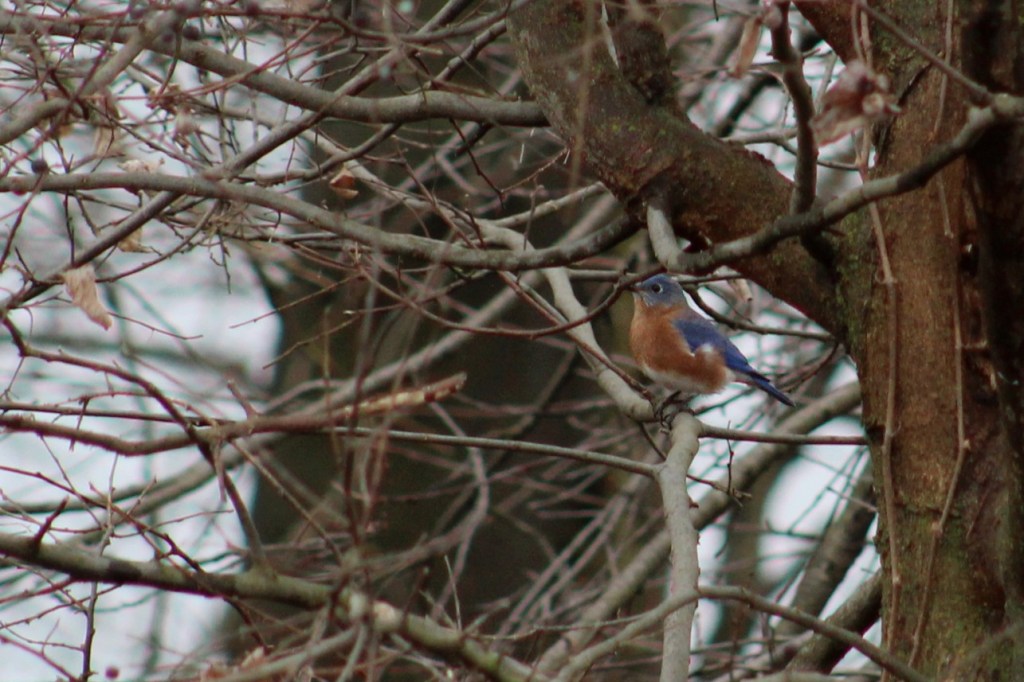
As our day waned, we finally traded in the forests for edge habitat. Overgrown, mixed hedgerows rose high over the car as we sidled down a muddy country lane. A few winter feeder birds popped over us, and as we were turning we noticed a flash of blue further away. Hopping out, all four of us trained our binoculars on a flurry of activity on a berry bush- Eastern Bluebirds! On a high, we headed to the last part of our route.

Construction blocked the usual route, so a quick detour got us back on track. We spotted another Red-Tailed Hawk and an American Kestrel surveying roadways for prey. The area we were birding was close to I-99, making it hard to hear birds over the roar of the road. A few more American Robins added to the list, and we closed up shop, heading back to our meeting place to disband.

Our day was five and a half hours of pure birding- starting at 7:15am and ending at 12:45pm. On this trip, I was able to add to my life list and learn new camera tricks. Already I can say this trip was the highlight of my long holiday vacation!

Practicing Bird Photography

Fresh snow coated the earth on Monday morning, making my daily birding easy from my spot at the window. Birds came and went, the usual suspects… Mourning Doves, Purple Finches, Tufted Titmice, and a Dark-eyed Juncos. Despite looking at birds more than my laptop, I didn’t see any American Goldfinches like I did the day before. At last, lunch came, and I could try something new: sneak out with my camera and take some pictures.

I bought a Canon Rebel T6 off of Facebook Marketplace two months ago. After replacing the batteries and buying an SD card, I haven’t had a chance to use it. I’ve been studying on how to best take pictures, but all advice pointed to “practice makes perfect.” I changed out to the larger zoom lens from my kit and slipped on my boots to wait on the porch for birds.

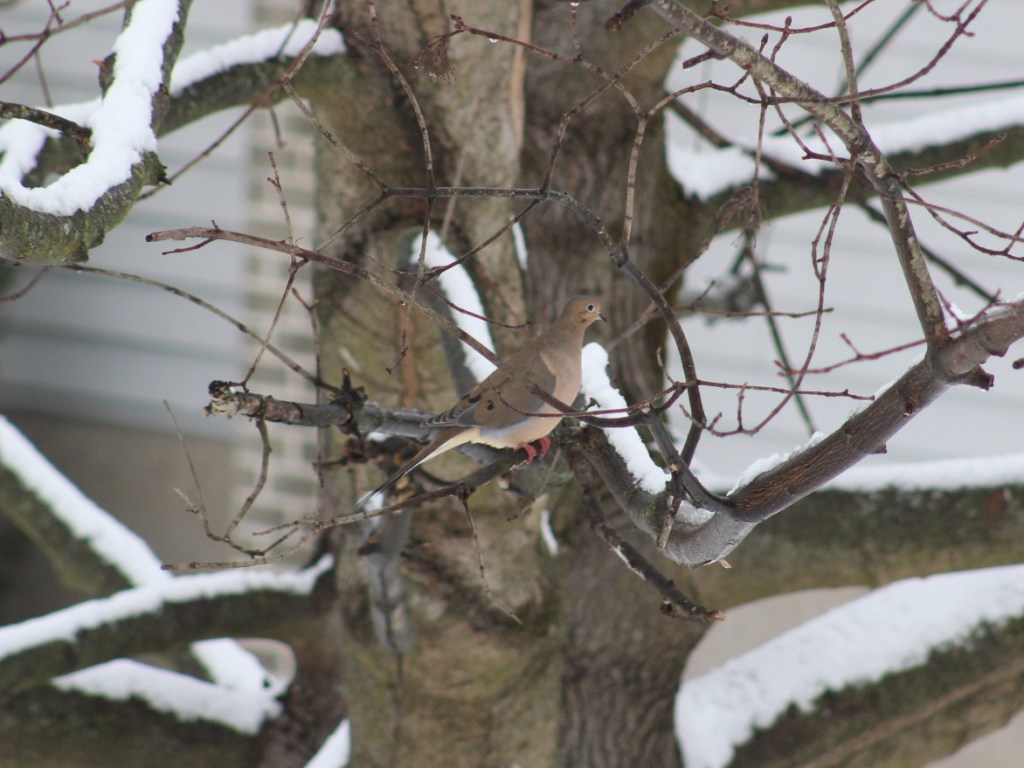
A handful of birds took off the second I opened the door. Left behind were two confused Mourning Doves. One belatedly shot into the upper canopy of the maple tree, too far away for me to capture in a photo. The other chose a lower spot, eyeing me as I stood still on my porch. I snapped a couple shots in quick succession before it, too, left for higher branches.

After about three minutes, the Tufted Titmice swarmed back into my feeders. At least three small family units visit my feeders daily. One brave bird swooped into my light-blue metal hopper and stole away with a sunflower seed. Others were dangling off the branches of the maple tree, waiting for their turn.

The Tufted Titmice were hard for me to photograph. They sprint across the yard, and when landed at the feeder, they antagonize each other. Of course, it’s in their nature to dine-and-dash, preferring to crack seeds at a high, safe spot than down at the feeder. Tufted Titmice also form hoards of food over the winter, so some will grab a seed and disappear. It was easiest to photograph them when they were watching me for sudden movements. The entire time I was photographing the Titmice, I was holding my breath!

I watched them come and go for ten minutes- Titmice dominate my feeders at any point during the day. A Red-Bellied Woodpecker flew overhead, and decided to not munch at the suet upon spotting me. A handful of Dark-eyed Juncos came to forage on the ground, but I missed a chance at photographing them. Their dark upper halves contrasted too much against the snow and white bellies.

As the end of my lunch drew near, the birds started to dwindle in my yard. My neighbor’s feeder, out of my camera’s view, was bustling with Purple Finches. I can imagine the birds felt safer with the shrubs and arbor between me and their tiny bodies. With their feeder so busy, a small group of birds waited on the far branches of the maple tree.

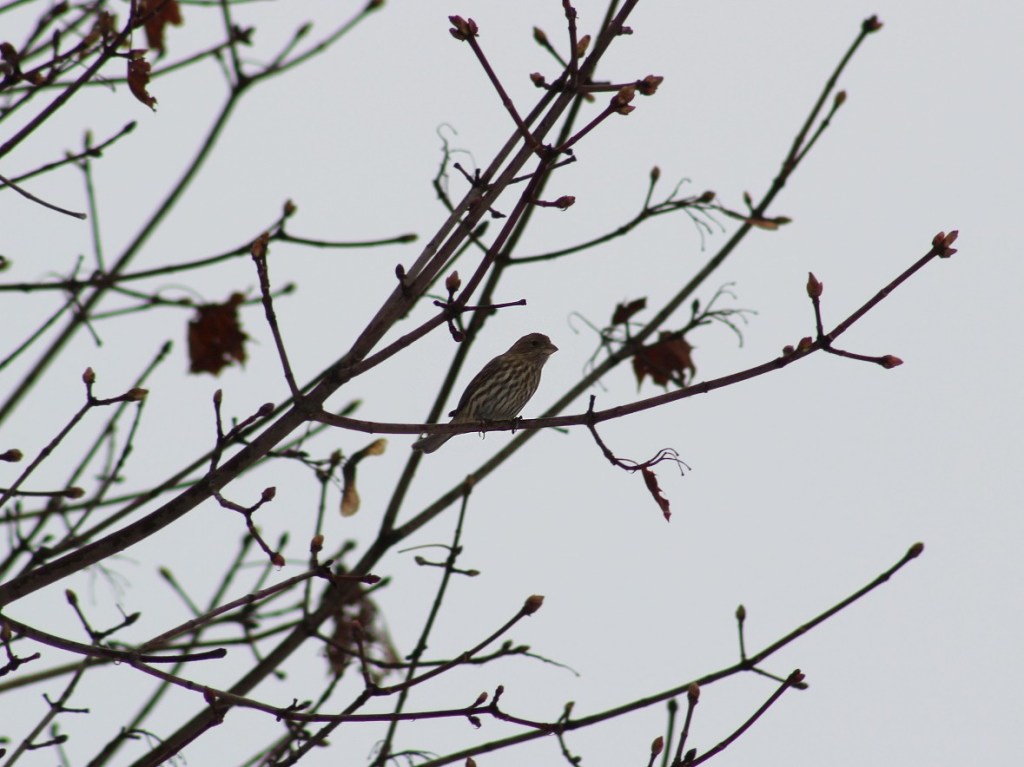
I leaned on the support of my porch roof as I zoomed into their spot. My movement scared away all except for one female, who ignored my existence. With the light misty sky behind her, the shot appeared too dark on my camera. Dejected, I went back inside, feeling that my experiment was a failure.

At my desk, I fumbled with the camera settings to import the pictures to my iPhone. I almost gave up in frustration, but with the help of a Youtube video, I figured it out in the nick of time. The last five minutes of my lunch break was total awe, admiring my pictures. I had never, in my life, taken a picture of a bird. I could see the subtle colors of the Mourning Dove and the gleam of a Titmouse’s eye. Satisfied, I put my camera away and went back to work, planning the next time to photograph birds in my backyard.

2024 eBird Year in Review

Birding is one of my favorite hobbies, and I try to squeeze in as much as I can. With my work schedule and life schedule, I’ve had minimal time birding until this past Fall. I learned about eBird this summer, and I’ve been growing my life list ever since. I’ve observed 43 species this year, and lucky enough to make memories at the same time.

First was when I went birding at Fisherman’s Paradise with the State College Bird Club. Observing the Great Blue Herons interacting with the Bald Eagles was new and exciting for me. I blogged about the trip on September 29th on Birding at Fisherman’s Paradise.

My second memorable trip was birding at Soaring Eagle Wetland (SEW). While the birds I saw there were not new to me, exploring the area was exciting. SEW has many active projects, and when I visit again, it will still feel like a brand-new place. I blogged about the trip on November 3rd on Early Fall at Soaring Eagle Wetland.

Another recent memory- I was birding with friends at Bald Eagle State Park will go in the books as a highlight. We were chatting on the beach area when one of my friends spotted an unusual bird out on the water. I focused my binoculars and discovered a Common Loon in winter plumage. It was my first-ever Common Loon, and having spotted it with friends felt extra special.

There’s still plenty of time to bird this winter. I’m participating in Project Feederwatch until it finishes in April. I’ve had a blast spending weekend mornings observing my backyard. There is a Downy Woodpecker that visits every day at 11:00am, rain or shine. Plus, Tufted Titmice are a daily treat, bringing joy to every morning. Visiting a winter raptor survey is on my to-do list, something I’ll share here when the trip concludes.

2024 was a successful year for birding. Despite not birding 24/7 all year, I’ve been able to make memories, add to my life list, and take part in fun projects. The rest of this winter and next year look to be even better. I’ve developed my identification skills and am working on becoming a better photographer. I can’t wait to share with you what comes next!

2024 Bird Species

  • Turkey Vulture
  • Eastern Bluebird
  • Common Merganser
  • European Starling
  • American Robin
  • Red-tailed Hawk
  • Mourning Dove
  • Red-Bellied Woodpecker
  • American Crow
  • House Finch
  • Dark-eyed Junco
  • Red-winged Blackbird
  • Northern Cardinal
  • Black Vulture
  • American Goldfinch
  • Field Sparrow
  • Common Grackle
  • Common Nighthawk
  • Great Blue Heron
  • Bald Eagle
  • Ring-billed Gull
  • Black-capped Chickadee
  • Eastern Phoebe
  • Tree Swallow
  • Cedar Waxwing
  • Double-crested Cormorant
  • Osprey
  • Killdeer
  • Blue Jay
  • Chipping Sparrow
  • Tufted Titmouse
  • Wood Duck
  • Mallard
  • Grey Catbird
  • Downy Woodpecker
  • Pileated Woodpecker
  • White-breasted Nuthatch
  • Carolina Wren
  • White-throated Sparrow
  • House Sparrow
  • Song Sparrow
  • Canada Goose
  • Common Loon

Summer Osprey Sightings

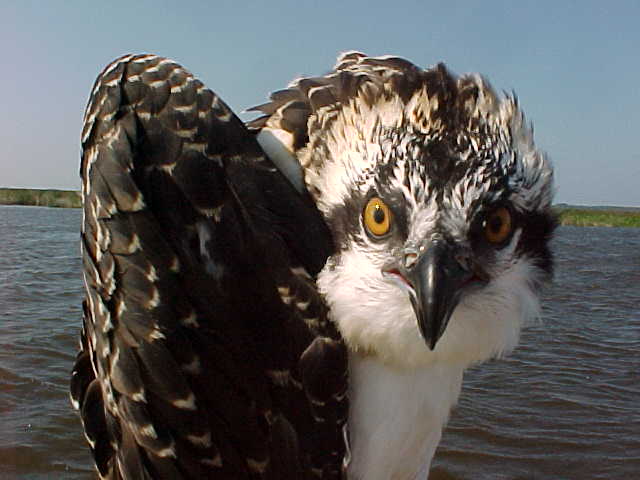
Photo of the Week – Osprey at Back Bay National Wildlife Refuge (VA)” by U. S. Fish and Wildlife Service – Northeast Region is marked with Public Domain Mark 1.0.

Near the intersection of Rt. 26 and Rt. 150, the Bald Eagle Overlook faces out over Foster Joseph Sayers Lake. Here, I watched a pair of Osprey dominate the northern bank of the lake all summer.

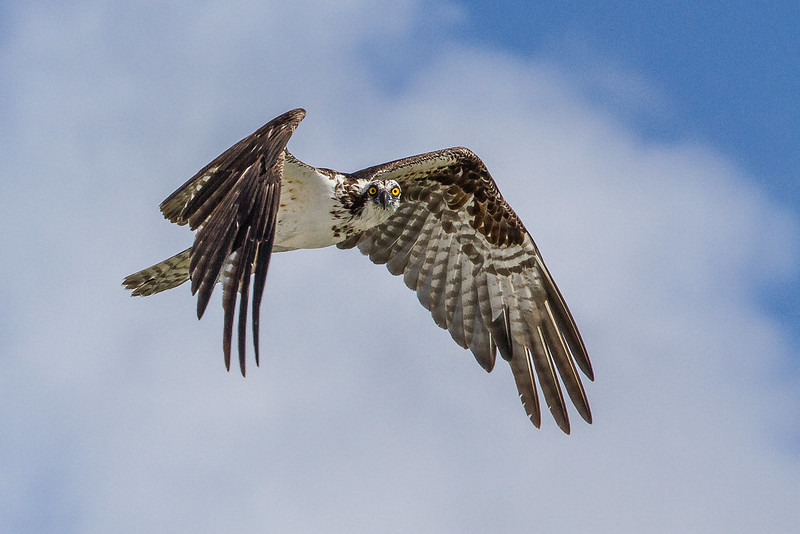
Considering the nearby Bald Eagle State Park, watching Osprey feels traitorous. I see at least one Bald Eagle per day while on my lunch walks- this is a gift I will never take for granted. Yet every time I spot an Osprey, I become transfixed, waiting for their yellow glare to pass over me.

The thing I like most about Osprey is their look; always torn between bewildered or cool. At the right angle, with ruffled feathers and wide eyes, Osprey have the same visage of a mad scientist. In flight, Osprey are every inch a predator with their long wings spread over the skies.

I usually find the osprey pair situated in a snag between Bald Eagle Overlook and the Rt. 26 causeway. Before the Osprey, this area had a fluctuating cast of characters. A normal day for me would be to spot Bald Eagles next to crows, next to starlings or even mourning doves. Aside from Double Crested Cormorants, no other birds appear here with any regularity.  

Ospreys prefer areas close to open water, with no overhead forest canopy. Perching on snags gives the birds a long view up and down the lake. Fish are their preferred prey and will live-catch every meal. Rarely did I ever see another species in the snags while the Osprey were nearby. Even the Cormorants would stay quiet while the Osprey glided by.

As I kept an eye on the Osprey all summer, gears turned in my mind. Osprey nest in Pennsylvania from March to August, with nests as close as Clinton County. Nests occur up to 1600ft away from open water. Additionally, nests are large, made of sticks and twigs. In Pennsylvania, many nests are on man-made structures, like buildings and telephone poles.

Osprey in Flight” by Andy Morffew is licensed under CC BY 2.0.

Knowing this, I started looking for a nest. My search was in vain- I never saw a single stick. Bald Eagle State Park rangers searched the whole park for a sign, and never had anything to report. The Rangers told me that age and inexperience may prevented the Osprey from nesting.

Despite our searching, Osprey nests can be difficult to find. This difficulty has led to many states enacting nest surveys. The Pennsylvania Game Commission enacted the Osprey Nest Survey program in the 1980s. The program relies on volunteers to follow a protocol and report to the Commission via email. The Commission uses the reports to update the Pennsylvania Natural Heritage Program databases.

In addition to nest surveys, some organizations build and erect nesting platforms. These platforms encourage Osprey to nest away from infrastructure and in safer areas. Many platforms are also equipped with cameras, which livestream nest activities.

Now that Fall has arrived, the Osprey have moved on to their wintering grounds in South America. I doubt I will see another Osprey until they decide to return to Bald Eagle State Park. I hope the excellent habitat draws them to return and nest in an accessible area!

Works Cited

Hawk Mountain Sanctuary. Osprey. Hawk Mountain Sanctuary, 2014, www.hawkmountain.org/raptors/osprey. Accessed 13 Sept. 2024.

Morffew, Andy. “Osprey in Flight.” Flickr, Digital Photograph, 4 Dec. 2012, www.flickr.com/photos/66020093@N03/8244633979. Accessed 4 Dec. 2024.

Pennsylvania Game Commission. Osprey Nest Survey. Pennsylvania Game Commission, 2019, www.pgc.pa.gov/InformationResources/GetInvolved/Pages/OspreyNestSurvey.aspx. Accessed 13 Sept. 2024.

—. “Osprey Species Profile.” Osprey Species Profile, Pennsylvania Game Commission, www.pgc.pa.gov/Wildlife/EndangeredandThreatened/pages/osprey.aspx. Accessed 13 Sept. 2024.

United States Fish and Wildlife Service. “Photo of the Week – Osprey at Back Bay National Wildlife Refuge (VA).” Flickr, Digital Photograph, 14 Apr. 2010, www.flickr.com/photos/43322816@N08/4520680333. Accessed 13 Sept. 2024.