Mushrooming at S.B. Elliott State Park

On the last Saturday in July, my family and I attended a Central Pennsylvania Mushroom Club meeting at S.B. Elliott State Park. Throughout the Spring, Summer, and Fall months, CPMC meets at various locations throughout Central Pennsylvania to hunt, talk, and teach about mushrooms. This meeting was my first time visiting S.B. Elliott State Park and hunting for mushrooms in July!

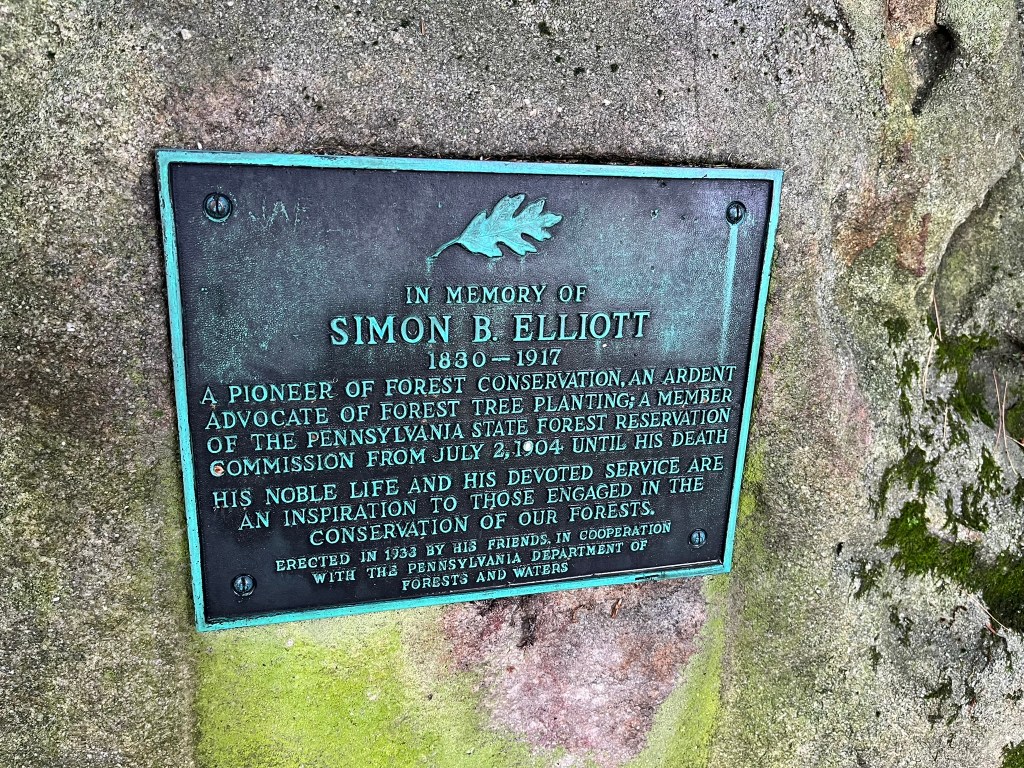
In the same year the Civilian Conservation Corps established Camp S-116-PA, 1933, the Department of Forests and Waters created S.B. Elliott State Park. A memorial plaque to Simon B. Elliott, a dedicated conservationist, was erected to commemorate the park. This heartfelt memorial is now shrouded by trees, which, I imagine, Simon B. Elliott would have liked. The CCC Lodge, outbuildings, and pavilions remain, which looked magnificently historical and mysterious.

Crown-Tipped Coral Fungus

Promptly at 1:00pm, our meeting divided into three groups. One group headed in the direction of the bog, which may be either the “Wallace Sphagnum Bog” or “Crystal Springs Bog.” I didn’t have the time on this trip, so I noted it for future exploration. Another followed Crystal Springs Road to walk up the snowmobile trails. The last group, which we followed, headed towards the wooded area between our pavilion and the old Dague Nursery. This area was composed of second-growth woodland, with lots of oak, beech, and evergreen trees. I also spotted plenty of Christmas Fern and New York Fern. Some trees had naturally fallen, but a small handful had been cut down and left to rot.

Just as we set out on our hunt, a light rain passed through our area. For a brief time, the rain cooled us off, but the humidity quickly ramped up again, and the bugs emerged. For a while, we found slugs and snails before seeing any mushrooms! I identified Western Dusky Slugs, but the snails escaped me. I was so focused on mushrooms that I forgot to take pictures of them.
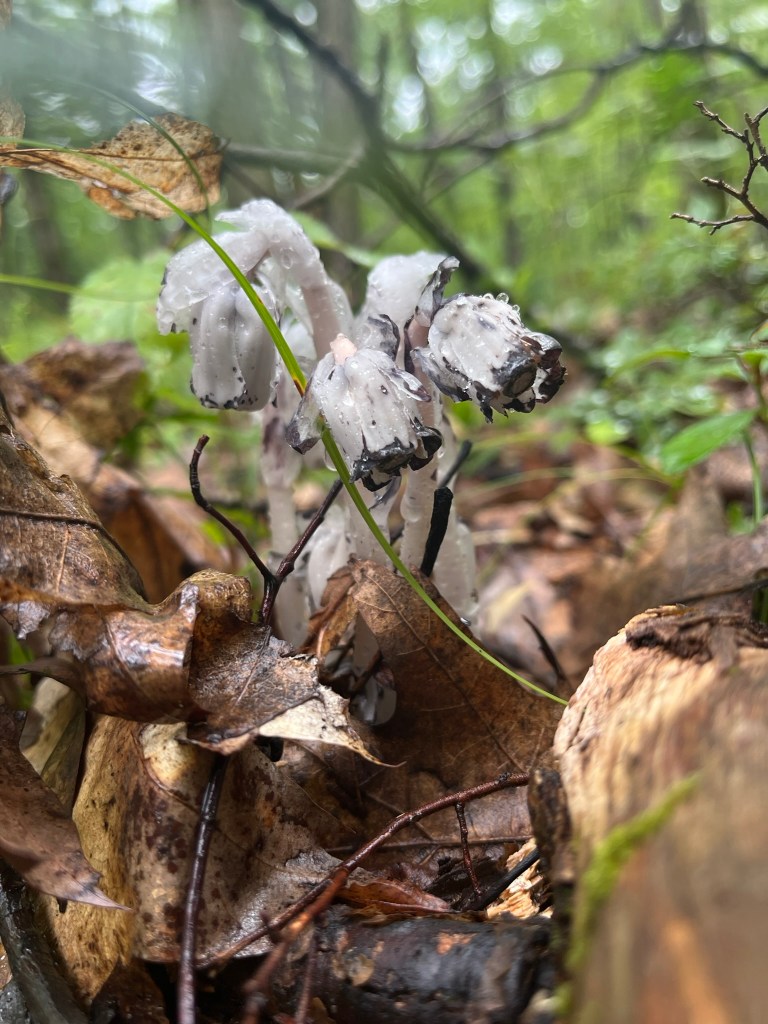
After the slugs and ferns, we spotted Monotropa uniflora, Ghost Pipes. These perennial wildflowers are found all throughout Pennsylvania. The plants are a mycoheterotroph, a parasitic flower hosted by fungi in the Russulaceae family. Ghost Pipes are known to be the favorite flower of Emily Dickinson. I hadn’t seen any in person for many years. I couldn’t take a single step without nearly crushing a bunch of Ghost Pipes!

As the humidity settled over us, we finally started spotting mushrooms. We were on the hunt for a Russula aeruginea, the Green Russula, which my sister spotted and took to our walk leader. I found some Crown-Tipped Coral Fungus sprouting in a large clump on a rotting log. I reached the point where I felt like every glance was full of mushrooms. We counted more than ten species from our small group alone. Favorites of mine were Oak Mazegill, Crowded Parchment, and Berkeley’s Polypore.

Jack-o’lantern Mushroom

Towards the end of our walk, our group stumbled upon a large growth of Omphalotus olearius, the jack-o’lantern mushroom. These poisonous mushrooms fruit at a similar time to Chantarelles, and look eerily alike. Jack-o’lantern mushrooms possess true gills, a feature Chantarelles lack. Plus, jack-o’lantern mushrooms are vivid orange, and are the same color throughout. While I know scientifically these mushrooms are poisonous enough to cause harm to human beings, I can’t imagine ever being tempted to eat them. There is a certain something in their appearance and smell that sets off my primitive instinct to leave them alone.

After we finished our walk, all the groups gathered at a pavilion to begin identifying all the mushrooms found. Quickly the plates of identified specimens filled two picnic tables, and the heady scent of fresh fungi filled the air. Club leaders walked us through the species and families one by one. One of the best parts of the club is that there is a mix of ages and experience, creating a wealth of knowledge. I love to simply listen to them discuss different specimens or trade stories.

All too soon, my family and I packed up our foraging baskets and backpacks. Tired and sweaty, we loaded in my Jeep and headed east on I-80. Mushrooms were on the mind as we discussed our plans for mushrooming in August. Soon a copy of Field Guide to Wild Mushrooms of Pennsylvania and the Mid-Atlantic will be on my doorstep, ready for more mushrooming adventures.

If you are interested in joining a local mushroom club, please check out NAMA, the North American Mycological Association. A database of mushroom clubs throughout the United States is on their website at https://namyco.org/clubs/. The schedule of events for the Central Pennsylvania Mushroom Club is on their website at https://centralpamushroom.club/events/.

Nature Journaling Sit-Spots

My break lasted longer than planned. As our wedding approached, time sped up, punctuated by frequent thunderstorms. The periodical cicadas came and went in their screaming glory. Pennsylvania has slipped into the dog days of summer, and Sirius rises high over us in the nighttime sky. The lake calls me, and I resist the urge to swim all day, every day.

When I first moved here in the summer of 2020, I worked from home each day. During my lunch breaks I would dash to the dock and slip into the water. I could take a dip at the boat launch and crawl out on the bank at the other side, undisturbed. I’ll never know if the park rangers let me have fun or chose to ignore my small-town antics.

While visiting earlier this week, the launch was quiet enough for me to sit at the end of the dock to nature journal. The sparkling summer lake was a fun challenge to capture in a pencil drawing. Beneath my feet, bluegill hovered around the dock pilings, their fins glinting gold. One snuck up to my foot to check me out, sucking in water through its nostrils to detect my scent. I drew the scene in my journal, delighted as the fish gathered near me.

Other delights found themselves in my journal. Several bass were jumping out of the water- from predation or delight, I won’t ever know. I captured the blue-fronted dancer that rested on my knee, and a green dragonfly that swept around my face. Tufts of algae floated by me, caught in the wake of a speedboat and my nature journal. After filling the page with pencil drawings, I packed my journal away to lay on the dock and watch the clouds.

Having a sit-spot, a place to sit and journal at many times over a period, is a common practice. Sit-spot recommendations include spaces that are at home, or if not, very close to home. My first sit-spot was on my porch, a safe and secluded spot where I could experiment with my journal in peace. Soon after, I started taking my journal on lunch break walks, and I developed a second sit-spot.

Bald Eagle Launch, where I was earlier this week, is my second and favorite sit-spot. I can sit anywhere on the property to journal… on the dock floating in water, under the pavilion, perched on the trail bench, or draped on the grassy hill. Every angle is beautiful, every corner of the area holds some fascinating bit of nature. Long before I kept a nature journal, I wrote in my diary here- and many, many pages of daily nature observations.

I’m not alone in having multiple sit-spots. One of my nature journal inspirations, Clare Walker Leslie, journals at several places. In her books, she shares pages from her spot at Mount Auburn Cemetery, her country home, and her city home. As she cycles through locations, the seasons pass and she captures snippets of time all over.

I know Bald Eagle Launch will remain as my most favorite sit-spot. Yet, I’m always on the hunt for a new spot- a place for me to visit every so often and witness nature throughout the seasons. The rest of this summer, I plan to attend Centred Outdoors events and journal my way through every outing. You can check out the schedule online and make a plan to join me!

A Weekend at Gifford Pinchot State Park

In April, I attended the Pennsylvania Outdoor Content Creator Meetup at Gifford Pinchot State Park. This event was organized by Christian from the Hemlocks to Hellbenders podcast and sponsored by Explore York PA. The drive, while long, was easy. I listened to The Ghost Furnace Podcast and The American Birding Podcast. A little after 1 o’clock, I rolled up to the camping cottage to unload my stuff.

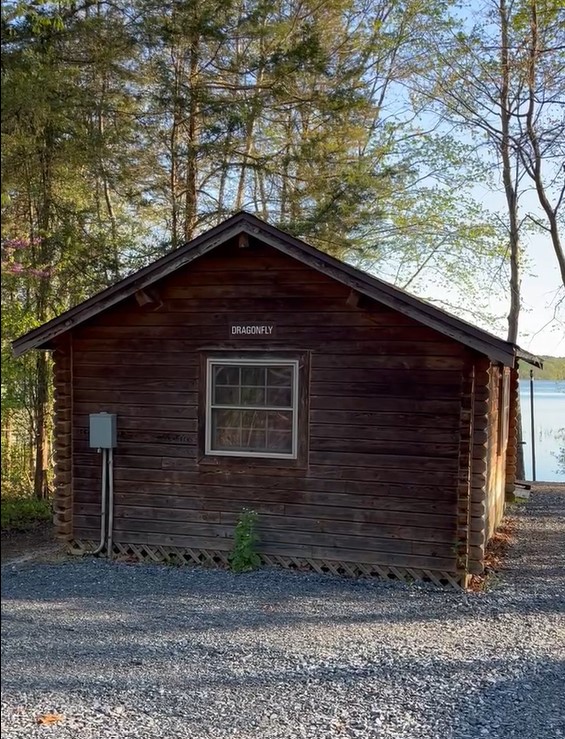
Dragonfly Cottage is at the back of the campground on the shore of the lake. As I hopped out of my car, a Bald Eagle took off from a snag across the water. Spotting the eagle felt like a good omen for the weekend. In a flash, I unloaded my bags and set up my bunk. I was set to share with Sara from Hiking Outdoor Family, Britt from Britt Around Town, and Michele from Adventures Abound.

A little later, I headed over to the Conewago Day Use area to meet everyone. I explored the area around our pavilion, finding lots of spring ephemerals. My favorites in this area were Virginia Springbeauty and Azure Bluets. Moss and lichens covered the diabase rocks scattering the area. Introductions were made, and before dinner we went on a hike along Lakeside Trail. Dinner was had, and then we loaded up to visit the vernal pools of Gifford Pinchot.

As Park Educator Beth spoke about vernal pools, I resisted the urge to dip my hands in the dark water. I wanted to hold tadpoles in my hands like a little girl. After she finished speaking, Beth let us explore the pool. I checked out the two citizen science projects there. On the far end is a CrowdHydrology station, and the near end a Chronolog station.

After we finished exploring, I headed back to our cabin to head to bed. I fell asleep fast – as I drifted off, I could hear the night calls of birds and a light patter of rain on the cottage roof.  

The following morning started with a shower and coffee. One of the creators, oneeyewanderz/itravel4coffee, brought an espresso machine. Yes, you read that right- an ENTIRE, ACTUAL espresso machine. He made me a latte, which energized me for our hike to Boulder Point.

Boulder Point is a unique geological feature at the park. It’s a “balanced rock” created by spheroidal weathering and repeated freeze-thaw cycles. About 200 million years ago, molten rock shot through Triassic-aged materials. Thousands of years of erosion revealed the diabase rocks. Keeping age in mind, these rocks may be a periglacial feature. 75 thousand years ago, a huge part of Pennsylvania lie under a glacier. The proximity to permafrost and dramatic freeze-thaw cycles would have accelerated erosion… leaving behind the rocks we see today.

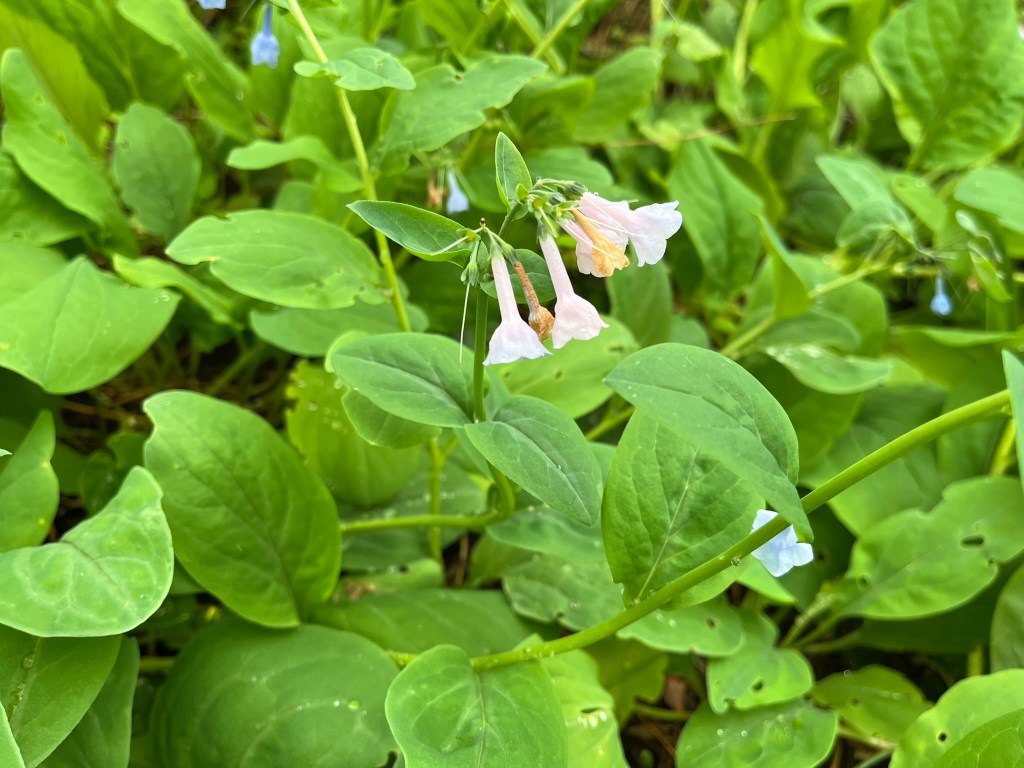
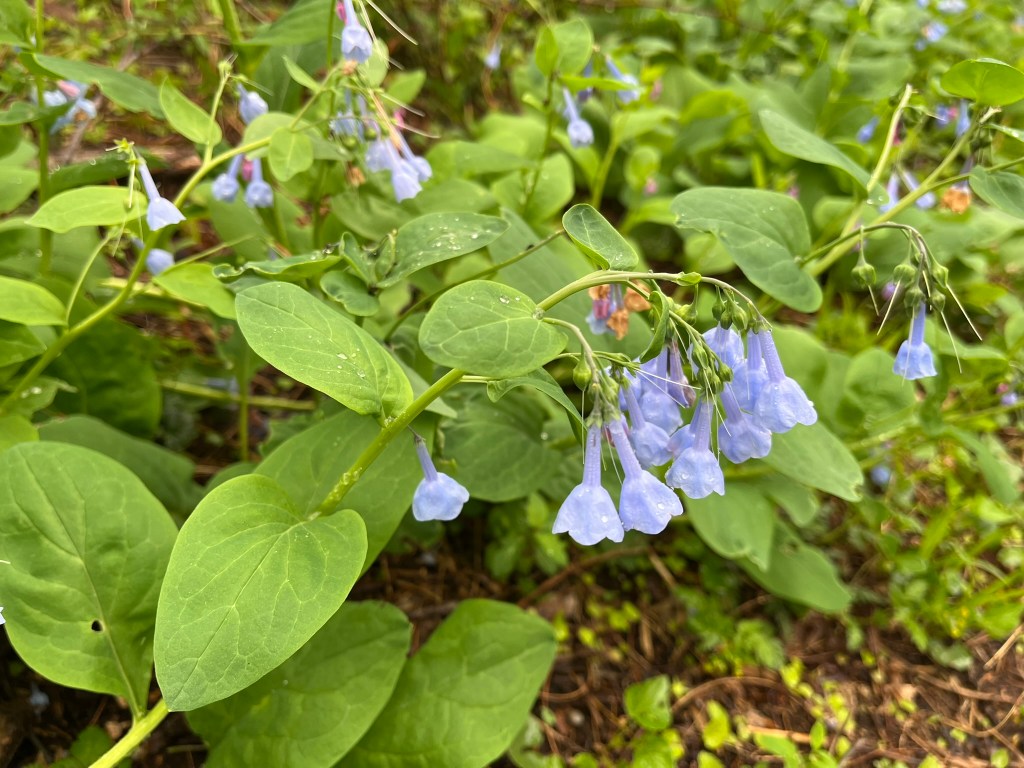
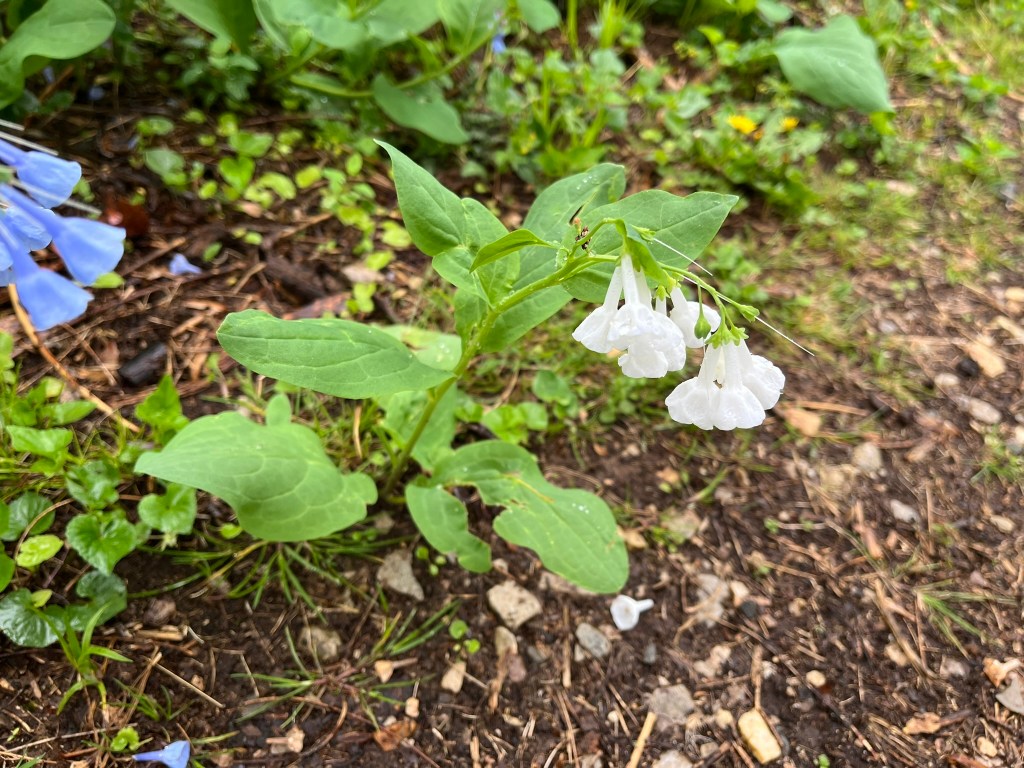
While hiking, the huge variety of spring ephemerals growing at the park delighted me. I saw many species, including: Jack-in-the-Pulpit, trilliums, Wild Geranium, and Wild Pinks. Virginia Bluebells grew in masses- some of the plots also had pink and white varieties. White bluebells are rare, and carry the scientific name Mertensia virginica forma berdii. I saw many clumps of white bluebells, again feeling it was a good omen.

Back at the pavilion, we lunched and enjoyed a variety of interesting talks and programs. Our highlight was DCNR Secretary Cindy Adams Dunn. She stopped to visit with us on her way to check on the forest fires in Michaux State Forest. Her words filled me with inspiration, and I thought about them often throughout the rest of the day.

During a break, I needed to rest and dry my feet. I attempted to take a brief nap, but instead relaxed at the picnic table at Dragonfly Cottage. With my polarized sunglasses, I watched bluegill and bass dart in the water close to shore. Further off, a Green Heron stalked the shallows. The air was full of the calls of Red-bellied Woodpeckers and Red-winged Blackbirds. My heart and soul felt restored while enjoying the peace around me.

Later after dinner, we met Dr. Reigner from the Office of Outdoor Recreation and Executive Director Blischke from the Pennsylvania Council on the Arts. Their session was a facilitated discussion, and I learned a lot from the others in our group. Compared to everyone else, I’m a “baby” creator. The mentorship I was receiving from this session alone… priceless.

The following morning, we packed up and carried on in own ways- and I decided to go birding. At Boat Mooring Area #1, I picked up new lifers: Northern Parula and Yellow-rumped Warbler. On the drive between areas, I saw a Brown Thrasher in a bush! At the Quaker Race Day Use Area, I watched a Cooper’s Hawk get mobbed by a huge flock of crows.

I continued on to the Dam Overlook, hoping to spot more wilderness and forest species. I only saw and heard Tree Swallows. A tall chain-link fence separated visitors from the actual dam area. The fencing eliminated the chance for a scenic overlook. I understand safety concerns, yet it felt out-of-place. Disappointed, I left as a group of peppy flyfishermen started their hike down to the water.

Once I finished birding, I set off for home. I listened to more podcasts- my favorite one from was a Ghost Furnace episode on a sasquatch sighting. I also re-listened to Think Outside with the Pennsylvania Parks & Forests Foundation. I made an impromptu stop at another park, which I’ll share about soon. I stopped at Red Rabbit for lunch, turned off the GPS, and cruised home to my cat, fiancé, and hot shower.

I recommend visiting Gifford Pinchot State Park. There’s a little bit of everything for everyone. With plenty of water, you can kayak, canoe, and fish to your heart’s content. A variety of hiking trails will entertain any level of hiker. Be sure, though, to pack a padded sleeping bag- the camping cottage bunks are unforgiving!

Have you visited Gifford Pinchot State Park before?

Picnicking at Penn-Roosevelt State Park

The turn off Old Rt. 322 onto Crowfield Road is innocuous. The road passes under the bridges and takes a sharp left, headed towards a small cleft in the valley. Cruising in my Jeep Patriot that day, the abrupt change from pavement to gravel woke my partner up from his nap. The 6-mile road up valley was a beautiful drive- one I had never seen before.

Up the mountain we climbed, passing many tidy hunting camps. The road reminded me of the way to my great-grandfather’s hunting camp. I mused on childhood memories while driving, and partner fell back asleep. Far too soon, we reached the rear entrance of Penn-Roosevelt State Park.

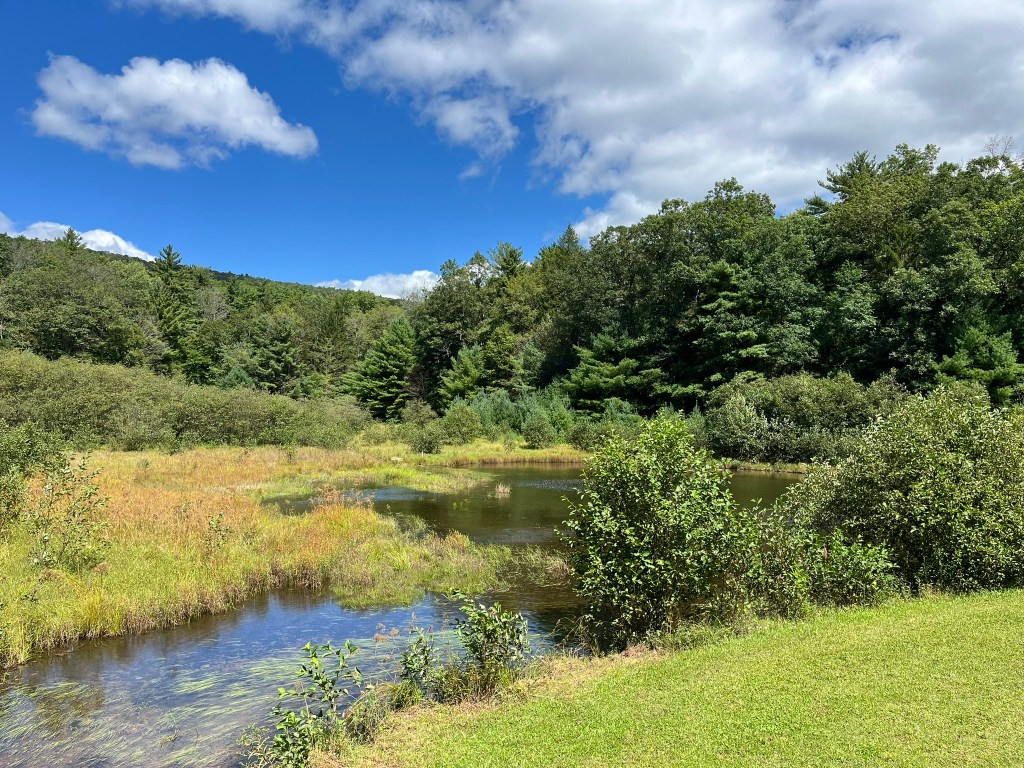
From behind, there are only signs to signal the entrance to the Park. The road splits off in two directions: a hard left turn over a bridge, or a gentler right turn downhill. First, we took the right-hand road, passing by the impoundment lake, picnic area, and CCC ruins. I turned around in a pull-off and headed back up to explore the other side- the tenting area.

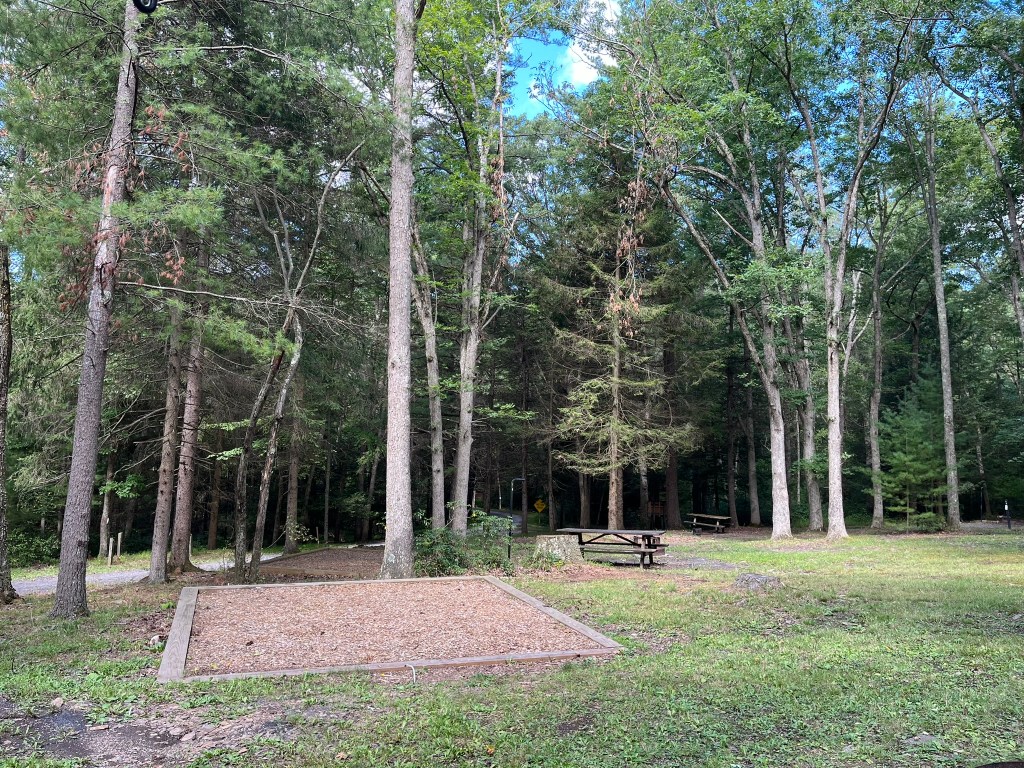
We decided to picnic in the tenting area, as it was close to the vault toilets and a bearproof trash can. A few families were camping- the Park felt empty in comparison to Bald Eagle State Park. Yet, there was a subtle bustle and we had our meal and played card games in the quiet of the woods.

After a while, we hiked over to the impoundment lake, the largest remnant of the CCC camp which was here in the 1930s. S-62-PA, otherwise known as “Stone Creek Kettle” or “Penn-Roosevelt,” was 1 of 12 Black CCC camps in PA. Despite legislation calling for integrated facilities, CCC camps were segregated. Many, like Penn-Roosevelt, were purposefully placed in remote areas.

When the CCC workers arrived, there were no improvements. They had to build their lodgings themselves, camping in old Army tents. Throughout the CCC era, the men helped fight forest fires and aid in rescue during floods. Their work made a lasting impact on the area; some of the facilities they built are standing today.

The facilities here are simple, but beautiful. The impoundment lake has started to silt in, with the forest taking over. In the 1960s, the DCNR covered the original dam and created the small side spillway visible today. The restored hearth of the original recreation building is close by the day-use area. Other ruins were nearby, but we didn’t have the chance to explore them.

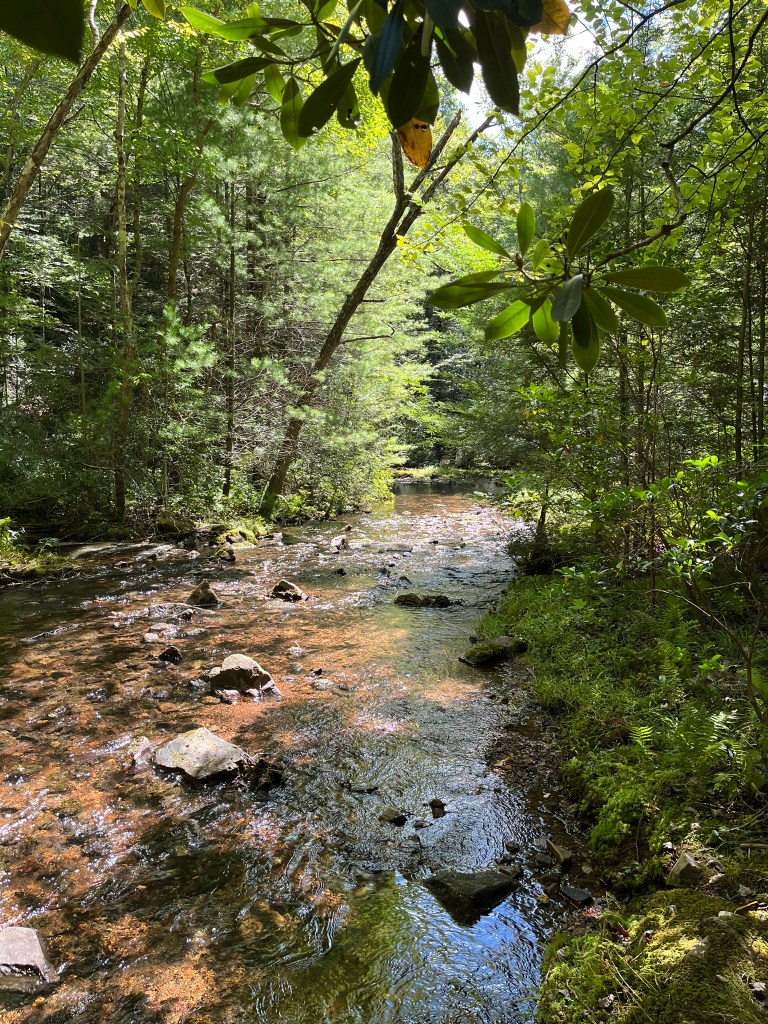
While ambling through the Park, I thought a lot about the geomorphology of the area. Stone Creek Kettle is not an actual kettle; a type of depression formed at the edge of glaciers. After some research, I couldn’t find any explanation for the name. DCNR recommended to contact Mr. Fagley, retired Greenwood Furnace State Park educator. He shared with me that in early America, folk considered any bowl-like feature a kettle. Mr. Fagley also mentioned in his e-mail that “neither the First nor Second Geological surveys of PA, both conducted in the 19th century, don’t mention the “Stone Creek Kettle” by this name, though do briefly mention the area and noted its geologic structure.”

After hiking around, we packed up for the day and headed back out Crowfield Road. Six miles later, we were on Old Rt. 322, headed for home. I wondered what the men of S-62 would have thought about the changes… what may have taken them hours or days to hike into the woods cost us an hour and a few dollars in gas.

Works Cited

DCNR. (2018, February 21). Recognizing the Conservation Work of Black CCC Companies in PA. Good Natured; Pennsylvania Department of Conservation and Natural Resources. https://www.dcnr.pa.gov/GoodNatured/pages/Article.aspx?post=33

DCNR. (2019). Penn-Roosevelt State Park. Pennsylvania Department of Conservation & Natural Resources. https://www.dcnr.pa.gov/StateParks/FindAPark/Penn-RooseveltStatePark/Pages/default.aspx

Fagley, P. (2024, September 11). Stone Creek Kettle Question [E-Mail to Autumn Dannay].

McNeil, A. (2022). Moving Forward Initiative: The African American Experience in the Civilian Conservation Corps. The Corps Network. https://corpsnetwork.org/moving-forward-initiative-the-african-american-experience-in-the-civilian-conservation-corps/#:~:text=To%20reduce%20community%20outcry%2C%20many

Pennsylvania CCC Online Archive. (n.d.). Camp Information for S-62-PA. Pennsylvania CCC Online Archive. Retrieved September 20, 2024, from https://www.iframeapps.dcnr.state.pa.us/stateparks/ccc/Camp.aspx?ID=88

Summer Osprey Sightings

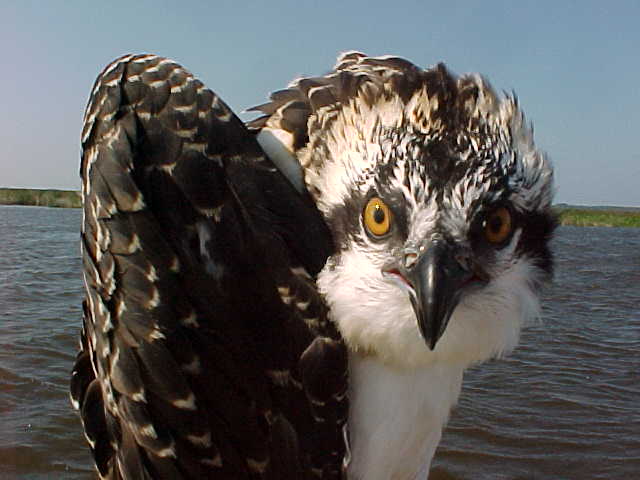
Photo of the Week – Osprey at Back Bay National Wildlife Refuge (VA)” by U. S. Fish and Wildlife Service – Northeast Region is marked with Public Domain Mark 1.0.

Near the intersection of Rt. 26 and Rt. 150, the Bald Eagle Overlook faces out over Foster Joseph Sayers Lake. Here, I watched a pair of Osprey dominate the northern bank of the lake all summer.

Considering the nearby Bald Eagle State Park, watching Osprey feels traitorous. I see at least one Bald Eagle per day while on my lunch walks- this is a gift I will never take for granted. Yet every time I spot an Osprey, I become transfixed, waiting for their yellow glare to pass over me.

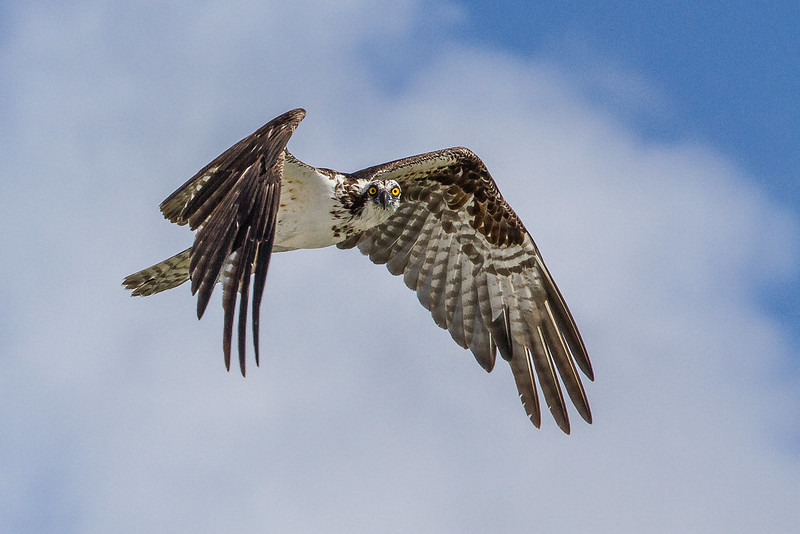
The thing I like most about Osprey is their look; always torn between bewildered or cool. At the right angle, with ruffled feathers and wide eyes, Osprey have the same visage of a mad scientist. In flight, Osprey are every inch a predator with their long wings spread over the skies.

I usually find the osprey pair situated in a snag between Bald Eagle Overlook and the Rt. 26 causeway. Before the Osprey, this area had a fluctuating cast of characters. A normal day for me would be to spot Bald Eagles next to crows, next to starlings or even mourning doves. Aside from Double Crested Cormorants, no other birds appear here with any regularity.  

Ospreys prefer areas close to open water, with no overhead forest canopy. Perching on snags gives the birds a long view up and down the lake. Fish are their preferred prey and will live-catch every meal. Rarely did I ever see another species in the snags while the Osprey were nearby. Even the Cormorants would stay quiet while the Osprey glided by.

As I kept an eye on the Osprey all summer, gears turned in my mind. Osprey nest in Pennsylvania from March to August, with nests as close as Clinton County. Nests occur up to 1600ft away from open water. Additionally, nests are large, made of sticks and twigs. In Pennsylvania, many nests are on man-made structures, like buildings and telephone poles.

Osprey in Flight” by Andy Morffew is licensed under CC BY 2.0.

Knowing this, I started looking for a nest. My search was in vain- I never saw a single stick. Bald Eagle State Park rangers searched the whole park for a sign, and never had anything to report. The Rangers told me that age and inexperience may prevented the Osprey from nesting.

Despite our searching, Osprey nests can be difficult to find. This difficulty has led to many states enacting nest surveys. The Pennsylvania Game Commission enacted the Osprey Nest Survey program in the 1980s. The program relies on volunteers to follow a protocol and report to the Commission via email. The Commission uses the reports to update the Pennsylvania Natural Heritage Program databases.

In addition to nest surveys, some organizations build and erect nesting platforms. These platforms encourage Osprey to nest away from infrastructure and in safer areas. Many platforms are also equipped with cameras, which livestream nest activities.

Now that Fall has arrived, the Osprey have moved on to their wintering grounds in South America. I doubt I will see another Osprey until they decide to return to Bald Eagle State Park. I hope the excellent habitat draws them to return and nest in an accessible area!

Works Cited

Hawk Mountain Sanctuary. Osprey. Hawk Mountain Sanctuary, 2014, www.hawkmountain.org/raptors/osprey. Accessed 13 Sept. 2024.

Morffew, Andy. “Osprey in Flight.” Flickr, Digital Photograph, 4 Dec. 2012, www.flickr.com/photos/66020093@N03/8244633979. Accessed 4 Dec. 2024.

Pennsylvania Game Commission. Osprey Nest Survey. Pennsylvania Game Commission, 2019, www.pgc.pa.gov/InformationResources/GetInvolved/Pages/OspreyNestSurvey.aspx. Accessed 13 Sept. 2024.

—. “Osprey Species Profile.” Osprey Species Profile, Pennsylvania Game Commission, www.pgc.pa.gov/Wildlife/EndangeredandThreatened/pages/osprey.aspx. Accessed 13 Sept. 2024.

United States Fish and Wildlife Service. “Photo of the Week – Osprey at Back Bay National Wildlife Refuge (VA).” Flickr, Digital Photograph, 14 Apr. 2010, www.flickr.com/photos/43322816@N08/4520680333. Accessed 13 Sept. 2024.