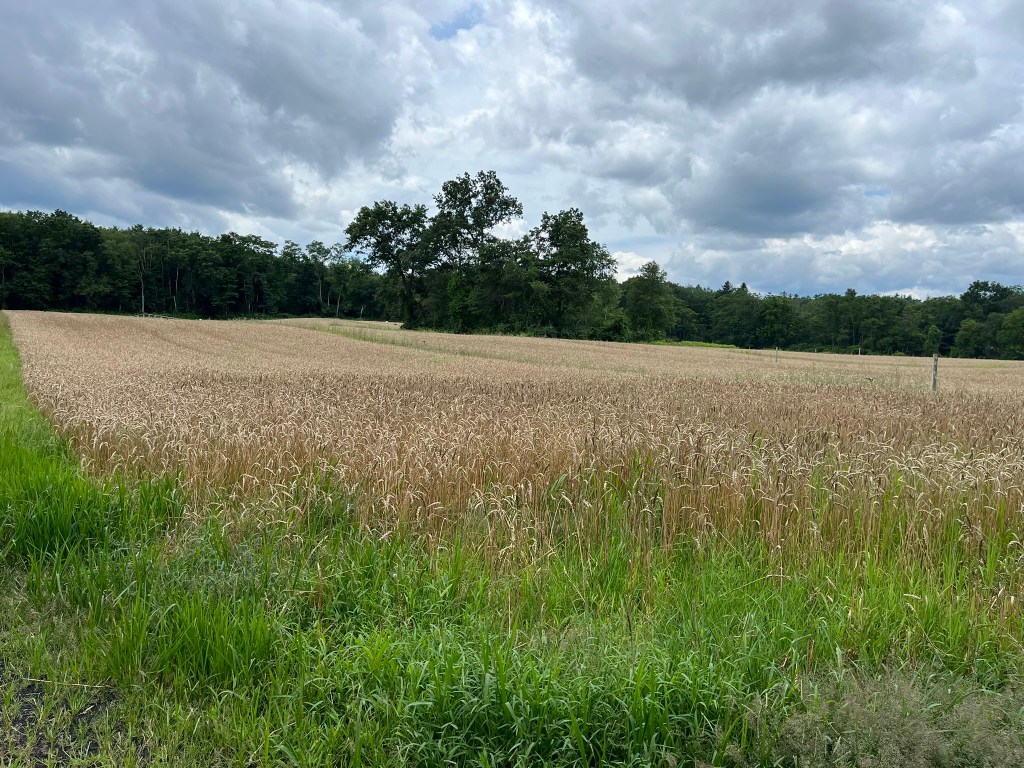
Late Summer at Shaver’s Creek

During the last weekend of August, two of my sisters and I took a trip to Shaver’s Creek Environmental Center to explore. On Saturday morning, we hustled down the road, first stopping at The Naked Egg Café for brunch. About an hour before the Penn State football game kicked off, we were parked and walking into Shaver’s Creek. We were practically alone- it felt like everyone in the Centre Region was at the game!

Established in 1976, Shaver’s Creek Environmental Center is now an integral branch of Penn State Outreach. Shaver’s Creek is more than a “typical” environmental or nature center- in addition to hosting many programs for the public and Penn State students, the Center participates in a number of research projects ranging from citizen science to Appalachian Botany and Ethnobotany. My favorite Shaver’s Creek program is Community Nature Journaling, which has inspired me on my own nature journaling journey.
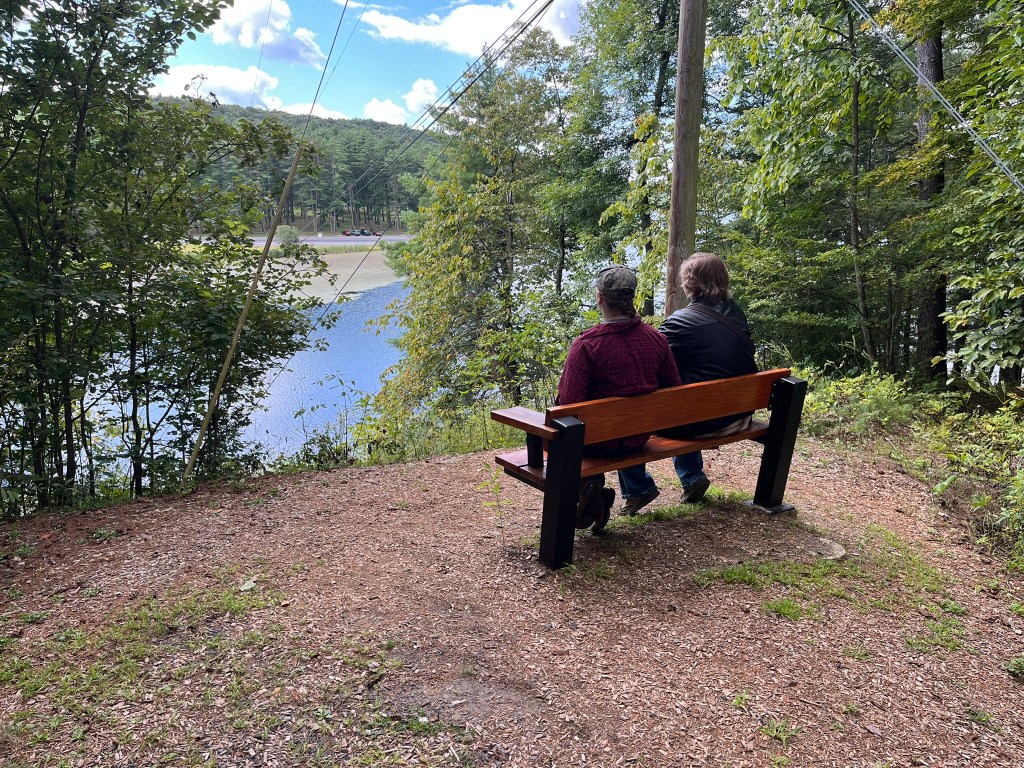
I was first introduced to Shaver’s Creek when taking my Pennsylvania Master Naturalist training classes in 2024. At the time, our classes were after-hours, and I could only explore small portions of the 7,000+ acres of it and Stone Valley Recreation Area. I have been back many times since exploring or attending programs hosted on its grounds. One of my favorite ways is to visit with family- there is something for everyone at Shaver’s Creek.

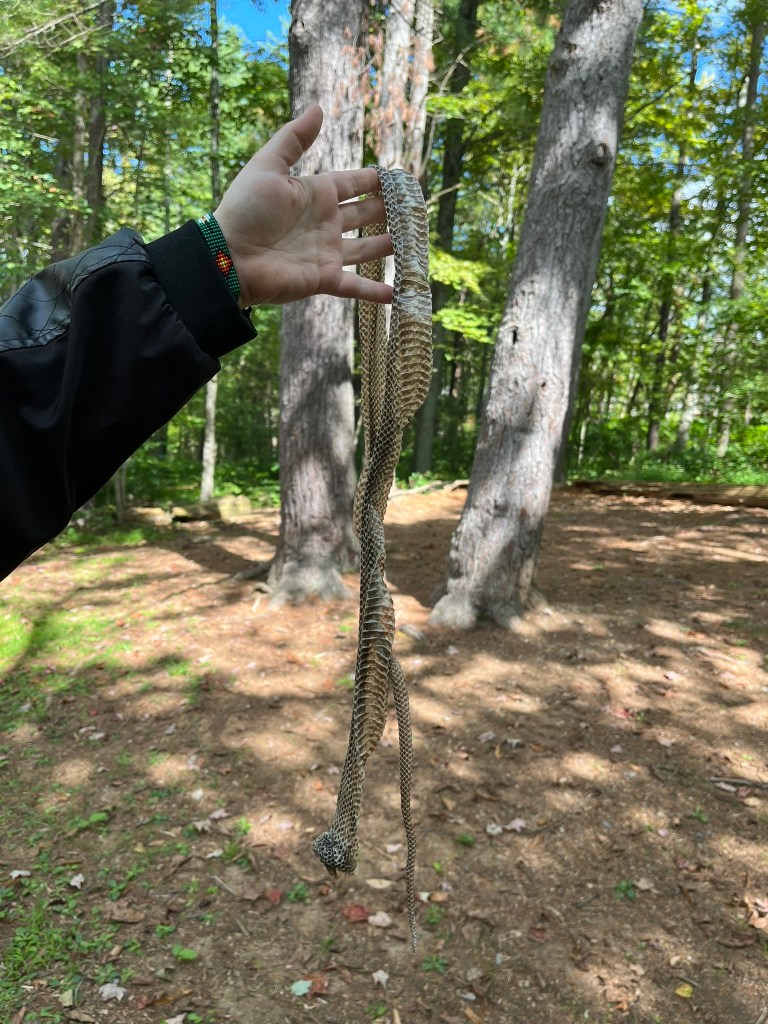
This Saturday, I wanted to share my favorite trail with my sisters. Together, we walked down the Point Trail to Sunset Point Pavilion. We were slow hikers, stopping many times to look at insects, lichen, or flowers. One of my sisters noticed a blacksnake shed- totally in one piece and very fresh. We put it back where she found it, so others could see the shed, too. Besides, if we wanted to find and keep a shed, I’m certain there’s one at home, from the blacksnake living in my garage!
We hung out at Sunset Point Pavilion for a long time, watching a flock of Canada Geese and some kayakers out on Lake Perez. The lake is the key feature of the Stone Valley Recreation Area, and Shaver’s Creek is deeply connected to it. Lake Perez is one of the locations of the Long-Term Ecological Reflections Project, and has experienced massive change over the last 20 years. For some time, the lake was drained, then eventually refilled. Now, Lake Perez is open to fishing and human-powered boating.

While hiking, we stumbled upon a geocache. It was my youngest sister’s first geocache- and my 41st find. It was a little tough to log the cache while out hiking- there is poor cell reception in the area, and only WiFi at the Center. For me, this is another reason why Shaver’s Creek is so wonderful- it’s the perfect place to go for an unplugged day outdoors.

After hiking around, we made a stop at Klingsberg Aviary. This is, by far and large, my favorite part of Shaver’s Creek. Four long buildings, mews, are home to a host of birds that now live in the care of devoted staff. For one reason or another, these birds have found themselves unable to return to life in the wild, and now they serve as avian ambassadors to the public. While Shaver’s Creek is home to a Red-Tailed Hawk, my favorite bird in residence is Jane the Sandhill Crane.

Unfortunately for us (well, me), Jane was not out-and-about in her mew during our visit. Currently, the Aviary is under renovation, and I can imagine it disturbs the birds quite a bit. While we were quietly observing the birds, Rosalie the Bald Eagle was out and surveying us with a sharp eye. As we were visiting her, she let out one of the signature Bald Eagle screeching laughs. Feeling oddly chastised by the bird, we tip-toed out of the Aviary and on to our next destination.

Our last stop at Shaver’s Creek was the Boardwalk. Neither of my sisters had been on the Boardwalk before, which perches over a leg of Lake Perez. While hiking, we found some White Turtlehead, an unusual late summer wildflower. We did a little more birdwatching and checked around for another geocache. Too quickly, it was time for us to head out for the day. As we hiked back to the Jeep, we started making plans for a return trip to Shaver’s Creek later in the Fall to search for geocaches.

If you are interested in visiting Shaver’s Creek Environmental Center, I highly recommend you go. The Center is open daily, from 10:00am to 5:00pm. You will need to be a little prepared before you visit- Shaver’s Creek is working on becoming a zero-waste facility, so you will need to recycle on-site or pack out your trash. Dogs are not permitted in the Aviary but may be at Shaver’s Creek or Stone Valley Recreation Area if they are on a 6-foot leash. Don’t forget lots of water and a trail map!

Have you visited Shaver’s Creek before?

Walking the Lower Trail

I participated in this event as part of my commitment to Centred Outdoor’s Outdoor Leadership Cohort. I recommend participating in their events throughout the Summer and Fall seasons. You can check out their schedule on their website. Please consider supporting Centred Outdoors and Clearwater Conservancy today.

Sunday dawned bright and happy, perfect for a mini-road trip to Williamsburg. Our plan was to take the scenic route to meet up with Centred Outdoors at the Lower Trail. For 17 miles, this rail-to-trail connects Canoe Creek State Park with Alexandria, PA. Centred Outdoors guided us for a 1.5-mile walk, where we explored the nature and history of this old railway.

Beebalm or Bergamot, Genus Monarda

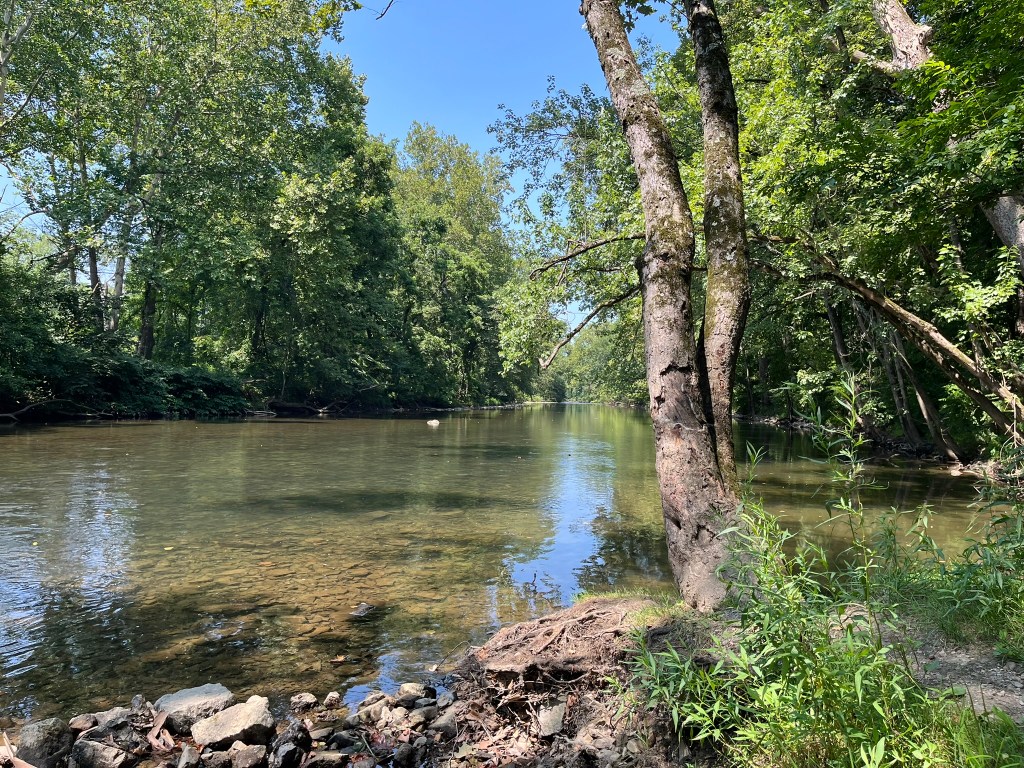
Long before colonists settled the Pennsylvania frontier, indigenous people travelled Morrisons Cove, an ancient eroded anticlinal valley. This path followed the Frankstown Branch of the Juniata River and has experienced many transformations since the colonization of Pennsylvania. In the canal era, the path of the Lower Trail was the towpath for the Pennsylvania Main Line Canal. This canal led to the Allegheny Portage Railroad, which traversed the Allegheny Front.

As the industrial revolution swept across America, the canal towpath was purchased by the Pennsylvania Railroad and converted into the Petersburg Branch. This branch line connected Altoona with Petersburg on the way to Mifflin County. Petersburg Branch barely survived the merger of the Pennsylvania Railroad and New York Central companies to create Penn Central Transportation Company. The corridor of line that makes up the Lower Trail was abandoned in 1979, scrapped out, and put up for sale.

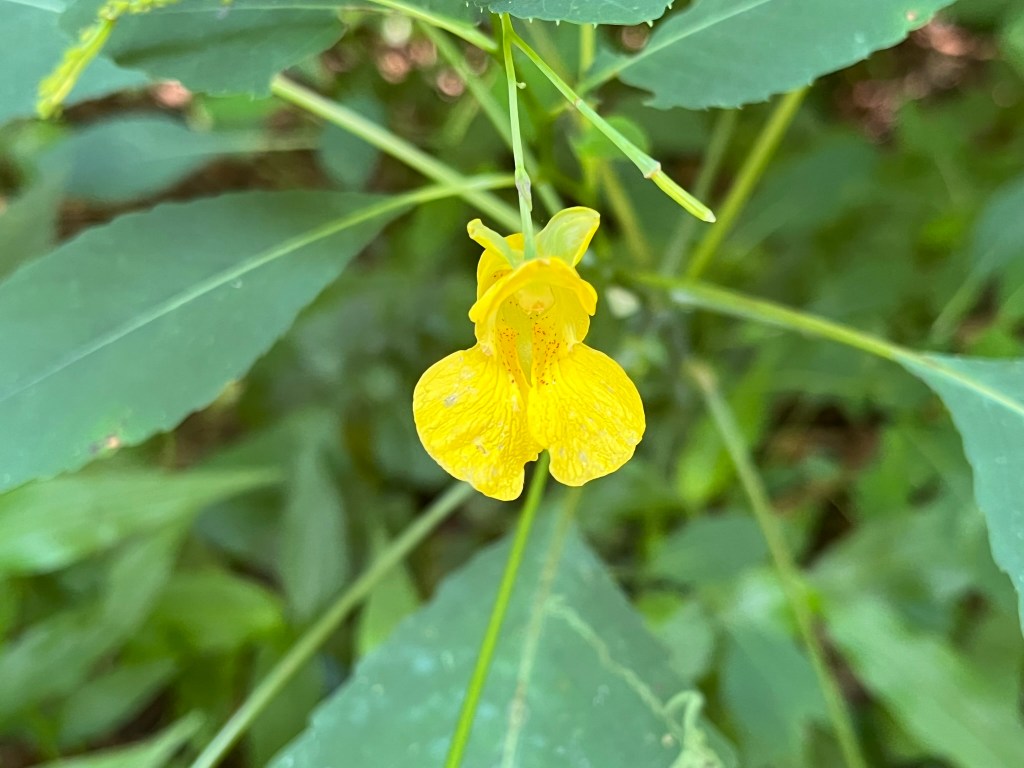
Pale Jewelweed, Impatiens pallida

1989 marks the beginning of the current chapter of the Lower Trail. Rails To Trails of Central Pennsylvania, Inc. purchased the first 11 miles of rail corridor, which stretched from Williamsburg to Alexandria. In 2004, another 5.5 miles was added, forming the trail as we know it today.  Rails to Trails of Central Pennsylvania has additional projects, including the Bells Gap Trail, and an extension of the Lower Trail which will connect to Hollidaysburg.

 On this Sunday, Centred Outdoors met us at Williamsburg Station. This spot was once an actual railway station, the perfect spot to hop on the trail and start walking. A big pavilion near the trail has picnic tables and a bike repair station, where trail users can make minor repairs on their bicycles. The trail near Williamsburg Station is paved and has wide grassy shoulders on either side, perfect for walkers to step to the side when bikers whizz by.

Olivia served as our guide for the day, stopping periodically to point out interesting historical and natural facts about the Lower Trail. She noted lots of tree and shrub species, drawing our attention to some replanting efforts made along the waterside. As a group, we admired the towering American Sycamores holding up the bank of the Frankstown Branch. Opposite the river, the bank was coated in Pale Jewelweed, a Pennsylvania native wildflower. We took turns touching the ripe fruit of the jewelweed, which shivered and exploded to the touch.

Meandering back from our turning point, our group took in the sights and sounds of the Frankstown Branch flowing below us. One of our stops was at canal ruins, the location of the keeper’s home and canal lock. Only the foundation and some rubble remain, but we climbed around, taking plenty of pictures. Carefully we navigated the shrubbery past the grassy path shoulders, taking care to avoid brushing up against poison ivy or tree of heaven.

All too soon, our walk was finished for the day. Fortunately, the Lower Trail Creamery was open. Just a few bucks later, I had a hot fudge sundae, and my husband had a milkshake. We enjoyed our snacks and watching bicyclists on the trail. We spotted all kinds of bikes- mountain, racing, and recumbent. It felt like all of Blair County was out on the trail, speeding along on two wheels.

If you are interested in visiting the Lower Trail, I highly recommend starting your trip at Williamsburg Station. With the trail paved for some distance in both directions, it makes for easy and shady walking. If you wear good bug spray and give bicyclists right-of-way, you will have a relaxed hike. Choose to have a snack at the Creamery before you go, and you’ll find yourself having a perfect Central Pennsylvania summer day.

Exploring Bilger’s Rocks

I participated in this event as part of my commitment to Centred Outdoor’s Outdoor Leadership Cohort. I recommend participating in their events throughout the Summer and Fall seasons. You can check out their schedule on their website. Please consider supporting Centred Outdoors and Clearwater Conservancy today.

On the last Saturday in July, I loaded up the Jeep and headed up the mountain to Bilger’s Rock in Clearfield County. My Mom and sister were tagging along to enjoy a picnic and explore the outcrop with Centred Outdoors. According to some of my Clearfield County friends, visiting Bilger’s Rock is a local rite of passage. For me, living just over an hour away, I hadn’t had an opportunity to visit the rock city.

The night before, I checked my trusty 1990 copy of Roadside Geology of Pennsylvania for any information it could provide to geologically prepare myself for the visit. The entry for Bilger’s Rock was brief- “This rock city developed in highly cross-bedded sandstones of the Pottsville group. The sandstone is a single bed 20-25 ft. thick, broken along widely separated joints” (Van Diver, 1990).

I also read about Bilger’s Rock in Pennsylvania Caves & Other Rocky Roadside Wonders. The author, Kevin Patrick, had much more to say, covering a rough outline of the development of Bilger’s Rock. Initially deposited at least 300 million years ago, the outcrop was eventually exposed to the elements. The large “streets” are from frost wedging, specifically from a periglacial climate which has long since passed.

In more recent human history, the property on which Bilger’s Rock is located was once owned by homesteader Jacob Bilger. The acreage was later purchased in a sheriff sale by a company that quarried and mined in Clearfield County. Miraculously, Bilger’s Rock was left alone and became a local tourist spot, its popularity waning until the 1980s, when it was purchased by the Bilger’s Rock Association and lovingly transformed into a park.  

After our arrival and family picnic, our guide led us down a gravel path, descending from the top of the rocks into the city below. We passed by the Rock House; a facsimile of the shelter Roland Welker made in Alone season 7. Despite its small appearance, the Rock House was large inside… no wonder he became the 100 Day King!

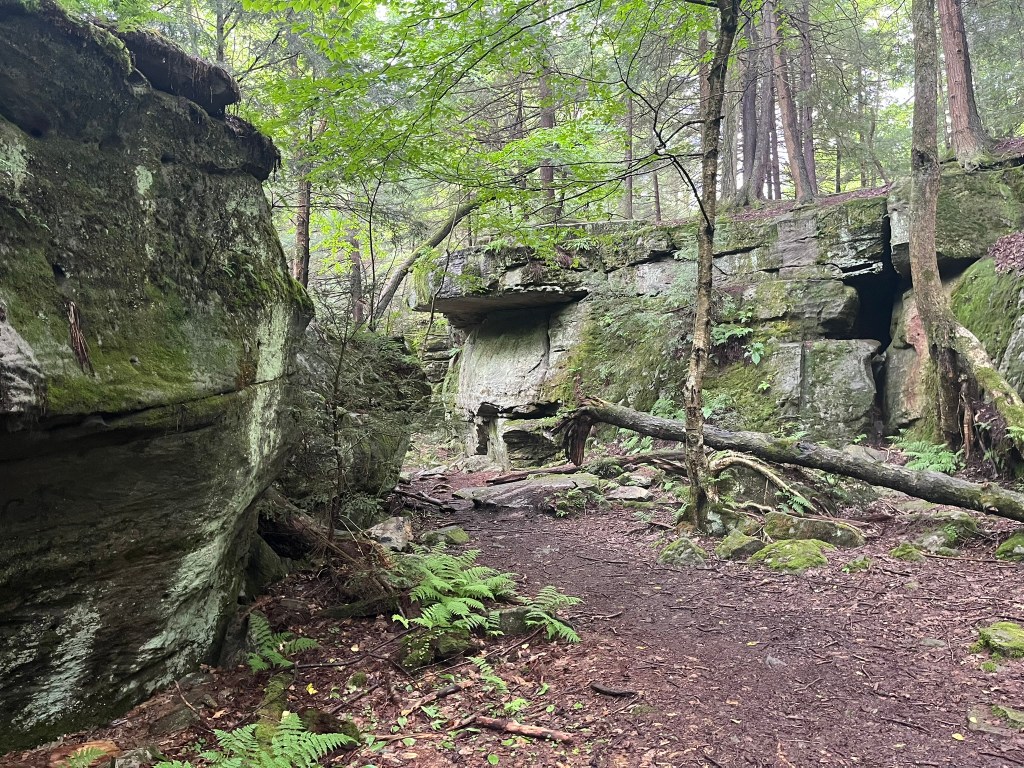
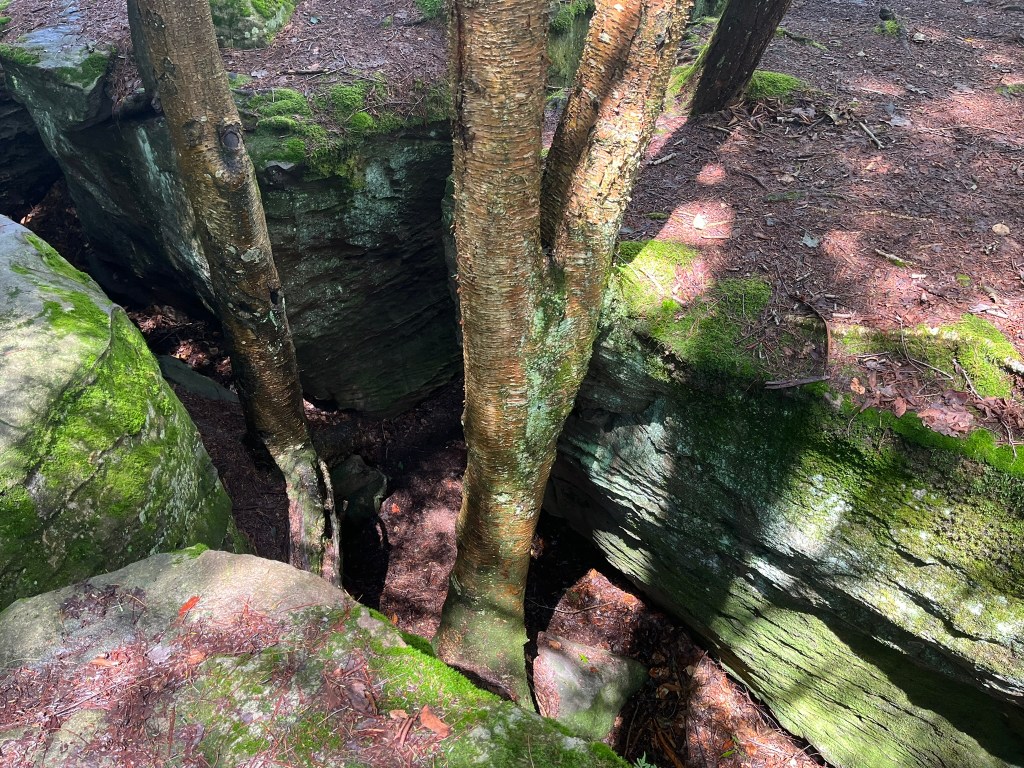
When the rocks came into view, I was speechless. Bilger’s Rock has a presence– something that words and pictures can’t capture. The 25-foot-tall walls towered over our heads, dark and glossy with a recent rain. Mosses and ferns draped over the rocks and trees sprouted in nooks too small for children. Our guide presented us with different opportunities to traverse the rocks, either ducking down to crawl under passes, or climbing up and over to the next spot.

Time didn’t feel real while we were exploring Bilger’s Rock. The hour and a half we had with our guide zipped by. During that time, we explored the Devil’s Dining Room as a large group and broke off into smaller pairs to slip into the Devil’s Kitchen or Ice Cave. Eventually, we emerged at the “entrance” to Bilger’s Rock, the site of a large carving.

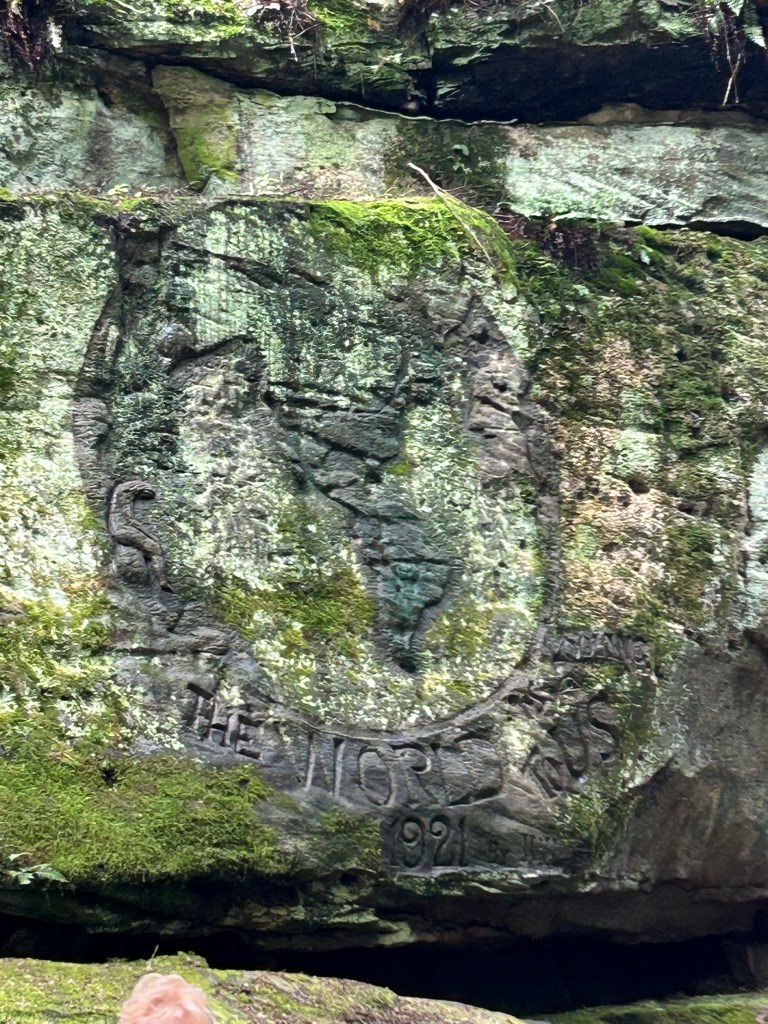
The rock art, “The World is Looking to Us” was completed by John W. Larson in 1921. Thought to be inspired by the U.S.’s role in World War I, it is now over 100 years old and showing signs of age. We took our time to look at the carving, and I thought about how even now, the world is looking to us… people that love the Earth and care for each other. In the moment, I felt very fortunate to be surrounded by a group of people that felt equally as curious and delighted by nature as me. For the remaining walk back to the top of the rocks, I dwelled on how I could help others feel the same.

Meeting the rest of the group at the top of the rock city, we carefully walked around the cracks and joints, exploring its mossy roof. I now thought about the ancient seas that deposited the original sediments. At the time, a jungle of spectacular plants dominated the land above, and new, bony fish swam in the seas below. Pennsylvania was covered by shallow seas which rose and receded to create Bilger’s Rock… and the plethora of coal beds which were mined as Jacob Bilger bought the property in the 19th century.

Once our guided tour was over, our group gathered for the weekly Sock Sunday giveaway- which my sister won! With her prize in hand, and my gear safely stowed, we loaded back up in the Jeep for the long ride home. While we were a little muddy from clambering on the rocks, we were energized by our time in the cool microclimate down inside. All the way home we talked about the different little things we noticed… and made plans for returning with our full family sometime in the future.

Mushrooming at S.B. Elliott State Park

On the last Saturday in July, my family and I attended a Central Pennsylvania Mushroom Club meeting at S.B. Elliott State Park. Throughout the Spring, Summer, and Fall months, CPMC meets at various locations throughout Central Pennsylvania to hunt, talk, and teach about mushrooms. This meeting was my first time visiting S.B. Elliott State Park and hunting for mushrooms in July!

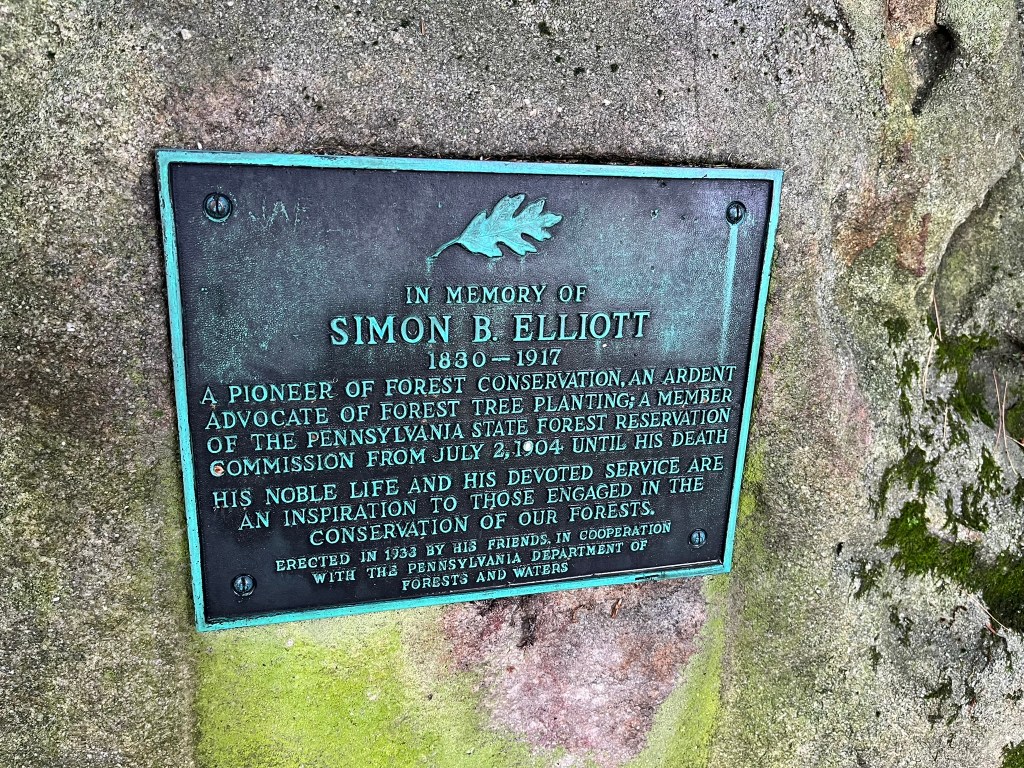
In the same year the Civilian Conservation Corps established Camp S-116-PA, 1933, the Department of Forests and Waters created S.B. Elliott State Park. A memorial plaque to Simon B. Elliott, a dedicated conservationist, was erected to commemorate the park. This heartfelt memorial is now shrouded by trees, which, I imagine, Simon B. Elliott would have liked. The CCC Lodge, outbuildings, and pavilions remain, which looked magnificently historical and mysterious.

Crown-Tipped Coral Fungus

Promptly at 1:00pm, our meeting divided into three groups. One group headed in the direction of the bog, which may be either the “Wallace Sphagnum Bog” or “Crystal Springs Bog.” I didn’t have the time on this trip, so I noted it for future exploration. Another followed Crystal Springs Road to walk up the snowmobile trails. The last group, which we followed, headed towards the wooded area between our pavilion and the old Dague Nursery. This area was composed of second-growth woodland, with lots of oak, beech, and evergreen trees. I also spotted plenty of Christmas Fern and New York Fern. Some trees had naturally fallen, but a small handful had been cut down and left to rot.

Just as we set out on our hunt, a light rain passed through our area. For a brief time, the rain cooled us off, but the humidity quickly ramped up again, and the bugs emerged. For a while, we found slugs and snails before seeing any mushrooms! I identified Western Dusky Slugs, but the snails escaped me. I was so focused on mushrooms that I forgot to take pictures of them.

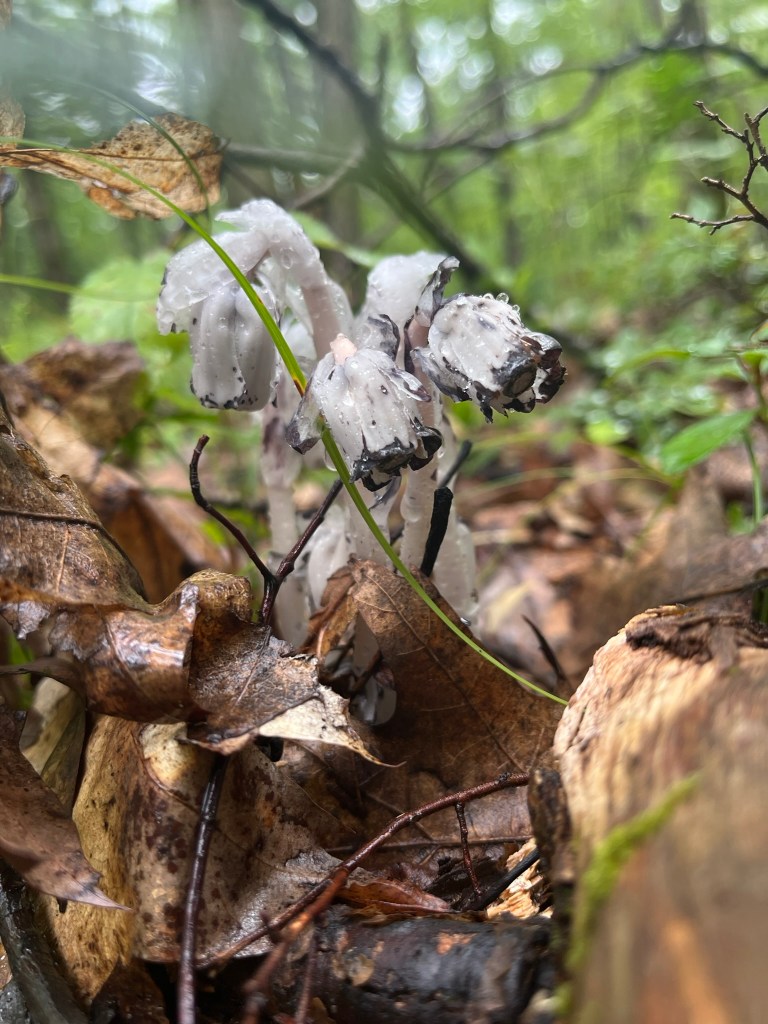
After the slugs and ferns, we spotted Monotropa uniflora, Ghost Pipes. These perennial wildflowers are found all throughout Pennsylvania. The plants are a mycoheterotroph, a parasitic flower hosted by fungi in the Russulaceae family. Ghost Pipes are known to be the favorite flower of Emily Dickinson. I hadn’t seen any in person for many years. I couldn’t take a single step without nearly crushing a bunch of Ghost Pipes!

As the humidity settled over us, we finally started spotting mushrooms. We were on the hunt for a Russula aeruginea, the Green Russula, which my sister spotted and took to our walk leader. I found some Crown-Tipped Coral Fungus sprouting in a large clump on a rotting log. I reached the point where I felt like every glance was full of mushrooms. We counted more than ten species from our small group alone. Favorites of mine were Oak Mazegill, Crowded Parchment, and Berkeley’s Polypore.

Jack-o’lantern Mushroom

Towards the end of our walk, our group stumbled upon a large growth of Omphalotus olearius, the jack-o’lantern mushroom. These poisonous mushrooms fruit at a similar time to Chantarelles, and look eerily alike. Jack-o’lantern mushrooms possess true gills, a feature Chantarelles lack. Plus, jack-o’lantern mushrooms are vivid orange, and are the same color throughout. While I know scientifically these mushrooms are poisonous enough to cause harm to human beings, I can’t imagine ever being tempted to eat them. There is a certain something in their appearance and smell that sets off my primitive instinct to leave them alone.

After we finished our walk, all the groups gathered at a pavilion to begin identifying all the mushrooms found. Quickly the plates of identified specimens filled two picnic tables, and the heady scent of fresh fungi filled the air. Club leaders walked us through the species and families one by one. One of the best parts of the club is that there is a mix of ages and experience, creating a wealth of knowledge. I love to simply listen to them discuss different specimens or trade stories.

All too soon, my family and I packed up our foraging baskets and backpacks. Tired and sweaty, we loaded in my Jeep and headed east on I-80. Mushrooms were on the mind as we discussed our plans for mushrooming in August. Soon a copy of Field Guide to Wild Mushrooms of Pennsylvania and the Mid-Atlantic will be on my doorstep, ready for more mushrooming adventures.

If you are interested in joining a local mushroom club, please check out NAMA, the North American Mycological Association. A database of mushroom clubs throughout the United States is on their website at https://namyco.org/clubs/. The schedule of events for the Central Pennsylvania Mushroom Club is on their website at https://centralpamushroom.club/events/.

Penn State’s Living Filter

I participated in this event as part of my commitment to Centred Outdoor’s Outdoor Leadership Cohort. I recommend participating in their events throughout the Summer and Fall seasons. You can check out their schedule on their website. Please consider supporting Centred Outdoors and Clearwater Conservancy today.

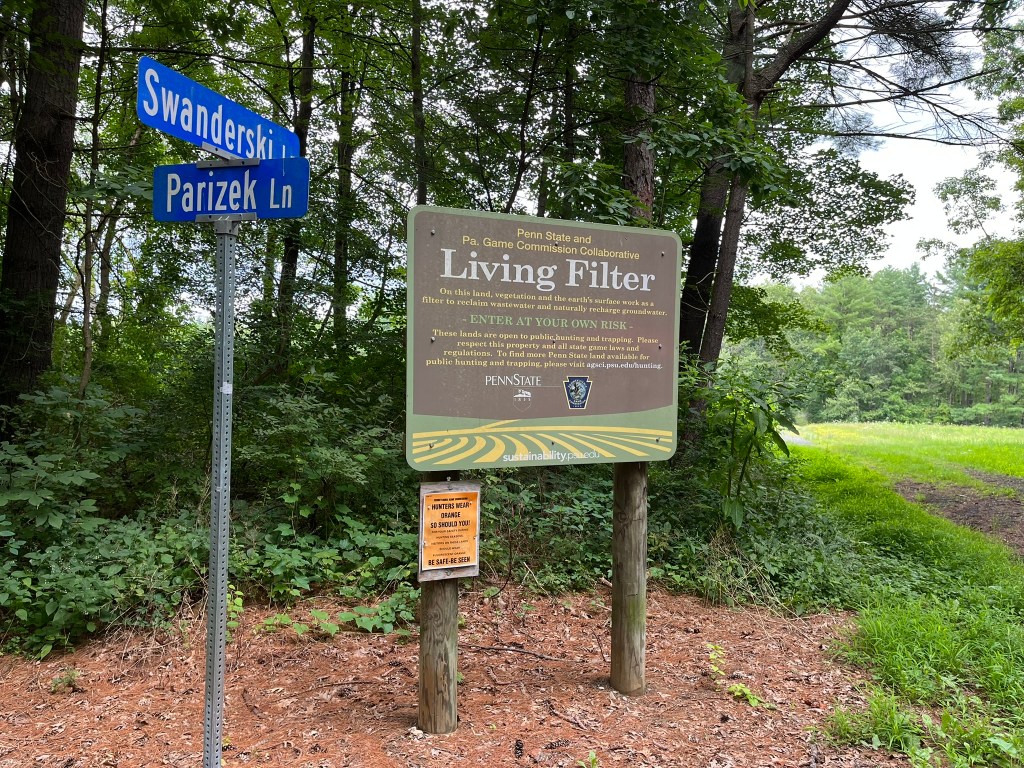
Last Sunday, I packed a bag and dashed out the door to reach Penn State’s Living Filter in time for the 1:00pm guided tour. I wasn’t sure what to expect… I had gathered from promotional materials that the Living Filter was an experiment, yet also an established wastewater management practice. From the guided walk, I learned the Living Filter was much more than what met my eye.

Dr. Preisendanz from the Department of Agricultural and Biological Engineering met us at the sign-in station to share the history of the Living Filter. For almost four decades, Penn State has used their wastewater effluent as forest and crop irrigation. The hope is that after nourishing the plants and crops, the water will recharge groundwater aquifers. Wastewater is sprayed over the foliage using aboveground pipe systems. This wastewater is some of the cleanest wastewater around- Penn State recently upgraded their wastewater treatment facility to better treat the wastewater from University Park campus and part of State College.

Penn State staff, faculty, and researchers play an active role in maintaining the Living Filter. To ensure proper safety and security of the pipes, staff manually turn on and off the sprayer systems and handle the collection of samples for researchers. Working together, they have managed to eliminate the direct discharge of wastewater into streams and assist in maintaining the base flow of Spring Creek. Plus, this system supports different crops which are used to nourish research animals, eliminating the need to purchase and transport commercial feed.

During our walk, we soaked in the lush foliage around the service roads. Thick bushes of jewelweed lined our walking path. Grain crops emanated a warm and comforting glow over the hills. Climbing up over the grain fields, we passed into fields of tall, strong corn. While the hedgerows were not perfect, they were tidy. However, not all plants love the nutrient-rich water. Some trees, most of species that prefer dryer territory, were fading or even already dead. Penn State technical service staff maintain the safety of the Living Filter by removing any dead trees before, or immediately after a tree goes down.

While the Living Filter is an inspiring facility, what caught me by surprise was the investment of the community members attending the outing. Our small crowd was certainly a mix of ages, experiences, and knowledge. We stopped multiple times during the walk to ask Dr. Preisendanz questions, which she met with enthusiasm. I felt comfortable in this group of (mostly) strangers, and happy to listen to the discussion surrounding wastewater management and sustainable agriculture. I learned that the morning group was larger and had even more questions than us. The 11:00 am group took over an hour, while ours was just under!

On my way home from the outing, I drove past the site of the old Radio Astronomy Building. Now a decommissioned special services building, the area of what used to study celestial objects using radio waves now is the home of the Living Filter’s second half. I didn’t stop to check it out as I was unsure of the permissions one would need to see it for themselves. The initial portion of the Living Filter, on State Game Lands 176, is publicly available. However, be warned that the sprayers are turned on for all other days- even in the middle of winter.

I enjoyed my visit to Penn State’s Living Filter. The “lesson” was fun, the walk was easy, and the attendees were interesting. While this place is checked off my To-Visit List for the Summer, it’s on my To-Visit List for the Winter. Dr. Preisendanz shared the area is a winter wonderland starting in December and worth the trip. For now, when I wash my dishes in the breakroom sink, I know the water will exit the system at the Living Filter!