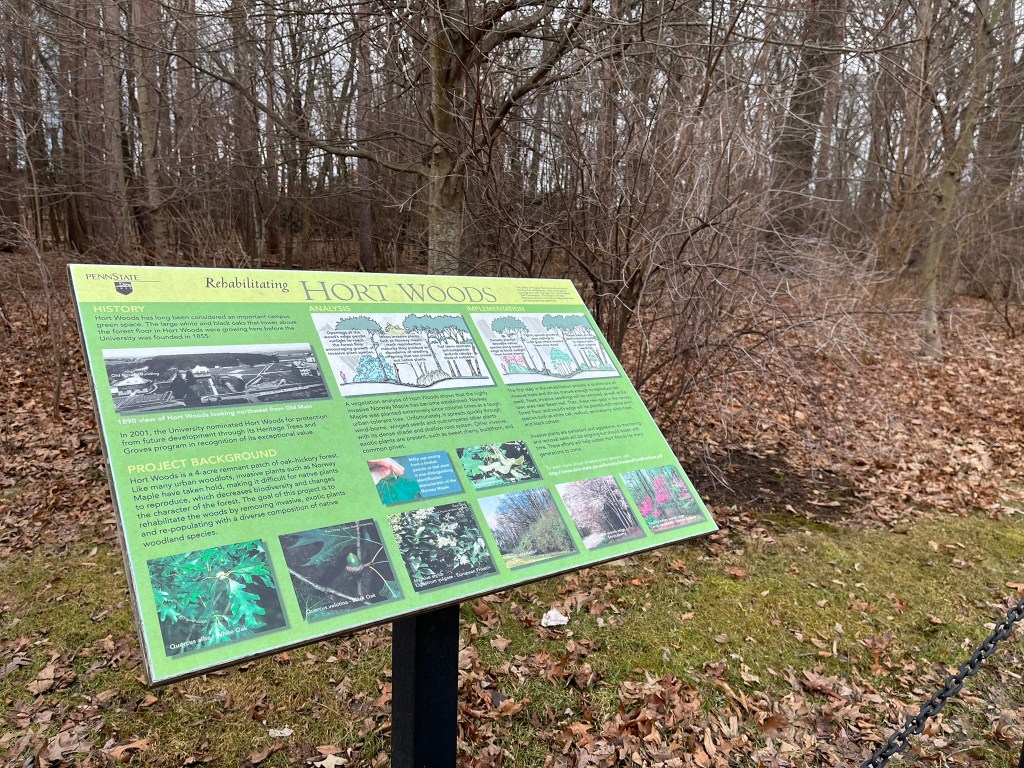
The March winds pushed me as I hurried down the sidewalk to Hort Woods. Traffic zipped by, and students shivered as they ran from dorm to dorm. Even though I’ve taken hundreds of walks on campus, I’ve never taken a dedicated walk through Hort Woods. This past Thursday I spent a half-hour in this historic grove of trees at University Park.
In 2001, Hort Woods earned “Heritage Grove” status at Penn State. In the 1800s, Hort Woods stretched from central campus to the Penn State Arboretum site. The original Hort Woods was cleared for construction. The remaining patch of land contains some surviving trees, or at least their progeny. Yet, by the 2010s, the area had become degraded by invasive plants. The Penn State Eco Action Club partnered with Penn State OPP to rehabilitate Hort Woods. Supplemental funding from the Penn State Student Fee Board helped the project along. Rehabilitation included removing invasive species and replanting with the Miyawaki Method.
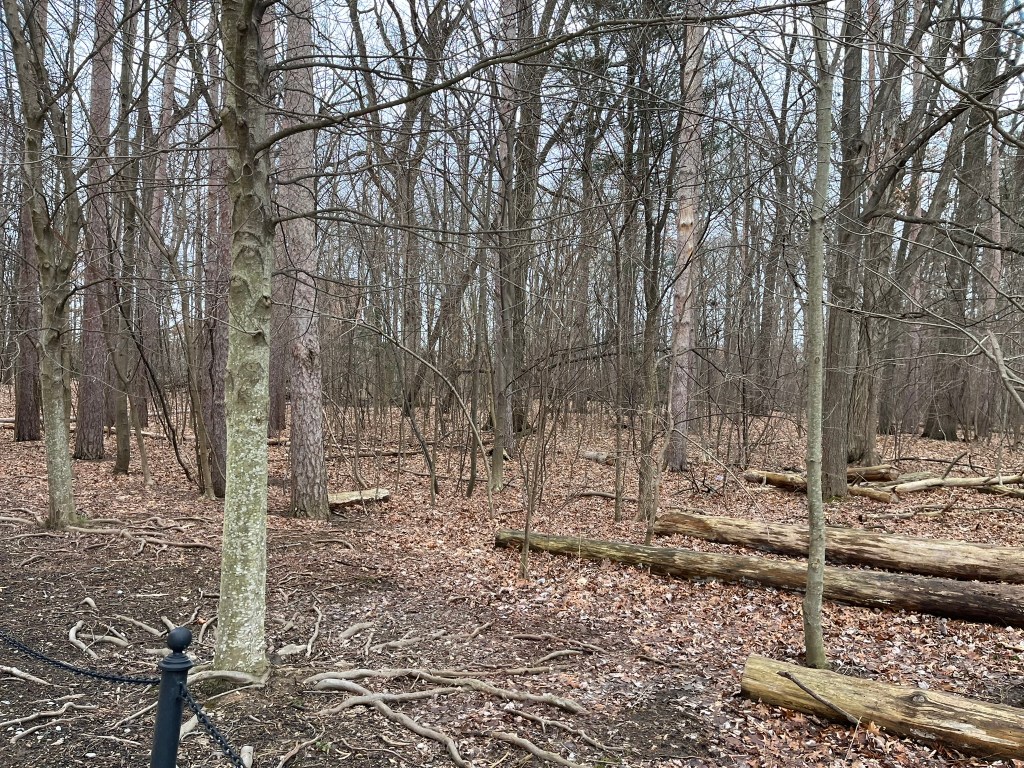
On my walk, I followed the sidewalks surrounding and through Hort Woods. Despite the dormant landscape, the tract of trees was humming with life. I first spotted a Red-Bellied Woodpecker digging through a snag. Right after, a Downy Woodpecker flitted over my head. I heard the high calls of American Goldfinches and House Finches in the canopy. A Merlin recording revealed more species: Black-capped Chickadees, Dark-eyed Juncos, and White-breasted Nuthatches.
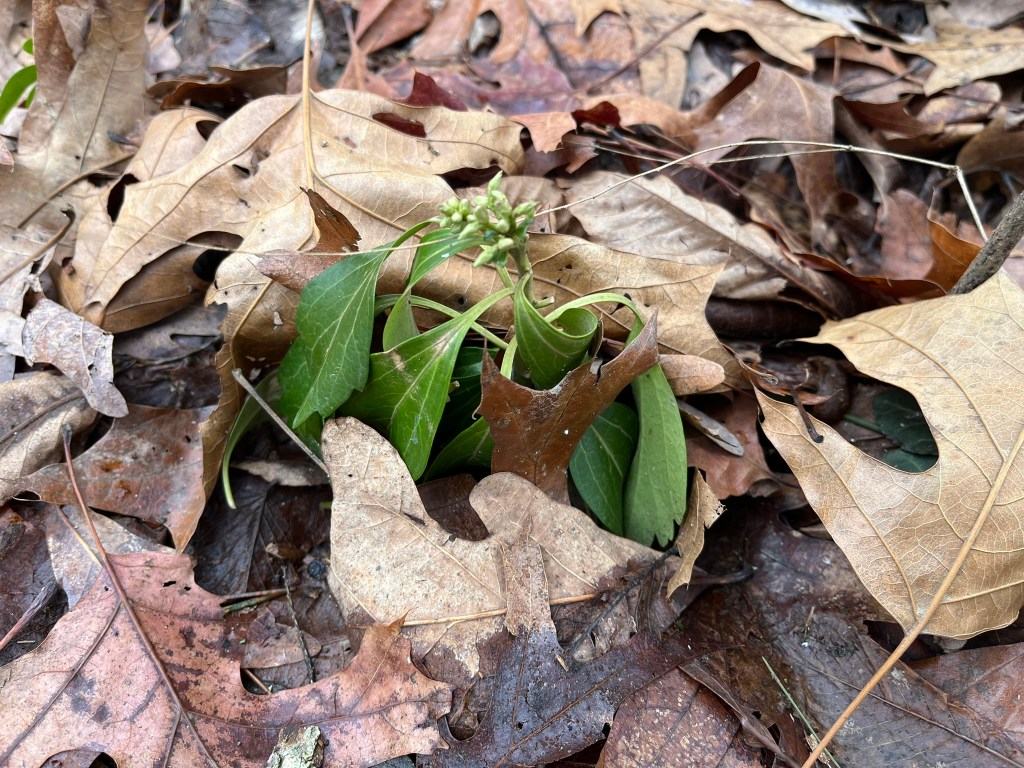
Along the sidewalk in some areas, small green plants were pushing up through the leaf litter. A check with iNaturalist revealed them to be Japanese Pachysandra. In other sections, English Ivy trailed along the ground and up the trunks of trees. English Ivy, while pretty, is difficult to eradicate. The ivy reminded me that eradicating invasive species requires many years of effort. Penn State is making that effort by implementing a sustainable landscape plan.
Derek K., Senior Landscape Architect and Eco Action Club Adviser, shared the University Park Campus Sustainable Landscape Implementation Plan with me via email. The plan mentions “Restoring the Legacy of Hort Woods” as a major action item. The goal of the project is to restore native species and develop the area into a 4-acre swath of healthy habitat. The action plan utilizes straightforward management techniques familiar to non-foresters like myself. Penn State is focusing on soil decompaction, low- or no-till methods, and composting. From my experience, I know these plans will be executed as carefully and thoughtfully as funding permits.
Late winter can be a depressing time of year. My walk tempered this feeling, and I left hopeful for what is in store for Hort Woods. By exploring this one patch of wood, I learned I’m one of many that care deeply for Penn State’s landscapes. Hort Woods is now a part of my walks, and I’m excited to observe the changes as we transition into Spring.
Works Cited
Penn State University. (2014, November 8). Heritage tree groves: G-6. The Pennsylvania State University. https://web.archive.org/web/20141108064008/http://lorax.opp.psu.edu/trees/heritage/groves/hgrove.jsp?ID=G-6
Penn State University. (2012, February 13). Hort Woods rehabilitation project to begin soon. https://www.psu.edu/news/university-park/story/hort-woods-rehabilitation-project-begin-soon
Stephen Stimson Associates Landscape Architects, Inc., Phyto Studio, Climate Positive Design, & The Pennsylvania Horticultural Society. (2024). University Park Campus Sustainable Landscape Implementation Plan. Penn State University.
 Autumn Knepp