
Snow floated down around me as I walked across the parking lot to Lakeside Trail. The trail, a 5.6 mile loop at the base of Bald Eagle Mountain, is a favorite of mine. American Robins chittered in the trees overhead, flying off when I whistled in return. The trail was snowy and undisturbed, perfect for some time alone in the winter woods.
Along the trail ranged a dense, berry-dotted shrub, obscuring my view of the lake. Little grey-blue berries clustered on branches… privet. Privet renders any habitat into a tangle of branches with its reproductive cycle. The invasive plant species will out-shade low-lying native plants. Once established, privet is an aggressive enemy, and here, the battle is already lost.
Interspersed throughout the privet is multiflora rose, another invasive species in Pennsylvania. Multiflora rose is a “Class B” noxious weed, as it is very prolific and difficult to control. An established plant will produce up to 500,000 seeds in a single year. Shade-tolerant and hardy, it’s taking over the base of Bald Eagle Mountain.
I can’t help but feel sad watching these species consume my favorite places. Japanese stiltgrass threatens my yard. Shrubs like privet edge out the mountain laurel, and English Ivy coats the ground in thick waves. These are not the scenes we should be seeing in Pennsylvania, but they are our reality.
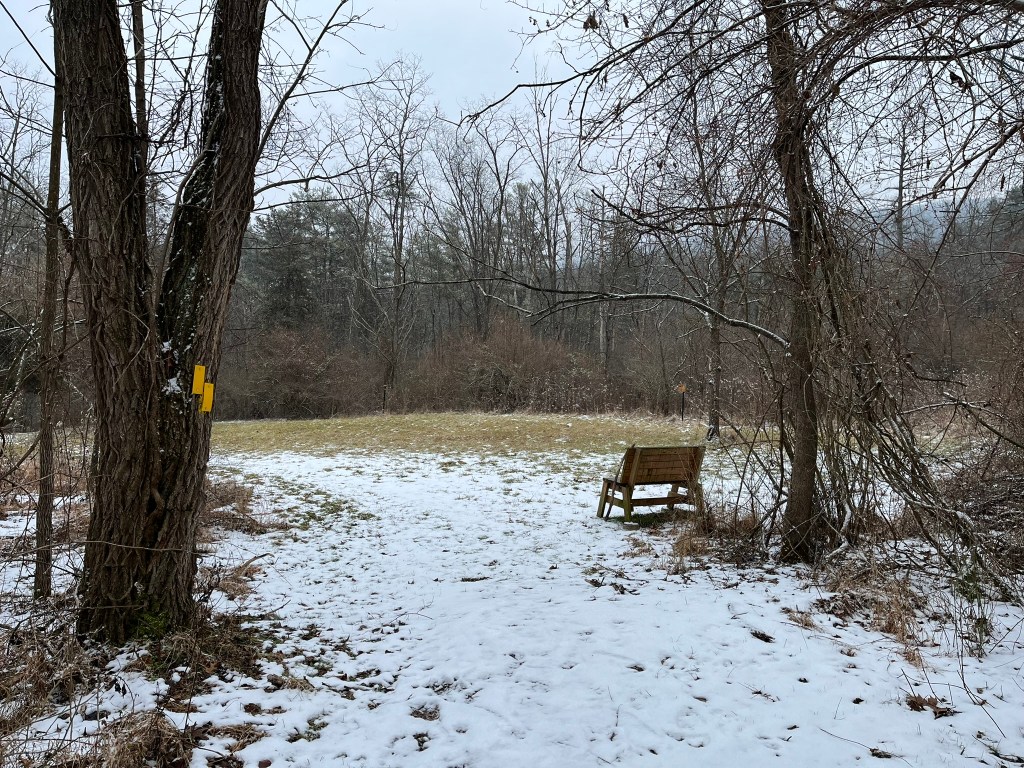
As I continued my walk, the dense shrubs gave way to a small clearing- the remains of an apple orchard. A bench sits near the trail, and I stopped for a moment to admire a common greenshield lichen on the bench. This native fungi species shone bright lime-green against the white snow. Typically found on bark, this lichen will grow on wood products if conditions are right. Upon my touch, it was not warm, but wet and floppy like lettuce leaves. After dwelling on invasive species, I felt better to know a native one was thriving here.
This orchard is one of my favorite places at Bald Eagle State Park. In my first year of living here, I would bring a book here to read on the bench or lay on a blanket in the meadow. I wondered what this meadow would look like if the privet or multiflora rose took over. The thought was too depressing- how could I only imagine a bad outcome for this scene?

A term popped into my mind as I strolled around- recency bias. Witnessing the fires in Los Angeles, and knowing the role invasive species had in them, had been on my mind all week. Our minds will often overemphasize recent experiences when thinking about the future.. Combating recency bias takes a concentrated effort, as all pessimistic thoughts do.
Instead, as I walked back home, I imagined what Lakeside Trail would be like if the invasives were managed. Reducing the invasive shrubs would open the understory, helping low-lying plants grow. Promoting the growth of native berry-bearing species would provide forage for wildlife. This type of project is intense, and in some cases, impossible. Yet, I didn’t feel daunted. The lichen gave me hope, proof that even in a space troubled with invasive species, with a little help, native ones may find a way.
 Autumn Knepp