
In mid-March, the US Army Corps of Engineers opens the gate of Foster Joseph Sayers Dam to drain the lake. In a few days, the lakebed lies exposed to the elements. People gather to meander amongst the rubble of historic Howard- myself included.
On a long post-work walk, I was able to explore the edge of the lake along the Bald Eagle Launch side of the dam. For five years I’ve made the annual trek along the gravel ridge that extends from the launch site. This gravel is old fill, a mixture of sandstone, limestone, and slag. More artificial reefs and ridges dot the land, placed to assist in building habitat.
Another type of creature benefits from these gravel beds- freshwater mussels.
Mussels live in flowing water, ranging from streams to rivers. Some species adapted to living in lakes. Mussels anchor themselves at the bottom of the stream with their byssal threads. To feed, mussels filter the water for nutrients, cleaning water of algae and muck along the way. Mussels are food for some mammals, including raccoons, otters, mink, and muskrat. In the past, mussels were food for the indigenous people of Pennsylvania. The Delaware and Lenape tribes included mussels as part of their regular diet.
Unfortunately, mussels are on the edge of extinction in Pennsylvania. Water pollution, habitat destruction, and invasive species put our mussels at great risk. The Salamander Mussel and Eastern Pearlshell are at enormous risk of extirpation. The Pennsylvania Fish and Boat Commission are managing them using Species Action Plans. Using habitat management plans, they are restoring habitat throughout the Commonwealth. They also try to control invasive species- a battle hard fought and rarely won.
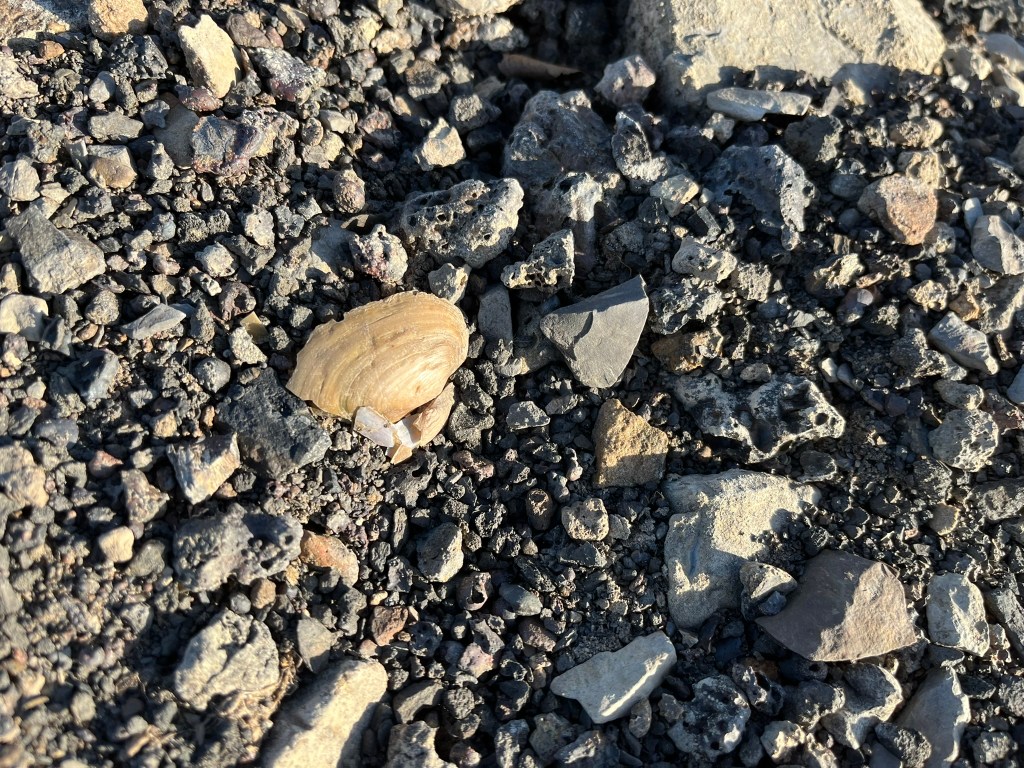
Walking the lakebed as a little girl, I would find large shells, at least 3 inches wide. As an adult, I often find smaller shells, ranging from 1 inch to 2 inches wide. Over the years, I have seen a significant decrease in the number of shells I find. On a similar walk 3 years ago, I found the remains of at least 10 mussels, while I only found 2 this year.

As I walked more, I started wondering what kind of mussels I found. On my way back, I stopped to take pictures of the shells. While it would have been easy to take the shells home with me, it’s safer to leave them where I found them. In the event the mussel was an endangered species, it’s illegal in Pennsylvania to have the shells. Once I finished with pictures, I hurried home.
Up to 4 species of mussels may appear in the Bald Eagle: Triangle Floater, Eastern Elliptio, Green Floater, and Creeper. I studied the pictures in the guide and compared to the pictures I took. The pictures and short descriptions were great, but I also searched on the web for more pictures. The shells I found looked like 2 of the species, the Triangle Floater and Green Floater.
Ultimately, I decided I found Green Floater shells. In addition to being small, I can see green stripes on the worn yellow shells. The shells are very thin, with a shallow umbo. The inside of the shells has a white, almost silvery lining. I read online that these mussels can be found in sandy and gravelly substrate, buried up to 15 inches deep. The water above is usually quiet pools and eddies. When water levels are high, this area of the lake is quiet, with gentle waves always lapping at the shore.

In 2023, the U.S. Fish and Wildlife Service proposed federal protection for Green Floaters. In a press release, USFWS shared that Green Floaters are rare in almost 80% of the watersheds where they occur. Since the USFWS is attempting to list this species as endangered, I felt like I should get a second opinion. I sent an email to the USFWS Ecological Services Office in State College, PA for confirmation. I have yet to hear back.
As the water levels have fallen throughout the past week, the state of these mussels has been on my mind. As I walk through and explore the lakebed, I’ve been keeping my eye out for more shells. Easier said than done, but another task of a naturalist I take seriously, and yet with great joy.
Works Cited
Delaware Tribe of Indians. “Foods Eaten by the Lenape Indians.” Delawaretribe.org, Official Web Site of the Delaware Tribe of Indians, 27 June 2013, www.delawaretribe.org/blog/2013/06/27/foods-eaten-by-the-lenape-indians/. Accessed 17 Mar. 2025.
Macdonald, Bridget, and Jennifer Koches. “Service Proposes Protections for Green Floater Mussel.” FWS.gov, U.S. Fish & Wildlife Service, 25 July 2023, www.fws.gov/press-release/2023-07/service-proposes-protections-green-floater-mussel. Accessed 17 Mar. 2025.
Pennsylvania Fish & Boat Commission. A Field Guide to Pennsylvania’s Freshwater Mussels. Pennsylvania Chapter of the American Fisheries Society, 9 Feb. 2018.
—. “Aquatic Invasive Species.” PA.gov, Commonwealth of Pennsylvania, 2025, www.pa.gov/agencies/fishandboat/conservation/aquatic-invasive-species.html. Accessed 17 Mar. 2025.
—. “Species Action Plan: Eastern Pearlshell (Margaritifera Margaritifera).” PA.gov, Commonwealth of Pennsylvania, June 2023. Accessed 17 Mar. 2025.
—. “Species Action Plan: Salamander Mussel (Simpsonaias Ambigua).” PA.gov, Commonwealth of Pennsylvania, June 2023. Accessed 17 Mar. 2025.
U.S. Fish & Wildlife Service. “Green Floater (Lasmigona Subviridis) .” FWS.gov, U.S. Fish & Wildlife Service, 2023, www.fws.gov/species/green-floater-lasmigona-subviridis. Accessed 17 Mar. 2025.
 Autumn Knepp