2024 eBird Year in Review

Birding is one of my favorite hobbies, and I try to squeeze in as much as I can. With my work schedule and life schedule, I’ve had minimal time birding until this past Fall. I learned about eBird this summer, and I’ve been growing my life list ever since. I’ve observed 43 species this year, and lucky enough to make memories at the same time.

First was when I went birding at Fisherman’s Paradise with the State College Bird Club. Observing the Great Blue Herons interacting with the Bald Eagles was new and exciting for me. I blogged about the trip on September 29th on Birding at Fisherman’s Paradise.

My second memorable trip was birding at Soaring Eagle Wetland (SEW). While the birds I saw there were not new to me, exploring the area was exciting. SEW has many active projects, and when I visit again, it will still feel like a brand-new place. I blogged about the trip on November 3rd on Early Fall at Soaring Eagle Wetland.

Another recent memory- I was birding with friends at Bald Eagle State Park will go in the books as a highlight. We were chatting on the beach area when one of my friends spotted an unusual bird out on the water. I focused my binoculars and discovered a Common Loon in winter plumage. It was my first-ever Common Loon, and having spotted it with friends felt extra special.

There’s still plenty of time to bird this winter. I’m participating in Project Feederwatch until it finishes in April. I’ve had a blast spending weekend mornings observing my backyard. There is a Downy Woodpecker that visits every day at 11:00am, rain or shine. Plus, Tufted Titmice are a daily treat, bringing joy to every morning. Visiting a winter raptor survey is on my to-do list, something I’ll share here when the trip concludes.

2024 was a successful year for birding. Despite not birding 24/7 all year, I’ve been able to make memories, add to my life list, and take part in fun projects. The rest of this winter and next year look to be even better. I’ve developed my identification skills and am working on becoming a better photographer. I can’t wait to share with you what comes next!

2024 Bird Species

  • Turkey Vulture
  • Eastern Bluebird
  • Common Merganser
  • European Starling
  • American Robin
  • Red-tailed Hawk
  • Mourning Dove
  • Red-Bellied Woodpecker
  • American Crow
  • House Finch
  • Dark-eyed Junco
  • Red-winged Blackbird
  • Northern Cardinal
  • Black Vulture
  • American Goldfinch
  • Field Sparrow
  • Common Grackle
  • Common Nighthawk
  • Great Blue Heron
  • Bald Eagle
  • Ring-billed Gull
  • Black-capped Chickadee
  • Eastern Phoebe
  • Tree Swallow
  • Cedar Waxwing
  • Double-crested Cormorant
  • Osprey
  • Killdeer
  • Blue Jay
  • Chipping Sparrow
  • Tufted Titmouse
  • Wood Duck
  • Mallard
  • Grey Catbird
  • Downy Woodpecker
  • Pileated Woodpecker
  • White-breasted Nuthatch
  • Carolina Wren
  • White-throated Sparrow
  • House Sparrow
  • Song Sparrow
  • Canada Goose
  • Common Loon

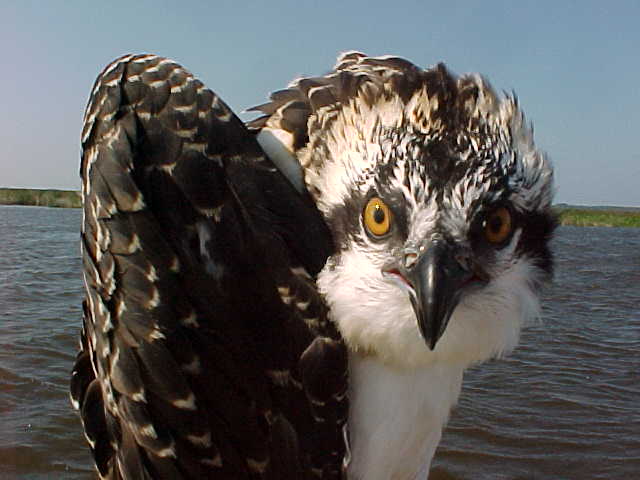
Summer Osprey Sightings

Photo of the Week – Osprey at Back Bay National Wildlife Refuge (VA)” by U. S. Fish and Wildlife Service – Northeast Region is marked with Public Domain Mark 1.0.

Near the intersection of Rt. 26 and Rt. 150, the Bald Eagle Overlook faces out over Foster Joseph Sayers Lake. Here, I watched a pair of Osprey dominate the northern bank of the lake all summer.

Considering the nearby Bald Eagle State Park, watching Osprey feels traitorous. I see at least one Bald Eagle per day while on my lunch walks- this is a gift I will never take for granted. Yet every time I spot an Osprey, I become transfixed, waiting for their yellow glare to pass over me.

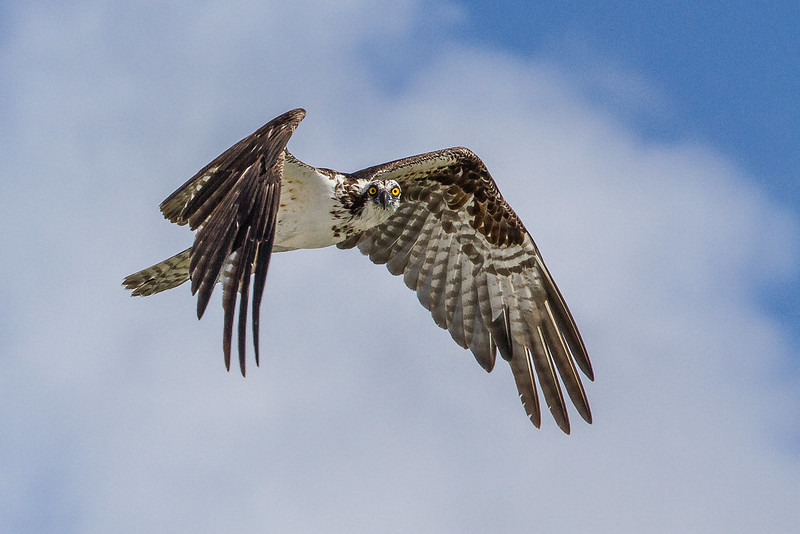
The thing I like most about Osprey is their look; always torn between bewildered or cool. At the right angle, with ruffled feathers and wide eyes, Osprey have the same visage of a mad scientist. In flight, Osprey are every inch a predator with their long wings spread over the skies.

I usually find the osprey pair situated in a snag between Bald Eagle Overlook and the Rt. 26 causeway. Before the Osprey, this area had a fluctuating cast of characters. A normal day for me would be to spot Bald Eagles next to crows, next to starlings or even mourning doves. Aside from Double Crested Cormorants, no other birds appear here with any regularity.  

Ospreys prefer areas close to open water, with no overhead forest canopy. Perching on snags gives the birds a long view up and down the lake. Fish are their preferred prey and will live-catch every meal. Rarely did I ever see another species in the snags while the Osprey were nearby. Even the Cormorants would stay quiet while the Osprey glided by.

As I kept an eye on the Osprey all summer, gears turned in my mind. Osprey nest in Pennsylvania from March to August, with nests as close as Clinton County. Nests occur up to 1600ft away from open water. Additionally, nests are large, made of sticks and twigs. In Pennsylvania, many nests are on man-made structures, like buildings and telephone poles.

Osprey in Flight” by Andy Morffew is licensed under CC BY 2.0.

Knowing this, I started looking for a nest. My search was in vain- I never saw a single stick. Bald Eagle State Park rangers searched the whole park for a sign, and never had anything to report. The Rangers told me that age and inexperience may prevented the Osprey from nesting.

Despite our searching, Osprey nests can be difficult to find. This difficulty has led to many states enacting nest surveys. The Pennsylvania Game Commission enacted the Osprey Nest Survey program in the 1980s. The program relies on volunteers to follow a protocol and report to the Commission via email. The Commission uses the reports to update the Pennsylvania Natural Heritage Program databases.

In addition to nest surveys, some organizations build and erect nesting platforms. These platforms encourage Osprey to nest away from infrastructure and in safer areas. Many platforms are also equipped with cameras, which livestream nest activities.

Now that Fall has arrived, the Osprey have moved on to their wintering grounds in South America. I doubt I will see another Osprey until they decide to return to Bald Eagle State Park. I hope the excellent habitat draws them to return and nest in an accessible area!

Works Cited

Hawk Mountain Sanctuary. Osprey. Hawk Mountain Sanctuary, 2014, www.hawkmountain.org/raptors/osprey. Accessed 13 Sept. 2024.

Morffew, Andy. “Osprey in Flight.” Flickr, Digital Photograph, 4 Dec. 2012, www.flickr.com/photos/66020093@N03/8244633979. Accessed 4 Dec. 2024.

Pennsylvania Game Commission. Osprey Nest Survey. Pennsylvania Game Commission, 2019, www.pgc.pa.gov/InformationResources/GetInvolved/Pages/OspreyNestSurvey.aspx. Accessed 13 Sept. 2024.

—. “Osprey Species Profile.” Osprey Species Profile, Pennsylvania Game Commission, www.pgc.pa.gov/Wildlife/EndangeredandThreatened/pages/osprey.aspx. Accessed 13 Sept. 2024.

United States Fish and Wildlife Service. “Photo of the Week – Osprey at Back Bay National Wildlife Refuge (VA).” Flickr, Digital Photograph, 14 Apr. 2010, www.flickr.com/photos/43322816@N08/4520680333. Accessed 13 Sept. 2024.

Our Wild Neighbor, the Red-tailed Hawk

Red-tailed Hawk” by Becky Matsubara is licensed under CC BY 2.0.

A Red-tailed Hawk swooped down through the trees, lighting a branch to watch who passed by. I was there- walking through Hort Woods after lunch with my colleagues. It’s been a while since I saw a hawk on campus, and years since I’ve been near to my favorite bird.

In medieval folklore, witches had a familiar, a type of supernatural companion. In a way, Red-tailed Hawks are my familiar, appearing at unusual moments to direct my attention. When I was fifteen, I had a close call with a hawk while refilling bird feeders. As I was shimmying the barrel of a feeder up its string, a soft whump sounded behind me. A chill crept up my neck as I turned- only to find a Red-tailed Hawk deep in the snow. It had likely seen prey in the yard and dived, not minding the teen bumbling around in a snowsuit.

When I was nineteen, I saw a Red-tailed Hawk crash-land on the road, bleeding and injured. I called the bird in to the Game Commission, and waited with it until the warden rescued and toted it off. Again, when I was twenty-six, I was talking on the phone in a courtyard when a Red-tail decided to take a seat on a brick wall. It enjoyed its lunch while I chatted with my Mom. The Red-tailed Hawks showed no fear of me, or of our surroundings.

Fear doesn’t appear to be part of a Red-tailed Hawk’s vocabulary. When mated, Red-tailed Hawks will guard their territory together. If a human strays too close, the hawks will take no qualm in scaring them away. The Red-tailed Hawks in my area will dive across I-99 traffic to hit prey in grassy medians. They’ll perch while a PennDOT mower rumbles past, surveying for new-exposed food.

Red-tailed Hawk” by U. S. Fish and Wildlife Service – Northeast Region is marked with Public Domain Mark 1.0.

On my daily commute, I see at least two hawks per day. Road warriors, hunting the hills between Bellefonte and State College. A huge swath of I-99 passes by SCI Rockview and Penn State research farms, excellent habitat for prey. Plus, the cultivated fields help form the thermals Red-tailed Hawks use to travel. Interspersed are WMUs, permitting wildlife to live with little human interference.

I’m not the only person with a love of wild raptors. I recently learned about HawkCount, which records the data collected from raptor watches. Over 300 sites dot North America- with 5 located near me. Right now, Fall watches are occurring at Jacks Mountain and Stone Mountain. I was able to sign up for daily email updates tallying the number of birds observed. I’m fascinated by how many raptors pass through my area during their migration. I’ve been more observant in the field, now that I have a better understanding of what I’m looking for.

I marked my sighting in eBird, delaying our march back to the office. Yet, as soon as I had seen the hawk, it was gone again. None of my colleagues had the chance to look up into the eyes of our wild neighbor. I explained to them the importance of my stop and eBird, but they continued as if nothing was out of the ordinary. I spent the rest of the day wondering what else my wild neighbor had wanted me to see.

Works Cited

Aucker, Jeff. “Hawkwatch Site Profile – Bald Eagle Mountain – Port Matilda.” HawkCount, 2023, www.hawkcount.org/siteinfo.php?rsite=635. Accessed 13 Sept. 2024.

Bohn, Mark, and U.S. Fish and Wildlife Service. “Red-Tailed Hawk.” Flickr, Digital Photograph, 20 Dec. 2010, www.flickr.com/photos/43322816@N08/5277662783. Accessed 13 Sept. 2024.

Bolgiano, Nick. “HawkWatch Site Profile – Bald Eagle Mountain – Eagle Field.” HawkCount, 2019, www.hawkcount.org/siteinfo.php?rsite=809. Accessed 13 Sept. 2024.

—. “HawkWatch Site Profile – Tussey Mountain HawkWatch.” HawkCount, 2024, www.hawkcount.org/siteinfo.php?rsite=438. Accessed 13 Sept. 2024.

Grove, Greg. “HawkWatch Site Profile – Stone Mtn.” HawkCount, 2015, www.hawkcount.org/siteinfo.php?rsite=436. Accessed 13 Sept. 2024.

Matsubara, Becky. “Red-Tailed Hawk.” Flickr, Digital Photograph, 26 Jan. 2017, www.flickr.com/photos/130819719@N05/32406640251. Accessed 13 Sept. 2024.

Pennsylvania Game Commission. “Hawks and Falcons.” Wildlife Note, Pennsylvania Game Commission, www.pgc.pa.gov/Education/WildlifeNotesIndex/Pages/Hawks-and-Falcons.aspx. Accessed 13 Sept. 2024.

Smith, Darrell. “HawkWatch Site Profile – Jacks Mountain.” HawkCount, 2023, www.hawkcount.org/siteinfo.php?r=on&rsite=104&go=Go+To+Hawkwatch+Profile. Accessed 13 Sept. 2024.