Tag: pennsylvania

  • A Mussel Mystery at Bald Eagle

    A Mussel Mystery at Bald Eagle

    In mid-March, the US Army Corps of Engineers opens the gate of Foster Joseph Sayers Dam to drain the lake. In a few days, the lakebed lies exposed to the elements. People gather to meander amongst the rubble of historic Howard- myself included.

    On a long post-work walk, I was able to explore the edge of the lake along the Bald Eagle Launch side of the dam. For five years I’ve made the annual trek along the gravel ridge that extends from the launch site. This gravel is old fill, a mixture of sandstone, limestone, and slag. More artificial reefs and ridges dot the land, placed to assist in building habitat.

    Another type of creature benefits from these gravel beds- freshwater mussels.
    Mussels live in flowing water, ranging from streams to rivers. Some species adapted to living in lakes. Mussels anchor themselves at the bottom of the stream with their byssal threads. To feed, mussels filter the water for nutrients, cleaning water of algae and muck along the way. Mussels are food for some mammals, including raccoons, otters, mink, and muskrat. In the past, mussels were food for the indigenous people of Pennsylvania. The Delaware and Lenape tribes included mussels as part of their regular diet.

    Unfortunately, mussels are on the edge of extinction in Pennsylvania. Water pollution, habitat destruction, and invasive species put our mussels at great risk. The Salamander Mussel and Eastern Pearlshell are at enormous risk of extirpation. The Pennsylvania Fish and Boat Commission are managing them using Species Action Plans. Using habitat management plans, they are restoring habitat throughout the Commonwealth. They also try to control invasive species- a battle hard fought and rarely won.

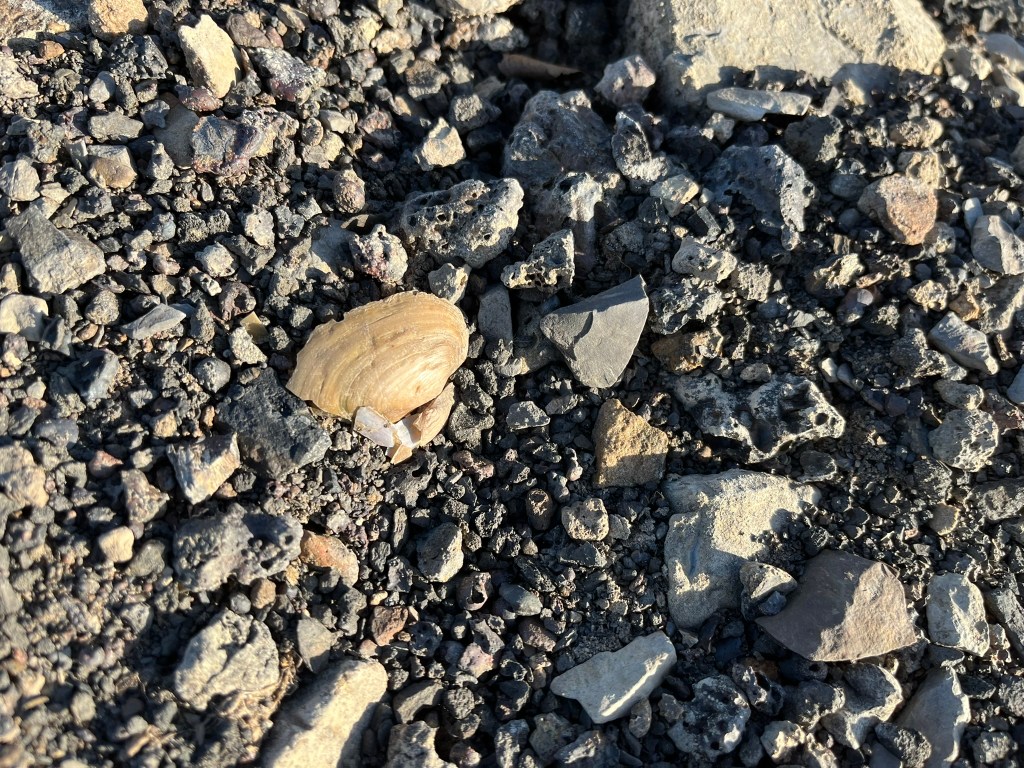
    Walking the lakebed as a little girl, I would find large shells, at least 3 inches wide. As an adult, I often find smaller shells, ranging from 1 inch to 2 inches wide. Over the years, I have seen a significant decrease in the number of shells I find. On a similar walk 3 years ago, I found the remains of at least 10 mussels, while I only found 2 this year.

    As I walked more, I started wondering what kind of mussels I found. On my way back, I stopped to take pictures of the shells. While it would have been easy to take the shells home with me, it’s safer to leave them where I found them. In the event the mussel was an endangered species, it’s illegal in Pennsylvania to have the shells. Once I finished with pictures, I hurried home.

    Up to 4 species of mussels may appear in the Bald Eagle: Triangle Floater, Eastern Elliptio, Green Floater, and Creeper. I studied the pictures in the guide and compared to the pictures I took. The pictures and short descriptions were great, but I also searched on the web for more pictures. The shells I found looked like 2 of the species, the Triangle Floater and Green Floater.

    Ultimately, I decided I found Green Floater shells. In addition to being small, I can see green stripes on the worn yellow shells. The shells are very thin, with a shallow umbo. The inside of the shells has a white, almost silvery lining. I read online that these mussels can be found in sandy and gravelly substrate, buried up to 15 inches deep. The water above is usually quiet pools and eddies. When water levels are high, this area of the lake is quiet, with gentle waves always lapping at the shore.

    In 2023, the U.S. Fish and Wildlife Service proposed federal protection for Green Floaters. In a press release, USFWS shared that Green Floaters are rare in almost 80% of the watersheds where they occur. Since the USFWS is attempting to list this species as endangered, I felt like I should get a second opinion. I sent an email to the USFWS Ecological Services Office in State College, PA for confirmation. I have yet to hear back.

    As the water levels have fallen throughout the past week, the state of these mussels has been on my mind. As I walk through and explore the lakebed, I’ve been keeping my eye out for more shells. Easier said than done, but another task of a naturalist I take seriously, and yet with great joy.

    Works Cited

    Delaware Tribe of Indians. “Foods Eaten by the Lenape Indians.” Delawaretribe.org, Official Web Site of the Delaware Tribe of Indians, 27 June 2013, www.delawaretribe.org/blog/2013/06/27/foods-eaten-by-the-lenape-indians/. Accessed 17 Mar. 2025.

    Macdonald, Bridget, and Jennifer Koches. “Service Proposes Protections for Green Floater Mussel.” FWS.gov, U.S. Fish & Wildlife Service, 25 July 2023, www.fws.gov/press-release/2023-07/service-proposes-protections-green-floater-mussel. Accessed 17 Mar. 2025.

    Pennsylvania Fish & Boat Commission. A Field Guide to Pennsylvania’s Freshwater Mussels. Pennsylvania Chapter of the American Fisheries Society, 9 Feb. 2018.

    —. “Aquatic Invasive Species.” PA.gov, Commonwealth of Pennsylvania, 2025, www.pa.gov/agencies/fishandboat/conservation/aquatic-invasive-species.html. Accessed 17 Mar. 2025.

    —. “Species Action Plan: Eastern Pearlshell (Margaritifera Margaritifera).” PA.gov, Commonwealth of Pennsylvania, June 2023. Accessed 17 Mar. 2025.

    —. “Species Action Plan: Salamander Mussel (Simpsonaias Ambigua).” PA.gov, Commonwealth of Pennsylvania, June 2023. Accessed 17 Mar. 2025.

    U.S. Fish & Wildlife Service. “Green Floater (Lasmigona Subviridis) .” FWS.gov, U.S. Fish & Wildlife Service, 2023, www.fws.gov/species/green-floater-lasmigona-subviridis. Accessed 17 Mar. 2025.

  • Signs of Spring

    Signs of Spring

    Sturnus vulgaris, European Starling

    The concrete porch was cold under me, but I paid no attention as I studied the bird on my suet feeder. I watched the glossy bird rip into the suet cake, pause, and gobble down its bite. This bird, a European Starling, is the scourge of my days, devouring pound after pound of seeds and suet. Yet, I can’t deny anything- it, too, is trying to survive in adverse conditions.

    In my attempt to spend 1,000 hours outside, I have been doing daily lunchtime birding. At home, I perch on my back porch and at work, I find a sunshine-drenched bench. All I have is my cellphone and binoculars. I keep to one place for about 15 minutes, recording all the birds I see and hear. The list is never very long, but I enjoy the regularity of the community of birds around me.

    Zenaida macroura, Mourning Dove

    On this afternoon, mine and my neighbor’s yards were full of birds. Mourning doves roosted in the trees, grooming in the sunshine. A Red-Tailed Hawk called from overhead as it flew by. A solitary crow annoyed a flock of European Starlings to my left. House Sparrows and House Finches argued over feeder space. As I wound down my session, a female Northern Cardinal appeared nearby. At last, two Tufted Titmice darted to the maple tree. All the while, a chorus of American Robins called, completing the scene.

    As I had my camera on hand, I decided to take pictures of some of the spring buds and shoots. The buds on the roosting tree of the Mourning Dove are already tinged red. Close by, the magnolia buds are fuzzy, growing larger by the day. On my remaining forsythia bush, the yellow buds are plentiful. I regret not ripping it out this past fall; this bush is a pain to care for. That said, I couldn’t rip it out- birds like roosting in its tangled branches.

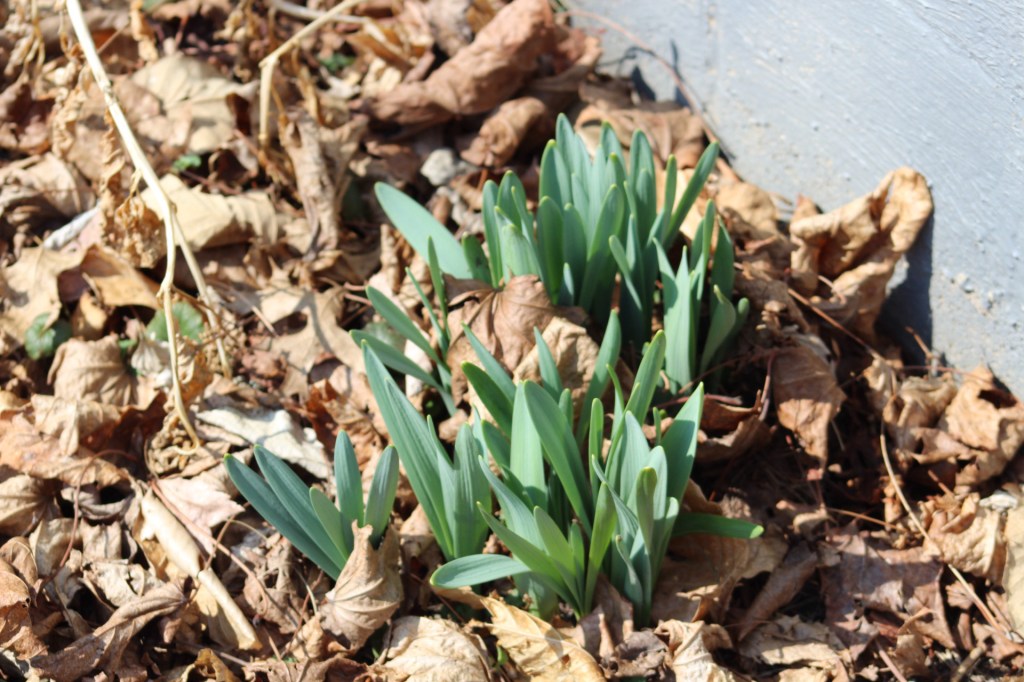
    Narcissus, Daffodil

    In the front yard, signs of Spring are a little different. Leaves are sprouting for daffodils, tulips, and hyacinths. Over winter, I debated on keeping them. On one hand, I could remove them and plant native flowers. On the other, I planted them before I knew about native flowers. The memory of my younger self prevailed; I decided to keep them. I will need to control spread of these plants. Hyacinths will produce bulblets as off-shoots and spread under the soil. Regular removal will curtail this spread and prevent an invasion in my yard.

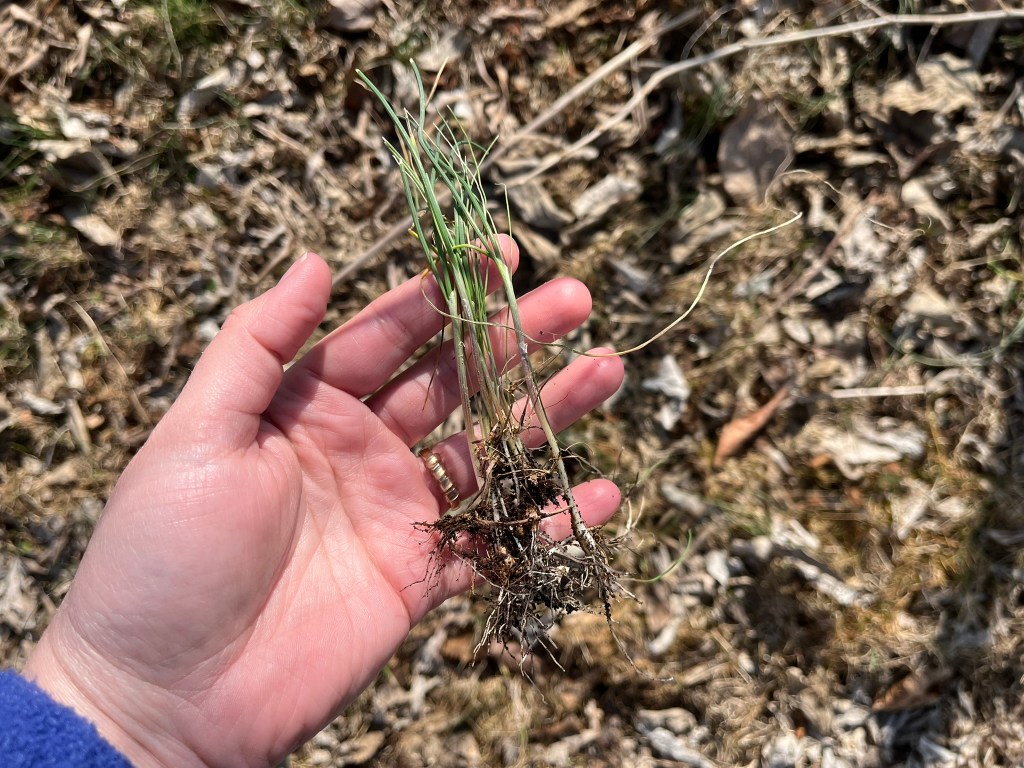
    Amongst the returning grasses are the thin rapier-like leaves of wild garlic. Allium vineale is also known as “Crow Garlic” and “Field Garlic.” Introduced in the mid-1800s, wild garlic spread to cover much of the eastern United States. While wild garlic is edible, I wouldn’t eat it. The garlic flavor is pervasive and overrules all others in dishes. The taste is so strong that the flavor will get into the butter and milk of cows that have eaten wild garlic.

    Allium vineale, Wild Garlic

    I have a few more weeks until the Spring wildflowers start blooming. Some friends have already seen skunk cabbage, the smelly harbinger of longer days. I’m waiting for Virginia Springbeauty and Wild Columbine. The emergence of these two flowers signals true Spring to me. I’m also excited for Yellow Trout Lily and Bloodroot this year. I will need to leave my yard to find these flowers- but it is a trek I look forward to.

    These subtle signs of Spring are refreshing to my winter-weary eyes. With a little noticing, the drab landscape burst into life. With returning birds, the plants are emerging from their dormancy. Each day, we’re one step closer to the chirping of nestlings and the leafing-out of trees. Now, if the Purple Martins would simply come back…

    What are you noticing about Spring near you? Share in the comments!

  • Late Winter at Hort Woods

    Late Winter at Hort Woods

    The March winds pushed me as I hurried down the sidewalk to Hort Woods. Traffic zipped by, and students shivered as they ran from dorm to dorm. Even though I’ve taken hundreds of walks on campus, I’ve never taken a dedicated walk through Hort Woods. This past Thursday I spent a half-hour in this historic grove of trees at University Park.

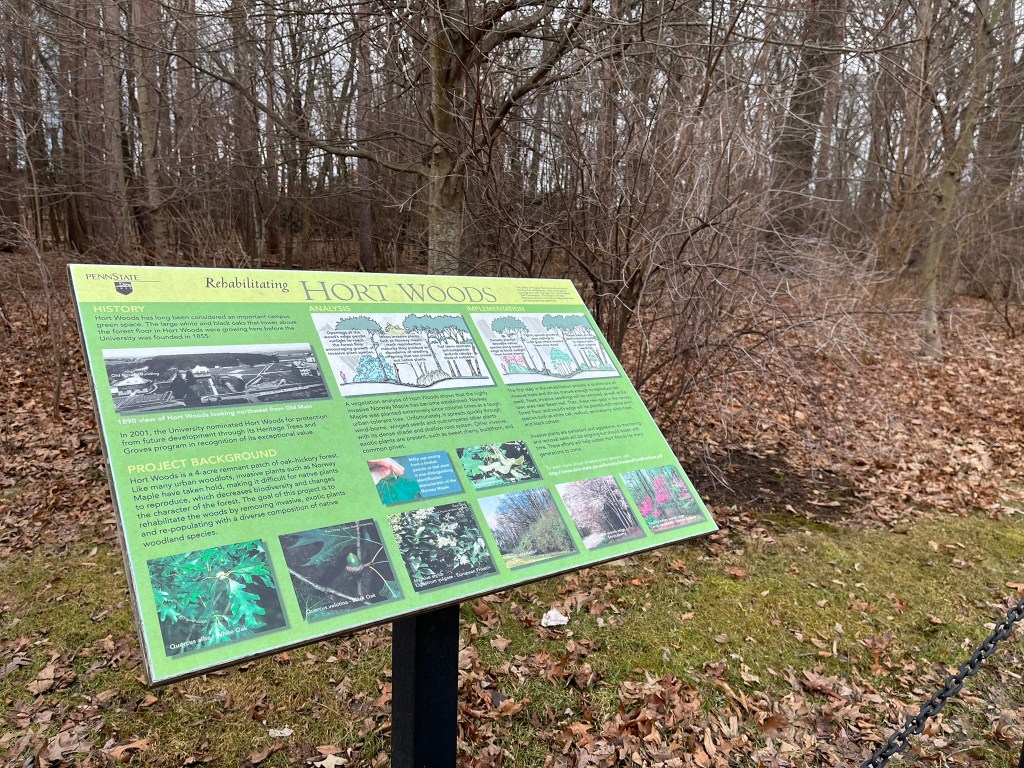
    In 2001, Hort Woods earned “Heritage Grove” status at Penn State. In the 1800s, Hort Woods stretched from central campus to the Penn State Arboretum site. The original Hort Woods was cleared for construction. The remaining patch of land contains some surviving trees, or at least their progeny. Yet, by the 2010s, the area had become degraded by invasive plants. The Penn State Eco Action Club partnered with Penn State OPP to rehabilitate Hort Woods. Supplemental funding from the Penn State Student Fee Board helped the project along. Rehabilitation included removing invasive species and replanting with the Miyawaki Method.

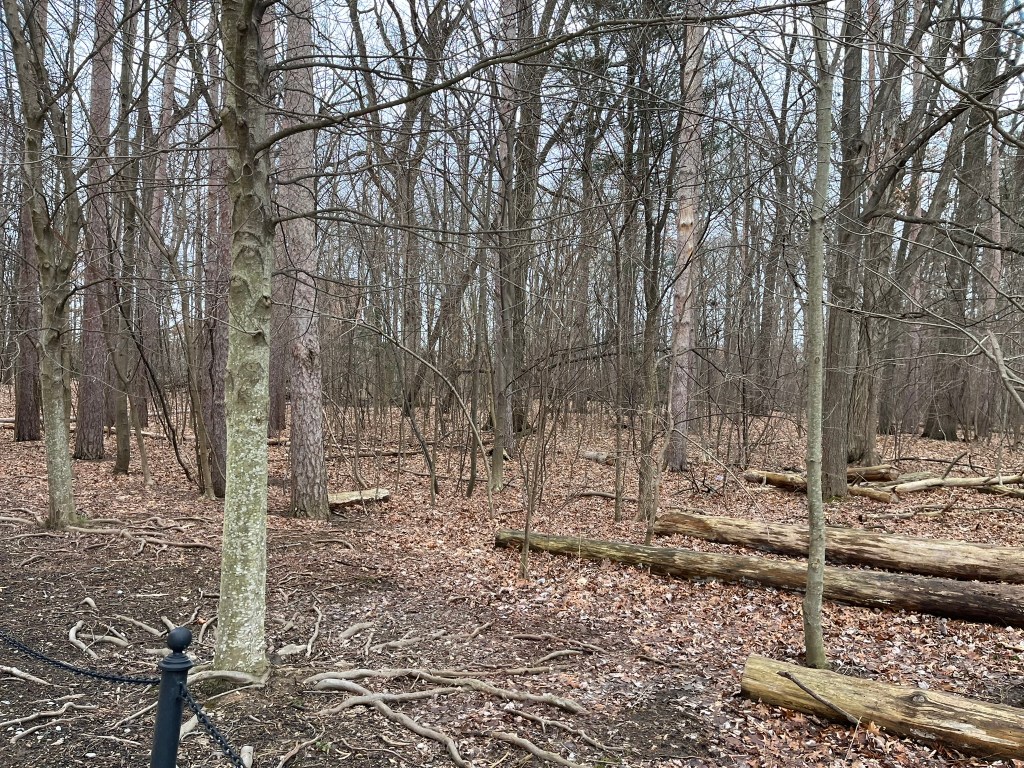
    On my walk, I followed the sidewalks surrounding and through Hort Woods. Despite the dormant landscape, the tract of trees was humming with life. I first spotted a Red-Bellied Woodpecker digging through a snag. Right after, a Downy Woodpecker flitted over my head. I heard the high calls of American Goldfinches and House Finches in the canopy. A Merlin recording revealed more species: Black-capped Chickadees, Dark-eyed Juncos, and White-breasted Nuthatches.

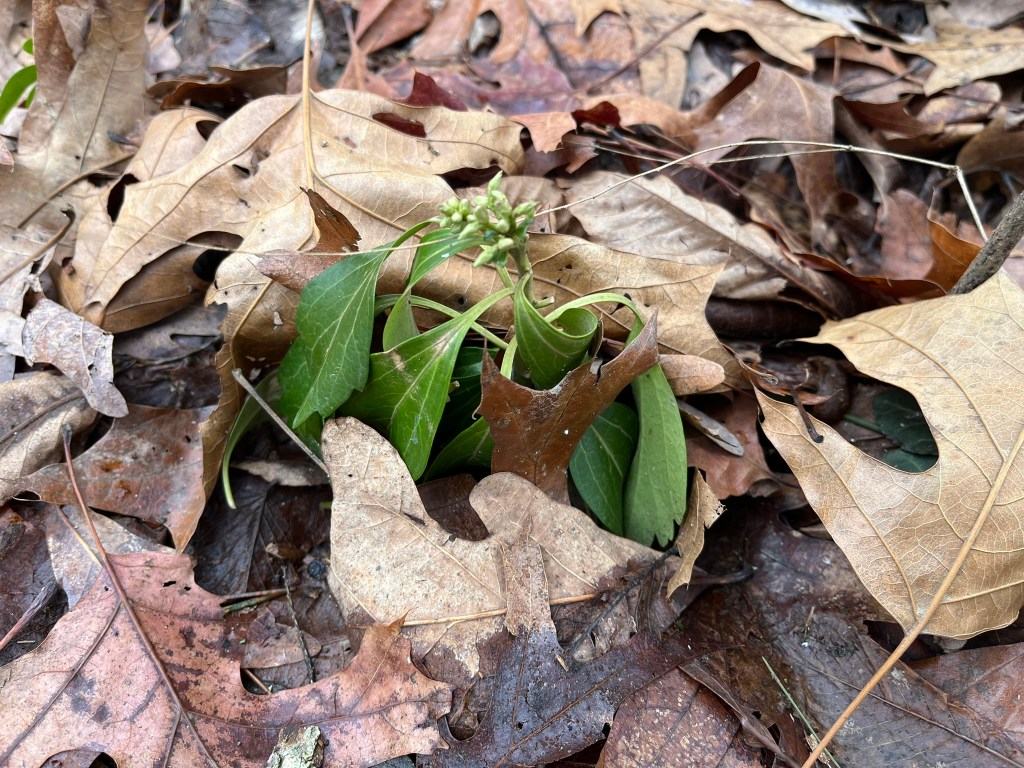
    Along the sidewalk in some areas, small green plants were pushing up through the leaf litter. A check with iNaturalist revealed them to be Japanese Pachysandra. In other sections, English Ivy trailed along the ground and up the trunks of trees. English Ivy, while pretty, is difficult to eradicate. The ivy reminded me that eradicating invasive species requires many years of effort. Penn State is making that effort by implementing a sustainable landscape plan.

    Derek K., Senior Landscape Architect and Eco Action Club Adviser, shared the University Park Campus Sustainable Landscape Implementation Plan with me via email. The plan mentions “Restoring the Legacy of Hort Woods” as a major action item. The goal of the project is to restore native species and develop the area into a 4-acre swath of healthy habitat. The action plan utilizes straightforward management techniques familiar to non-foresters like myself. Penn State is focusing on soil decompaction, low- or no-till methods, and composting. From my experience, I know these plans will be executed as carefully and thoughtfully as funding permits.

    Late winter can be a depressing time of year. My walk tempered this feeling, and I left hopeful for what is in store for Hort Woods. By exploring this one patch of wood, I learned I’m one of many that care deeply for Penn State’s landscapes. Hort Woods is now a part of my walks, and I’m excited to observe the changes as we transition into Spring.

    Works Cited

    Penn State University. (2014, November 8). Heritage tree groves: G-6. The Pennsylvania State University. https://web.archive.org/web/20141108064008/http://lorax.opp.psu.edu/trees/heritage/groves/hgrove.jsp?ID=G-6

    Penn State University. (2012, February 13). Hort Woods rehabilitation project to begin soon. https://www.psu.edu/news/university-park/story/hort-woods-rehabilitation-project-begin-soon

    Stephen Stimson Associates Landscape Architects, Inc., Phyto Studio, Climate Positive Design, & The Pennsylvania Horticultural Society. (2024). University Park Campus Sustainable Landscape Implementation Plan. Penn State University.

  • Midwinter at the Arboretum

    Midwinter at the Arboretum

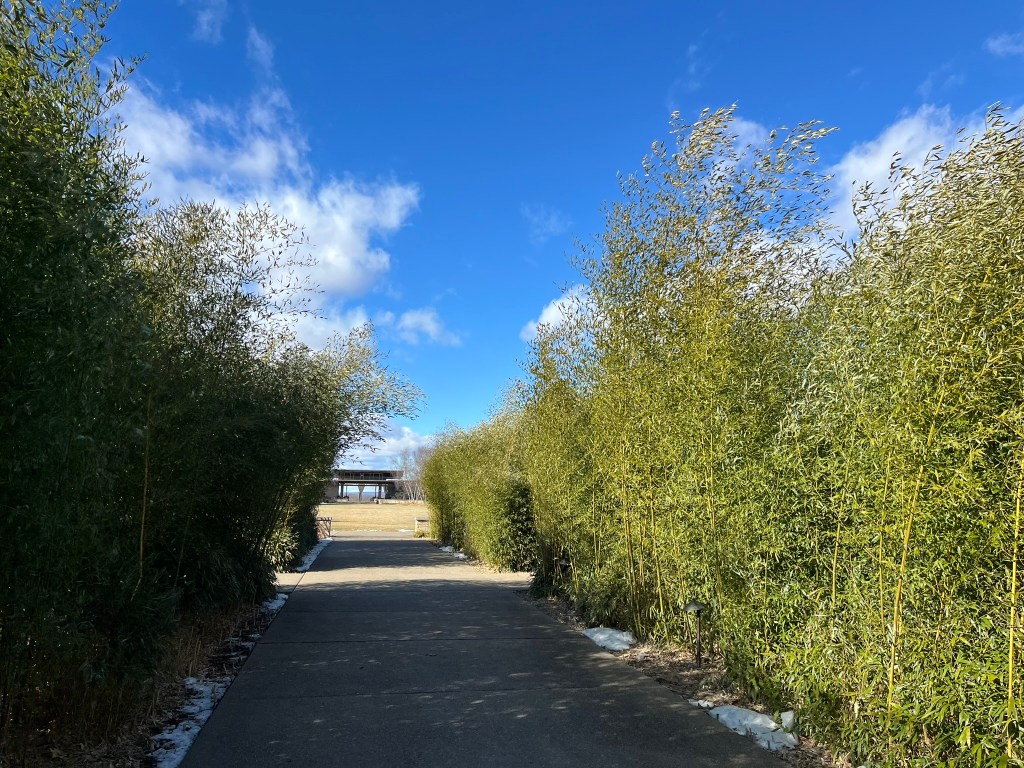
    Lime-green stalks of bamboo greeted me as I entered the Arboretum at Penn State. This wonderful, ever-changing botanical garden always captures my attention and imagination. Even at midwinter, I enjoy spending my midday break walking among the dormant plants.

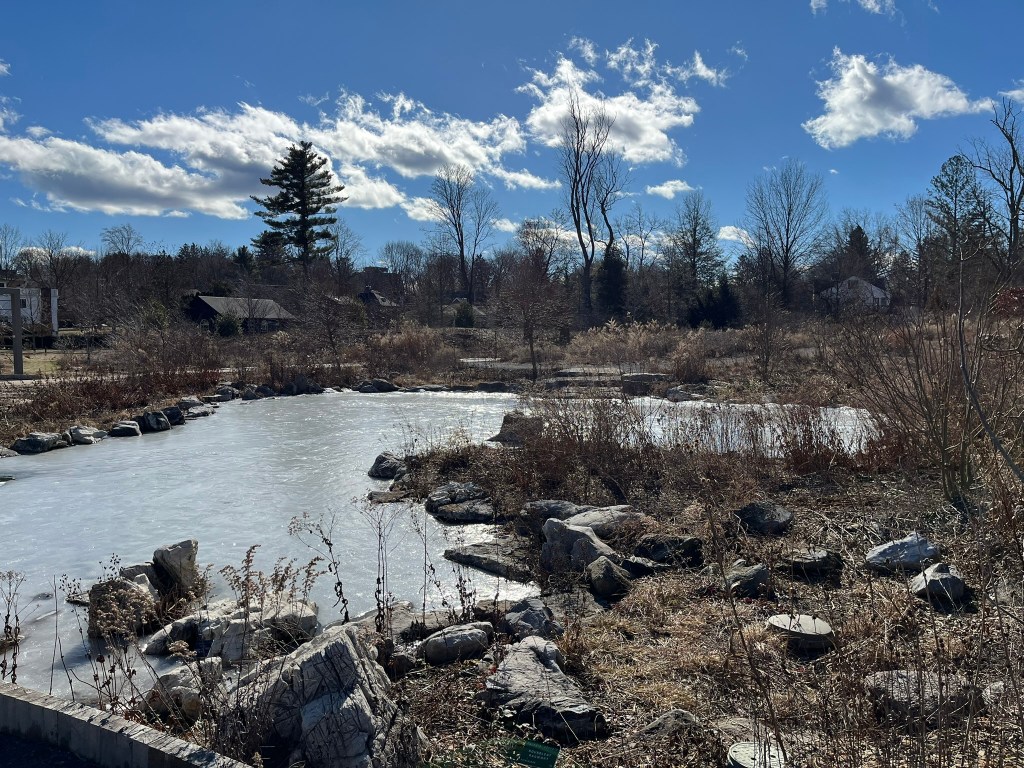
    I always start with the Oasis Garden. Taking the first left, I wandered through and spun the ice on the Lotus Pool. The walls protected me from the wind as I poked around the plants. Very little was growing here, with most fading away into the mulch. The Rose and Fragrance Garden was more promising. The little buds peeping from the tips of branches signal oncoming Spring. As I finish looping through, a gust of wind shakes the waxy magnolia leaves, causing them to clack like bones.

    The walled gardens lead into the Pollinator and Bird Garden. Here the wind gusted, unobstructed by trees or hedges. I pull my shawl closer to my neck and continue to the pond by the Pollinator Plaza. From the top of the willow house, a Song Sparrow calls, spinning around on its perch to watch me. Most other birds are flitting overhead, or on a beeline to the Bird House.

    The small wooden building is a relief from the wind. Another visitor is sitting on the porch, so I veer to the back and rest on the bench to watch the feeders. Dark-Eyed Juncos were tumbling over each other as they dig through the mulch for seeds. From the tops of the evergreen trees, a Blue Jay crunched a peanut. After a few minutes, a trio of Black-Capped Chickadees swept in to chase House Finches. I could- and I have- spent hours in this exact spot. Yet with my break ticking to a close, I knew I needed to keep going.

    The Pollinator and Bird Garden connects to an esplanade with a giant sundial. The sidewalks border the Children’s Garden. I veered left into the Children’s Garden and entered the faux cave. Cold water dripped from the ceiling, most likely ice melting from the roof. The path carved through the cave, then out and behind the Glass House. Grey and black squirrels danced in the trees overhead as I walked. An employee was tending to the garden, and I stayed out of their way as best as I could.

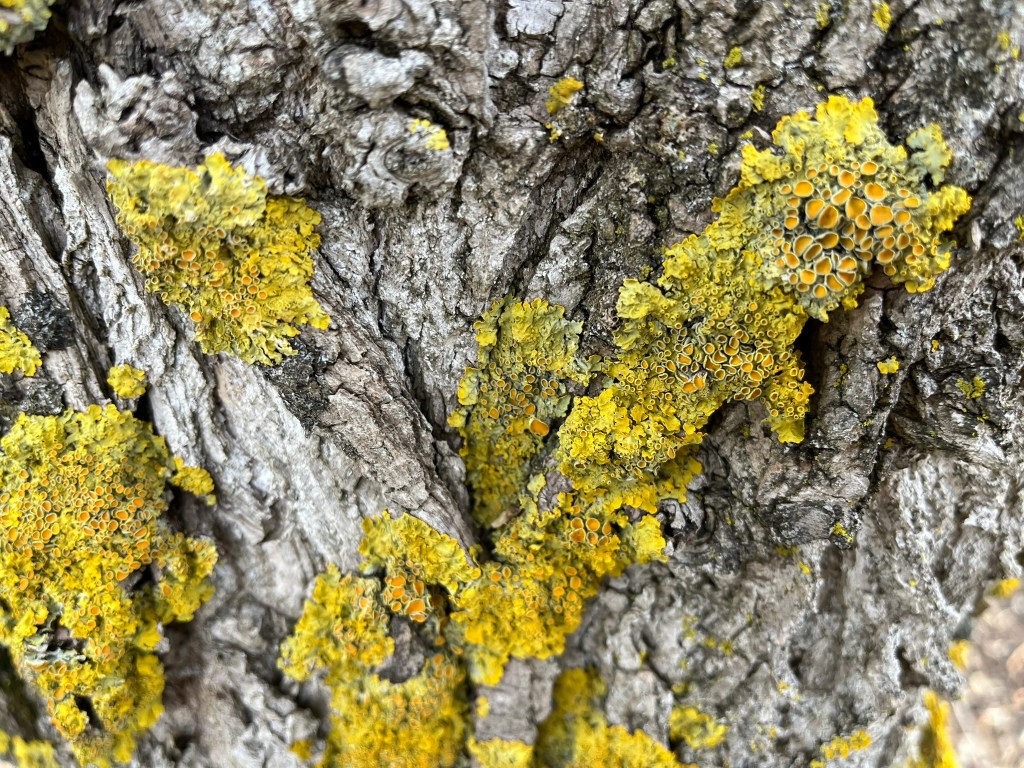
    From the Children’s Garden, I followed the the Strolling Garden path to the Poplar Court. The Black Poplars stretched high into the sky over my head. I wove in and out between the trees, admiring the neon yellow and neon orange lichens. Most appeared to be a species from genus Candelaria. (I’m still waiting for some confirmations on iNaturalist now.) I took as many pictures as I could before I hurried back to work.

    Xanthoria parietina (Common Sunburst Lichen)

    Even though there were few blooming flowers, the Arboretum is still full of life in winter. From lichens to songbirds, there is a little bit of something for everyone. During my walk, I found a pamphlet rack, which had a booklet on trails in Hartley Wood. As I’ve been walking, I’ve been planning the rest of this year’s adventures… which won’t take me very far at all!

  • Exploring Local Lichens

    Exploring Local Lichens

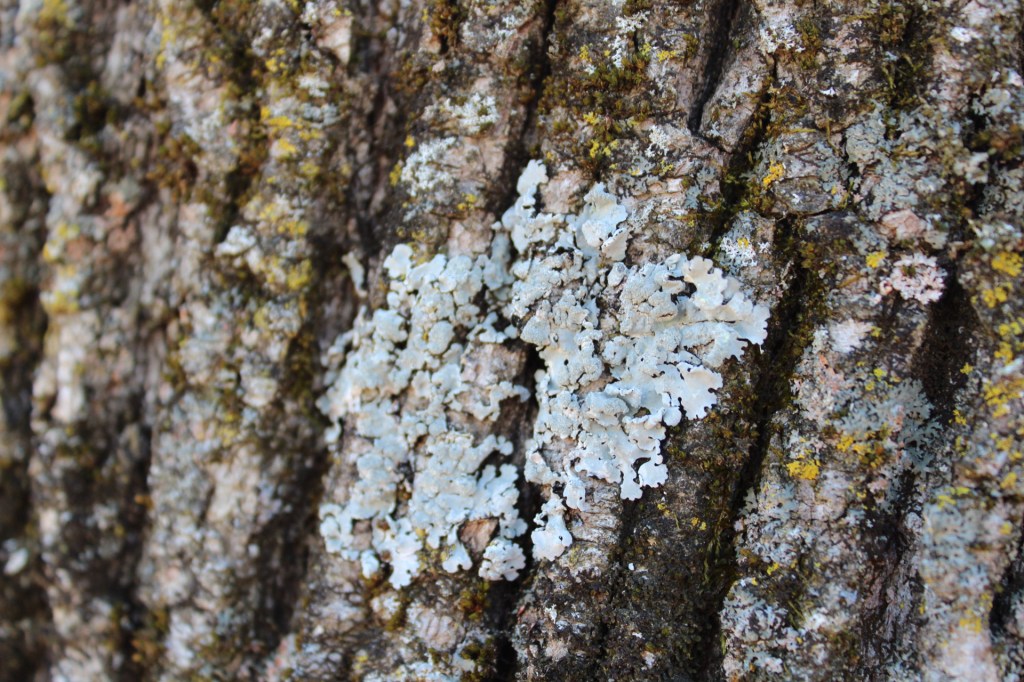
    Foliose lichen found on a Norway Maple tree

    Despite my interest in mushrooms, I know little about lichens. At the January Community Nature Journaling meeting, Stephen Bucklin introduced us to lichens. I learned a little on their ecology, physiology, and reproductive systems. Since then, I’m noticing lichens a lot more, especially in my own backyard.

    I first noticed some lichens growing on the Norway Maple tree in my front yard. On the eastward side of the tree were many lichens, and I took a couple of snaps of the largest ones. The majority of them appear to be at least be Parmelioideae; typical shield lichens. To the touch, the lichens were cold and a little leathery.

    The Norway Maple also had many small yellow lichens, which my camera and I struggled to capture. They grew in many small spots, some smaller than a pencil tip. Most were between the size of a pencil eraser to bottle cap. If I touched them, they brushed right off the tree. In the picture above, you can see the abundance of the yellow lichen all around the big shield lichen.

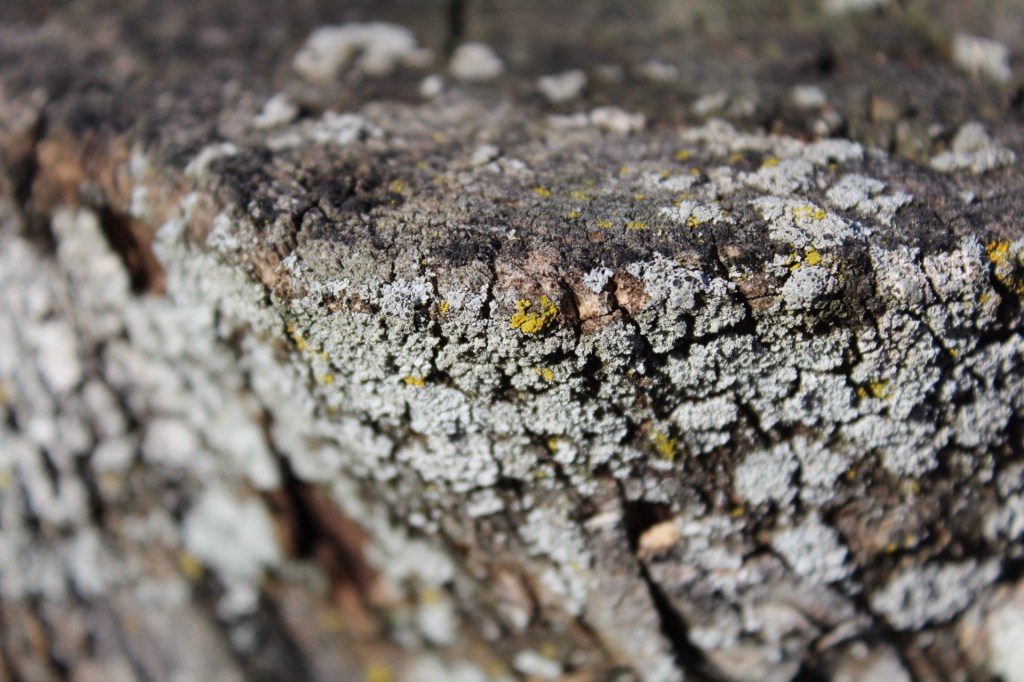
    Crustose lichen found on a post

    On the post that holds my CoCoRaHS rain gauge, a crustose lichen appears on all sides. It didn’t brush off using my finger pad or nails- the medulla of the lichen anchors it to the substrate. In this case, the substrate is a post of unknown origin. Looking close, I could see little black dots- the mycobiont’s reproductive structures.

    Foliose lichen found on same post

    Near the ground, the post had another species, a foliose lichen. Yet again, iNaturalist suggested that it hailed from the typical shield lichen family. I’m waiting for more species suggestions from experts now. These felt cold and leathery to the touch, too. I liked how bright and green they were in comparison to the grey-green of the crustose lichen at the top of the post.

    Foliose lichen and Ulota crispa competing for habitat

    On a dead snag in my yard, I found an example of a lichen and a moss competing for habitat. The foliose lichen spread all over the trunk of the snag, in groups roughly the size of my hand. In one spot, Ulota crispa, crisped pincushion moss, was growing over and up through the lichen. Lichens take anywhere from tens to hundreds of years to grow and develop. On the flip side, a moss can grow in spread in a year and a half or less. The moss is out-competing the lichen on this tree. I’m going to keep an eye on its development in the future.

    I’m surprised that my yard had so many examples of lichens. I only have three trees, a snag, a forsythia bush, and a single post. I didn’t see any lichens growing on my house or garage. With such little habitat, the lichen has found its niche and is growing. Considering how long it takes for a lichen to develop, I can say that they may have been “born” at the same time as me. Thinking about it, some of these lichen may be older than me!