Noticing April Yard Flowers

Vinca minor, Lesser Periwinkle

On my quest to explore the nature close to me, I have spent a lot more time in my own yard than I expected. A long-standing tradition of grass lawns in America has taught many generations that our backyards are devoid of nature, not full of it. Of course, I know better than that! Yet, I still found myself trapped in the belief that nothing exciting or interesting grows in my yard.

Two things have changed how I view my backyard:
1. I’ve been spending more time in my own yard
2. My lawnmower needed repaired

In the months I’ve been spending more time outside, my yard has transformed from a brown, barren wasteland to thriving blanket of plants. In years past, I would be dragging the mower out, spending two hours on a weeknight cutting the grass lower than the neighboring yards. This year is a little different- our aging mower needed repaired, delaying the “first cut” by a few weeks.
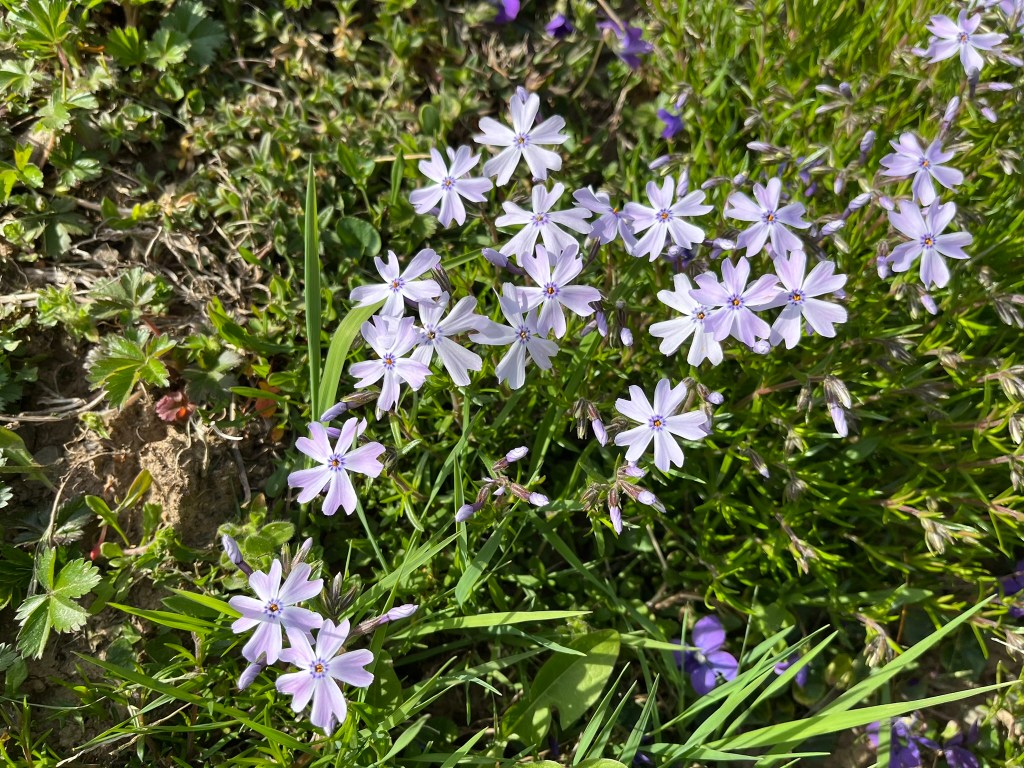
Phlox subulata, Moss Phlox

Coupled with my increased time spent on the patio- primarily doing “back porch birding” and reading after work- more subtle changes jump out at me. Early last week, a tiny blue flower popped up in the time between lunchtime birding and evening reading. A day later, smoky purple stalks shot up and revealed speckled flowers. By the weekend, violets erupted across the yard.

On my 0.33-acre property, I found 9 species of flowering forbs: Moss Phlox, Ground-Ivy, Little Mouse-Ear, Philadelphia Fleabane, Hairy Bittercress, Lesser Periwinkle, Grey Field-Speedwell, Birds’-eye Speedwell, and Common Blue Violet. In early- to mid-April, only a handful were blooming. Most are nearly budding and will most likely bloom in another week or so, revealing their flowers to the world.
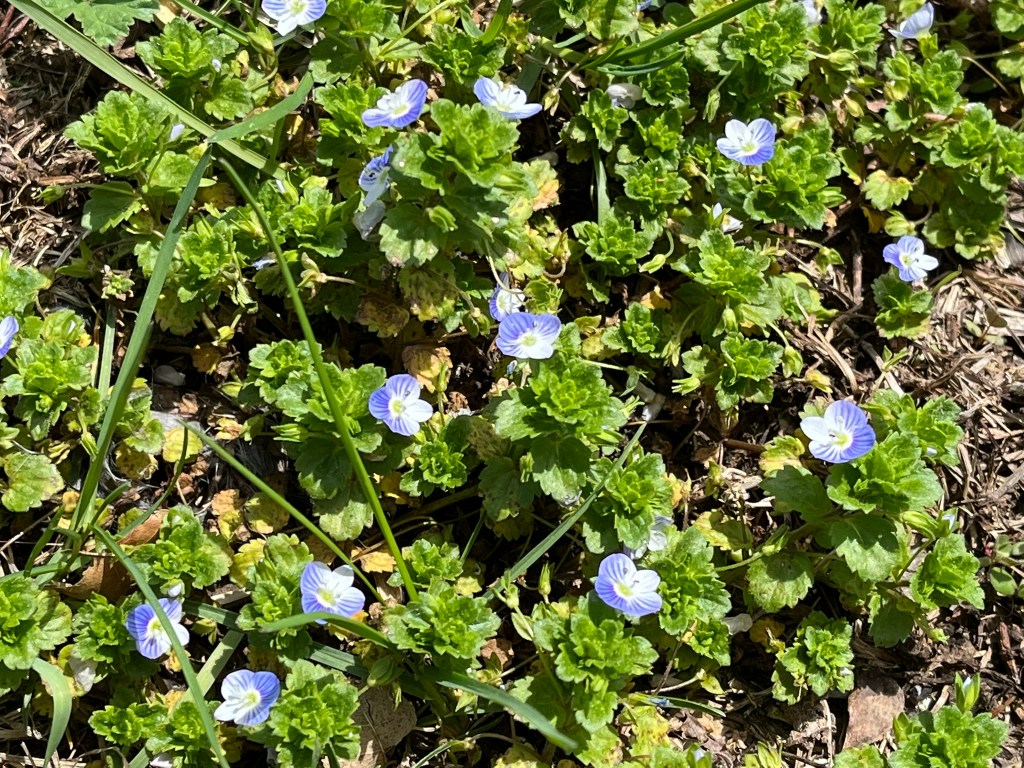
Veronica polita, Grey Field-Speedwell

While beautiful, some of these species are not native to my ecoregion. Veronica polita, the Grey Field-Speedwell, was most likely introduced by settlers in Europe. White-tailed deer and Eastern cottontail don’t appear to favor the plant, and it will continue to spread in areas that have thin soil and are infrequently mown. Another plant in my yard, Glechoma hederacea, Ground-Ivy, was introduced as a medicinal plant by European settlers and left to grow wild.

On the flip side, two species I’ve noticed are native to Pennsylvania- violets and Moss Phlox. Violets are a favorite of mine, and in my ecoregion grow as the Common Blue, or if I’m lucky, the Northern White. My yard lies low and retains water well, great habitat for Common Blue violets. Near my grandmother’s house, in a patch of wood, Northern White Violets grow up from the leaf litter. The other native flower, Moss Phlox, is often cultivated as a ground cover in my area. While I’ve never purposefully planted phlox, I appreciate volunteering to crowd out unsavory species.

Viola sororia, Common Blue Violet

Right now, the lawn is over 6 inches tall, and over 9 inches tall in especially lush areas. My lawnmower is due to be returned any day, and I dread it. I’m torn between allowing my lawn to grow into a meadow and keeping it trimmed. I’ve always wanted to grow a native grass meadow for a lawn and am free of homeowner’s authorities to prevent me- yet the knowledge that a lawn meadow will attract ticks holds me back. Keeping a trimmed lawn will permit me to be outside more often and enjoy what is there. A compromise my partner proposed is to simply mow less, and when we do mow, trim the grass on the highest blade setting.

I’m going to attempt to hold out to see some of the other flowers before trimming the yard. The Little Mouse-Ear, Philadelphia Fleabane, and Hairy Bittercress are only days away from bloom. Even then, I may attempt to wait even longer to allow the native species to pollinate and grow seeds. Yet, I know I can’t wait forever. Eventually I will need to trim the lawn and carry on with my explorations beyond the yard.
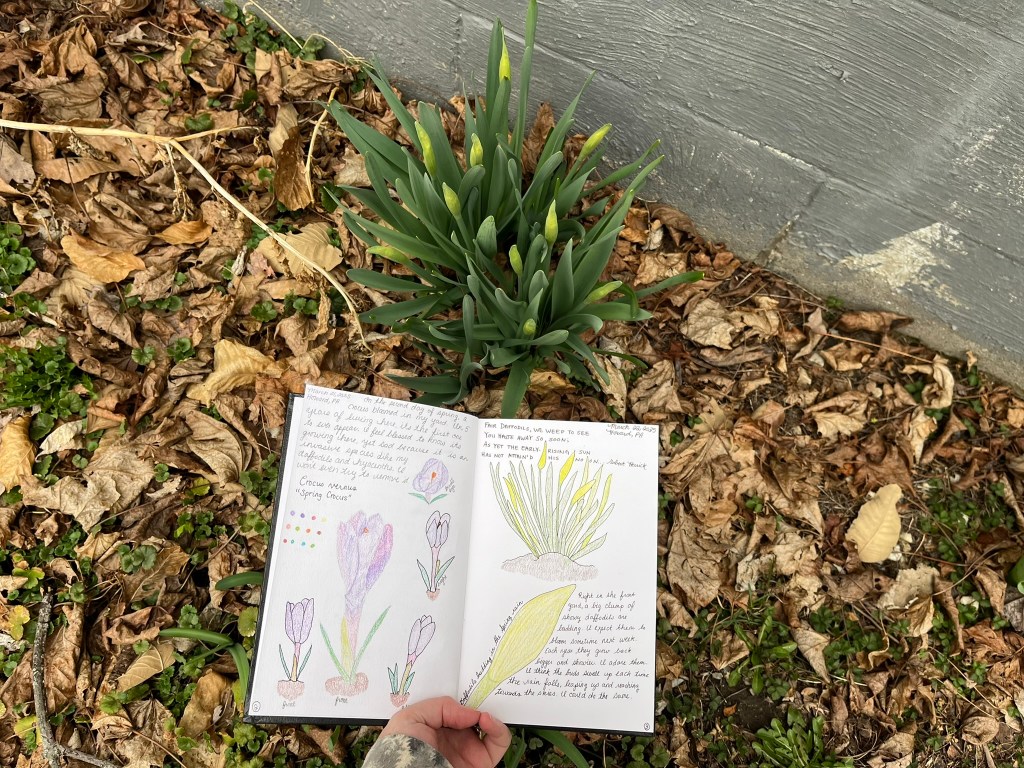
A Nature Journal Week: Spring 2025

On The Keystone Naturalist Facebook page, I have been sharing my daily nature journal pages. I’ve been loosely following along with The Wild Wonder Foundation‘s monthly nature journaling prompts.

March 20 – Spring Equinox has come and with it a project- a year of exploring the nature at home. Every day (or nearly) I’ll take my journal out and explore my home. Today I drew wild garlic, which grows in my yard. I plucked a handful to bring inside. The pungent smell filled my kitchen. As a little girl, I’d pick this in my parents’ yard until my hands would stink. Mom would give me a hot bath and forbid me from touching it again. Somehow, I’d always end up in it again, stinking all over!

March 21 – On the second day of Spring, a crocus bloomed in my yard. In five years of living here, it’s the first one to ever appear. I feel blessed to know it’s growing here, yet sad because it’s an invasive species like my daffodils and hyacinths. I won’t even try to remove it.

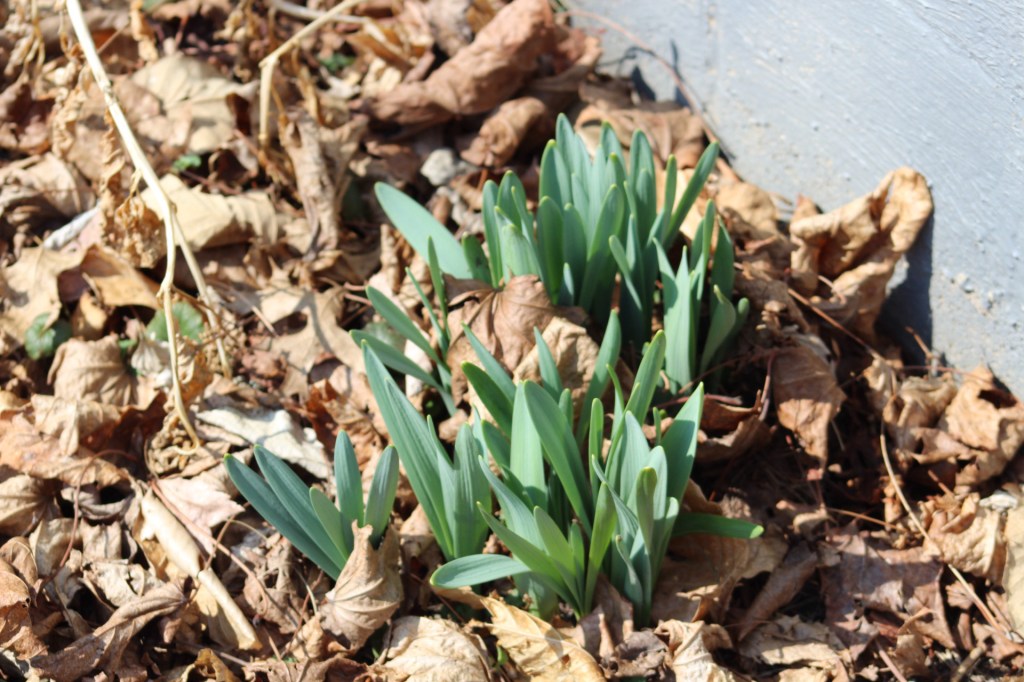
March 22 – Right in the front yard, a big clump of showy daffodils are budding. I expect them to bloom sometime next week. Each year, they grow back bigger and showier. I adore them. I think the buds swell up each time the rain falls, leaping up and reaching towards the skies. I would do the same.

March 23 – I took a walk to the launch today, searching for some peace after a busy weekend. The sycamore trees dominated my thoughts, towering high over me and loaded with seed pods. The water is low, revealing the lake bed. Lots of people are out fishing in the water. Robins are everywhere. I counted thirty on the hill over the parking lot. Song sparrows call incessantly, naming their territory with sweet liquid voices.

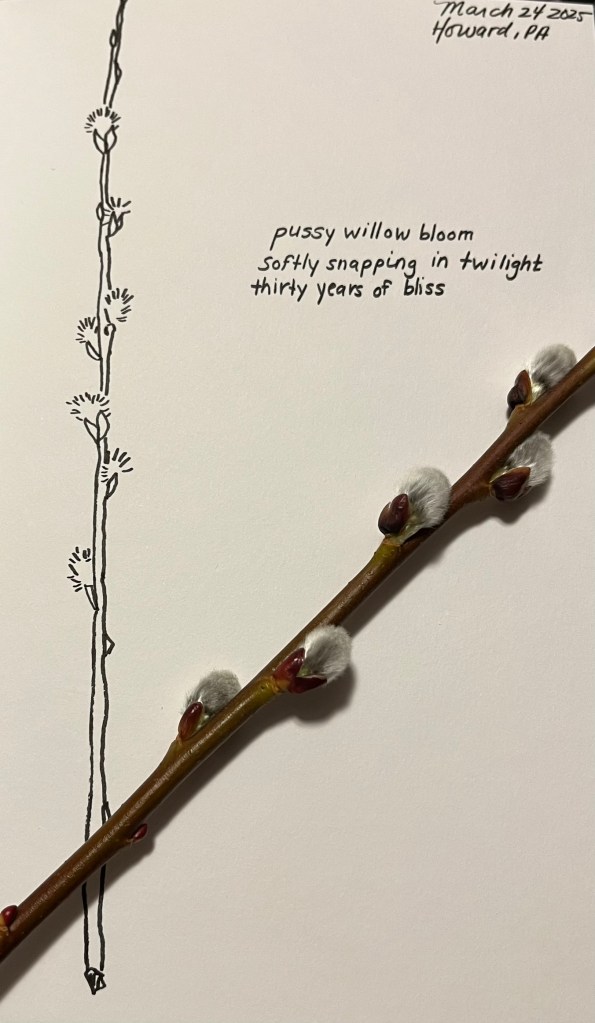
March 24 – Today is my 30th birthday. The pussy willow bush is blooming. As much as this bush perturbs me and obstructs my view of the backyard, it is beautiful in the Spring. The catkins are soft like Oliver’s paws. The weather was beautiful today, and it felt like the whole world was celebrating the season with me.

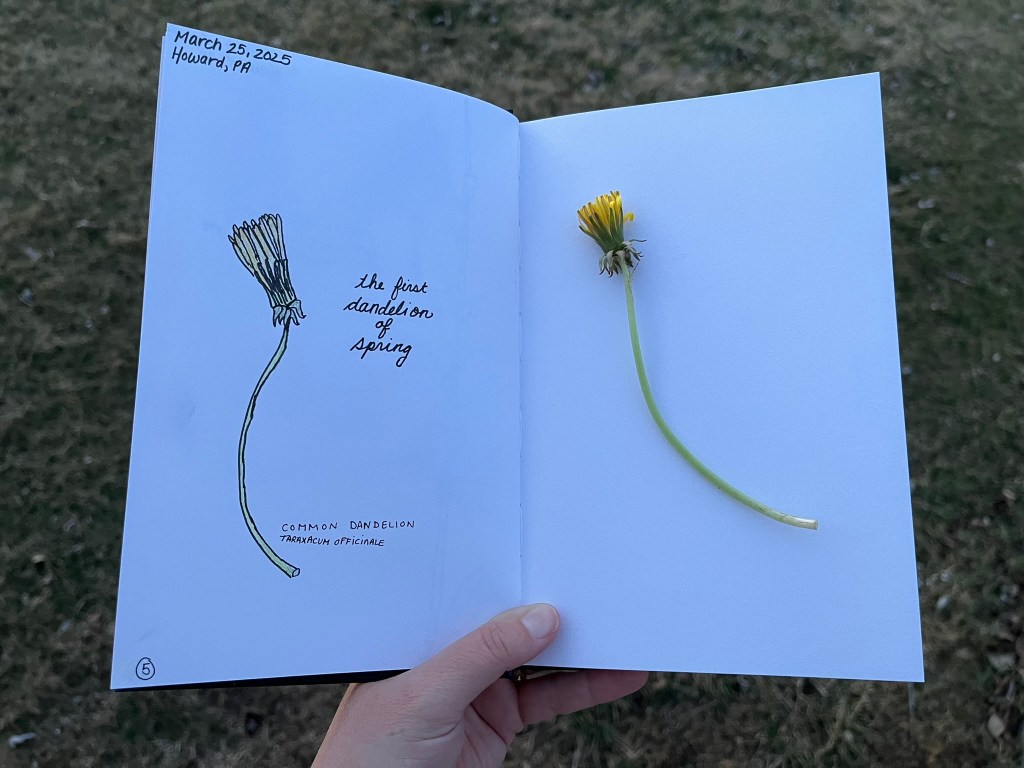
March 25 – As I walked up the sidewalk, I noticed a new flower in the yard, a dandelion. I plucked it and brought it in to draw. Taraxacum officinale, the Common Dandelion, is naturalized to Pennsylvania. Originally from Eurasia, it was brought to our country by early colonists. While I don’t mind them in my yard, I think it’s interesting how this “noxious weed” so many love to hate is the result of the actions of colonists.

March 26 – Rough, cold winds blew and prevented me from journaling outdoors. Instead I sat in my car at Millbrook Marsh Nature Center waiting for the bird club meeting to start. The bark of a Paper Birch tree blew in the wind. Pennsylvania is at the southernmost tip of its natural range. If it continues to warm, will we still have the Paper Birch growing freely in Pennsylvania?

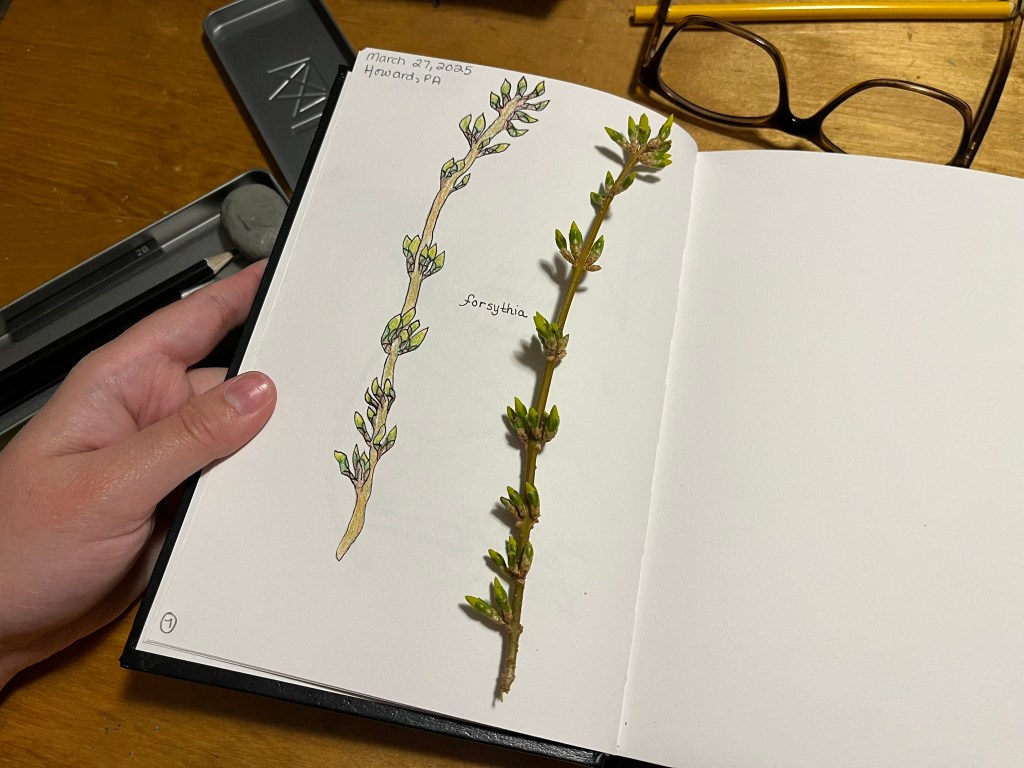
March 27 – The remaining forsythia bush in the yard is close to blooming. This shrub is pretty in the Spring, but an annoyance at any other time. I hesitate to call it horrible, but that’s how I think of it in my heart. I can’t wait to remove this one and burn it to ashes this summer. The current drought is preventing me from burning anything.

Have you been keeping a nature journal this Spring? What changes in the environment around you have you noticed? Please share in the comments!

Signs of Spring

Sturnus vulgaris, European Starling

The concrete porch was cold under me, but I paid no attention as I studied the bird on my suet feeder. I watched the glossy bird rip into the suet cake, pause, and gobble down its bite. This bird, a European Starling, is the scourge of my days, devouring pound after pound of seeds and suet. Yet, I can’t deny anything- it, too, is trying to survive in adverse conditions.

In my attempt to spend 1,000 hours outside, I have been doing daily lunchtime birding. At home, I perch on my back porch and at work, I find a sunshine-drenched bench. All I have is my cellphone and binoculars. I keep to one place for about 15 minutes, recording all the birds I see and hear. The list is never very long, but I enjoy the regularity of the community of birds around me.

Zenaida macroura, Mourning Dove

On this afternoon, mine and my neighbor’s yards were full of birds. Mourning doves roosted in the trees, grooming in the sunshine. A Red-Tailed Hawk called from overhead as it flew by. A solitary crow annoyed a flock of European Starlings to my left. House Sparrows and House Finches argued over feeder space. As I wound down my session, a female Northern Cardinal appeared nearby. At last, two Tufted Titmice darted to the maple tree. All the while, a chorus of American Robins called, completing the scene.

As I had my camera on hand, I decided to take pictures of some of the spring buds and shoots. The buds on the roosting tree of the Mourning Dove are already tinged red. Close by, the magnolia buds are fuzzy, growing larger by the day. On my remaining forsythia bush, the yellow buds are plentiful. I regret not ripping it out this past fall; this bush is a pain to care for. That said, I couldn’t rip it out- birds like roosting in its tangled branches.

Narcissus, Daffodil

In the front yard, signs of Spring are a little different. Leaves are sprouting for daffodils, tulips, and hyacinths. Over winter, I debated on keeping them. On one hand, I could remove them and plant native flowers. On the other, I planted them before I knew about native flowers. The memory of my younger self prevailed; I decided to keep them. I will need to control spread of these plants. Hyacinths will produce bulblets as off-shoots and spread under the soil. Regular removal will curtail this spread and prevent an invasion in my yard.

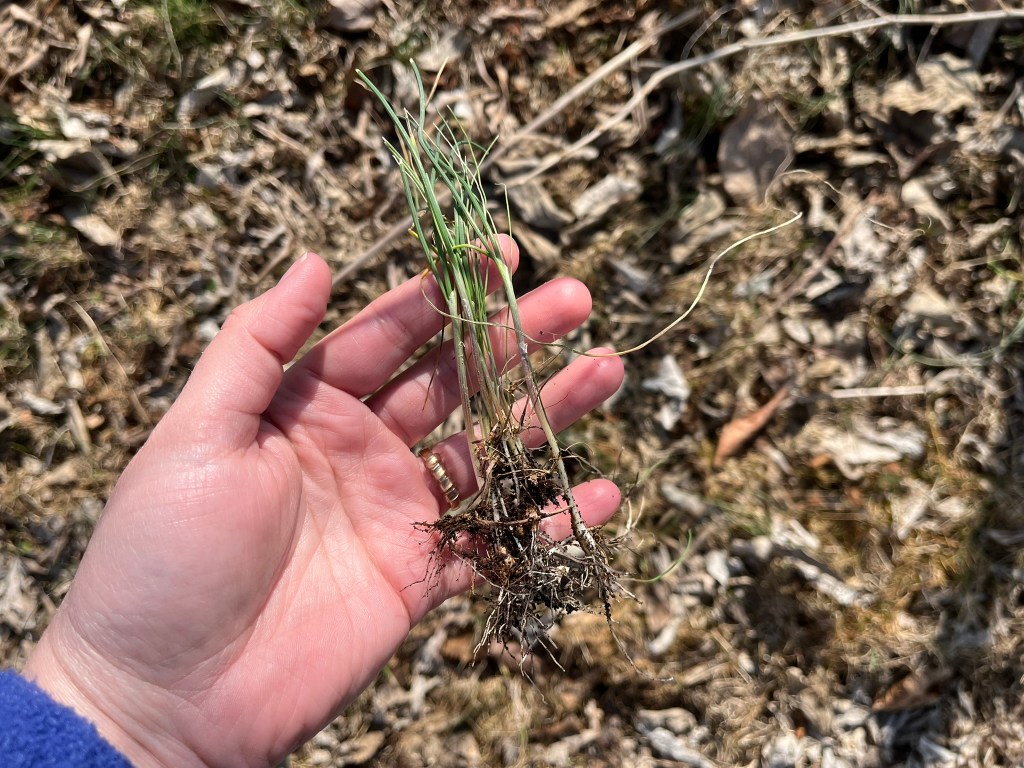
Amongst the returning grasses are the thin rapier-like leaves of wild garlic. Allium vineale is also known as “Crow Garlic” and “Field Garlic.” Introduced in the mid-1800s, wild garlic spread to cover much of the eastern United States. While wild garlic is edible, I wouldn’t eat it. The garlic flavor is pervasive and overrules all others in dishes. The taste is so strong that the flavor will get into the butter and milk of cows that have eaten wild garlic.

Allium vineale, Wild Garlic

I have a few more weeks until the Spring wildflowers start blooming. Some friends have already seen skunk cabbage, the smelly harbinger of longer days. I’m waiting for Virginia Springbeauty and Wild Columbine. The emergence of these two flowers signals true Spring to me. I’m also excited for Yellow Trout Lily and Bloodroot this year. I will need to leave my yard to find these flowers- but it is a trek I look forward to.

These subtle signs of Spring are refreshing to my winter-weary eyes. With a little noticing, the drab landscape burst into life. With returning birds, the plants are emerging from their dormancy. Each day, we’re one step closer to the chirping of nestlings and the leafing-out of trees. Now, if the Purple Martins would simply come back…

What are you noticing about Spring near you? Share in the comments!