Nature Journaling and Me

The sky hangs low and grey, threatening rain. Mist shrouds the mountains, adding an eerie ambiance that’s hard to shake. Journaling has been difficult with the birds few and far between at my feeders. With the mists, watercolors smear and pencil lines fade, so journaling from my window is best.

I started nature journaling this past year. It’s been a fun challenge to stretch my abilities and explore a new way to record what I see. I started keeping a diary when I was a preteen, and have always made comments about the natural world. When I was in college, I started writing poetry while doing field work. I would compose a poem on the back of worksheets and field notes, on napkins and in texts to myself.

Keeping a nature journal felt like the next step. Words are something I don’t struggle with- as the miles of diaries attest- but art is hard. I’ve never been artistic, despite loving photography and handcrafts. I would struggle through a drawing, but would abandon it as it didn’t meet my standard for perfection. I dropped art and returned to words, but after I felt like my journals were missing soul.
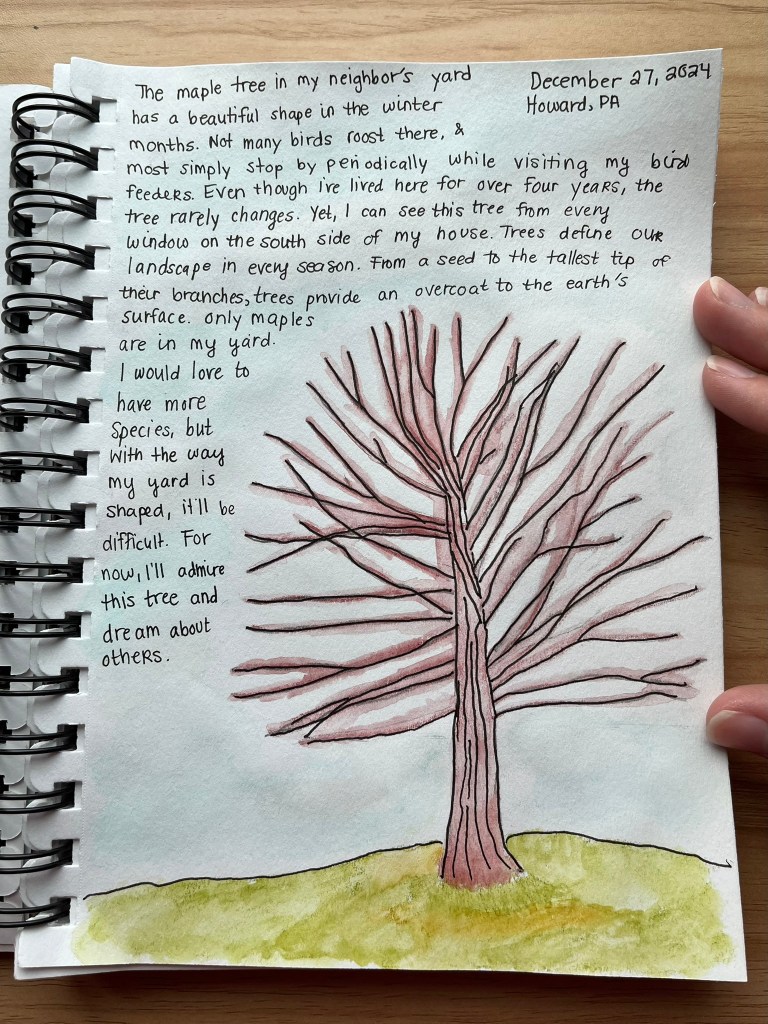
I came to a turning point this past fall, when I participated in an online nature journaling workshop. John Muir Laws, with Take Me Outside presented on how to start nature journaling and bring it to others. For the first time, I realized that nature journals don’t have to be an artistic experience. While drawing and painting are intrinsic to the concept, nothing has to be perfect.

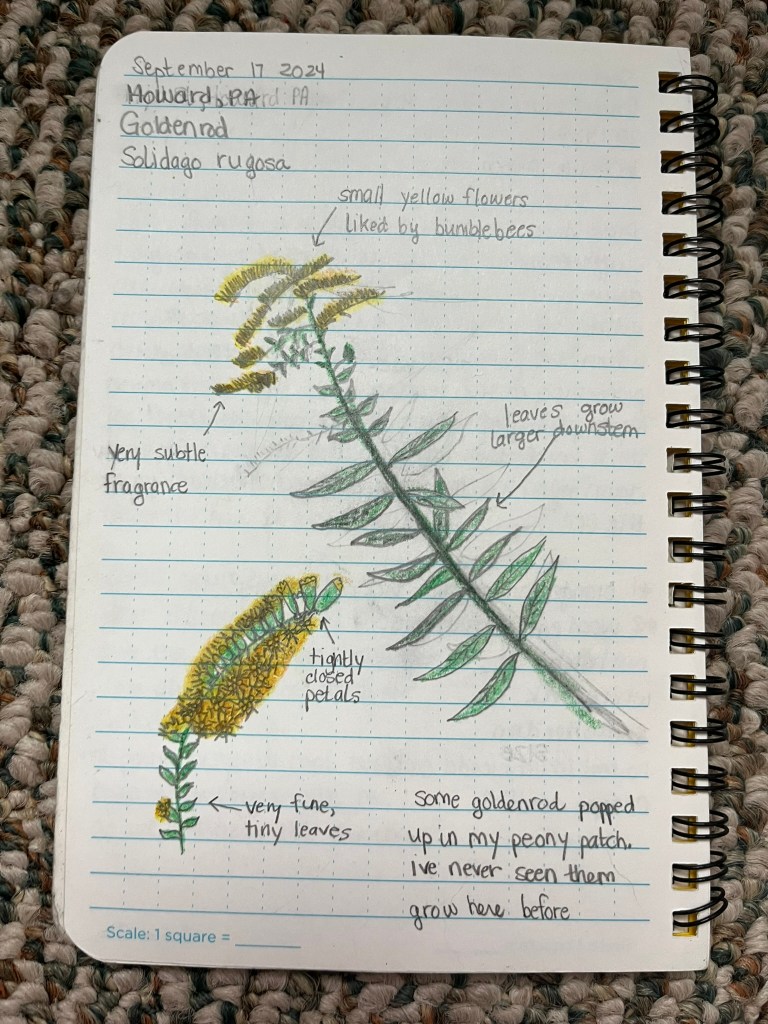
My inner perfectionist felt relief. I didn’t have to exactly render the things I was seeing. Simple is a great starting place. I didn’t have to have a MoMA level piece on every page- even a scribble is better than nothing. I drew my first entry and made notes in the corners of the pages. It was not the beautiful aesthete work of John Muir Laws- but it was my work. What I don’t have is the decades of experience of him and the others online, but one hour’s worth of experience.

That first hour has turned into a few more… and now a weekly routine. I’m more connected to the landscape around me than ever before. While I’ve taken thousands of pictures of the park and my walks, taking the time to draw has created more depth. I’ve enjoyed exploring my yard the most- there’s more to see each day I go out with my journal and pencil.

Coming in the next few weeks will be more supplies, rounding out my kit. One of my goals for 2025 involves working in my nature journal at least three times per week. I’m starting off strong with Nature Journaling January with the Wild Wonder Foundation. Each day will have a different theme and reason for breaking into my journal to reflect on the world around me.

On top of my goals and planned projects, I’ll be starting a nature journaling group at Bald Eagle State Park. Our first meeting will be on January 18th at 1:00pm in the Environmental Learning Center. We will be journaling about Pennsylvania fossils using samples from my collection. I’m excited for this club and am looking forward to meeting other nature journalers in my area.

I’m leaving 2024 with a strong sense of accomplishment. Besides starting my nature journal, I started this blog, which has brought a ton of joy to my life. One of my life’s goals is to write about Pennsylvania’s outdoors and natural resources. Exploring this topic via my blog and nature journal has helped me feel fulfilled and excited. Without these two things, I wouldn’t be as excited as I am for 2025!
Practicing Bird Photography

Fresh snow coated the earth on Monday morning, making my daily birding easy from my spot at the window. Birds came and went, the usual suspects… Mourning Doves, Purple Finches, Tufted Titmice, and a Dark-eyed Juncos. Despite looking at birds more than my laptop, I didn’t see any American Goldfinches like I did the day before. At last, lunch came, and I could try something new: sneak out with my camera and take some pictures.

I bought a Canon Rebel T6 off of Facebook Marketplace two months ago. After replacing the batteries and buying an SD card, I haven’t had a chance to use it. I’ve been studying on how to best take pictures, but all advice pointed to “practice makes perfect.” I changed out to the larger zoom lens from my kit and slipped on my boots to wait on the porch for birds.

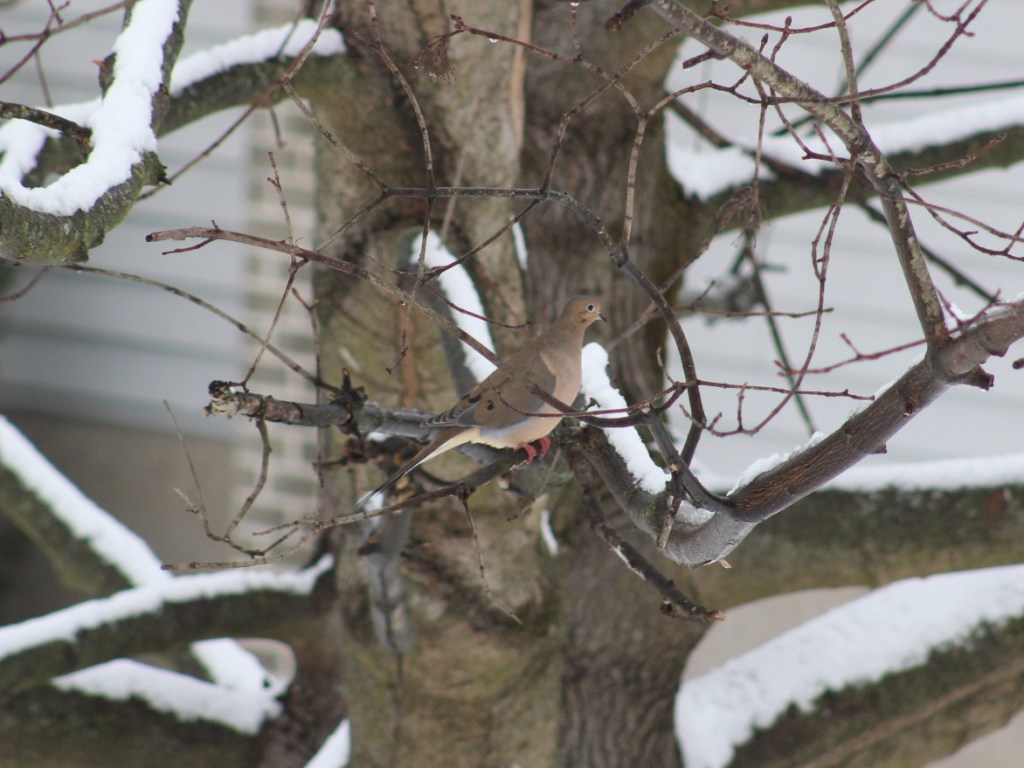
A handful of birds took off the second I opened the door. Left behind were two confused Mourning Doves. One belatedly shot into the upper canopy of the maple tree, too far away for me to capture in a photo. The other chose a lower spot, eyeing me as I stood still on my porch. I snapped a couple shots in quick succession before it, too, left for higher branches.

After about three minutes, the Tufted Titmice swarmed back into my feeders. At least three small family units visit my feeders daily. One brave bird swooped into my light-blue metal hopper and stole away with a sunflower seed. Others were dangling off the branches of the maple tree, waiting for their turn.

The Tufted Titmice were hard for me to photograph. They sprint across the yard, and when landed at the feeder, they antagonize each other. Of course, it’s in their nature to dine-and-dash, preferring to crack seeds at a high, safe spot than down at the feeder. Tufted Titmice also form hoards of food over the winter, so some will grab a seed and disappear. It was easiest to photograph them when they were watching me for sudden movements. The entire time I was photographing the Titmice, I was holding my breath!

I watched them come and go for ten minutes- Titmice dominate my feeders at any point during the day. A Red-Bellied Woodpecker flew overhead, and decided to not munch at the suet upon spotting me. A handful of Dark-eyed Juncos came to forage on the ground, but I missed a chance at photographing them. Their dark upper halves contrasted too much against the snow and white bellies.

As the end of my lunch drew near, the birds started to dwindle in my yard. My neighbor’s feeder, out of my camera’s view, was bustling with Purple Finches. I can imagine the birds felt safer with the shrubs and arbor between me and their tiny bodies. With their feeder so busy, a small group of birds waited on the far branches of the maple tree.

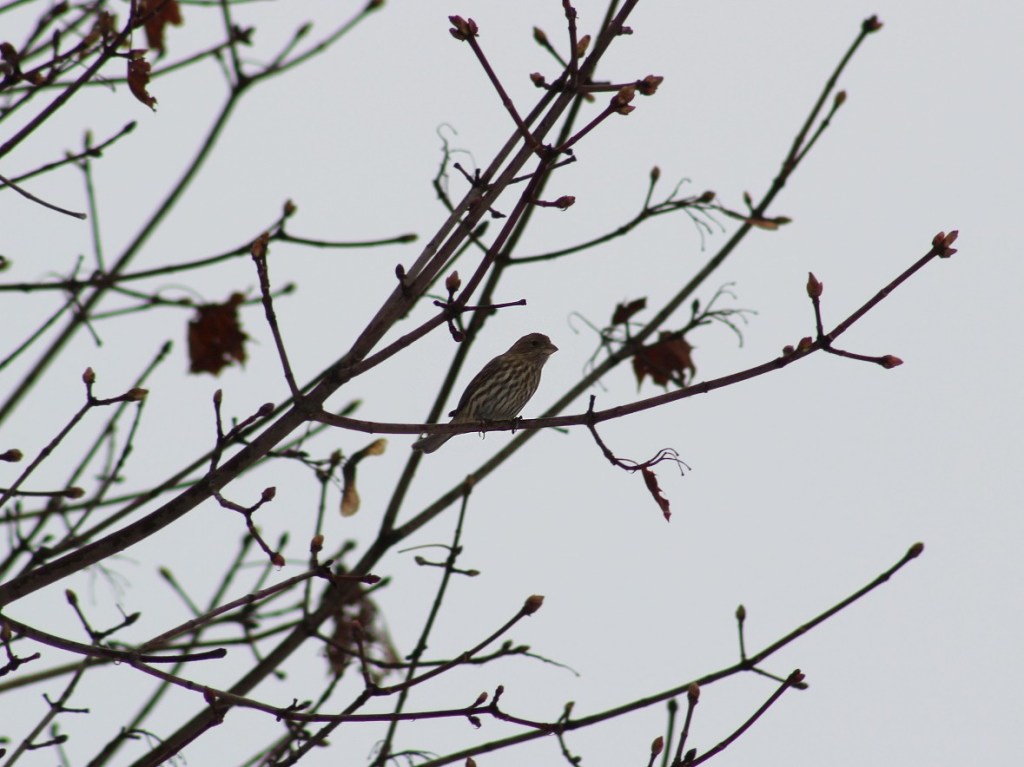
I leaned on the support of my porch roof as I zoomed into their spot. My movement scared away all except for one female, who ignored my existence. With the light misty sky behind her, the shot appeared too dark on my camera. Dejected, I went back inside, feeling that my experiment was a failure.

At my desk, I fumbled with the camera settings to import the pictures to my iPhone. I almost gave up in frustration, but with the help of a Youtube video, I figured it out in the nick of time. The last five minutes of my lunch break was total awe, admiring my pictures. I had never, in my life, taken a picture of a bird. I could see the subtle colors of the Mourning Dove and the gleam of a Titmouse’s eye. Satisfied, I put my camera away and went back to work, planning the next time to photograph birds in my backyard.

2024 CoCoRaHS Year in Review

I learned about Community Collaborative Rain, Snow, and Hail Network (CoCoRaHS) in 2020. At the time, I didn’t have the cash I needed to invest in the proper gear, or the place to set up a station. Flash forward 4 years, I’m now measuring precipitation every morning in my backyard.

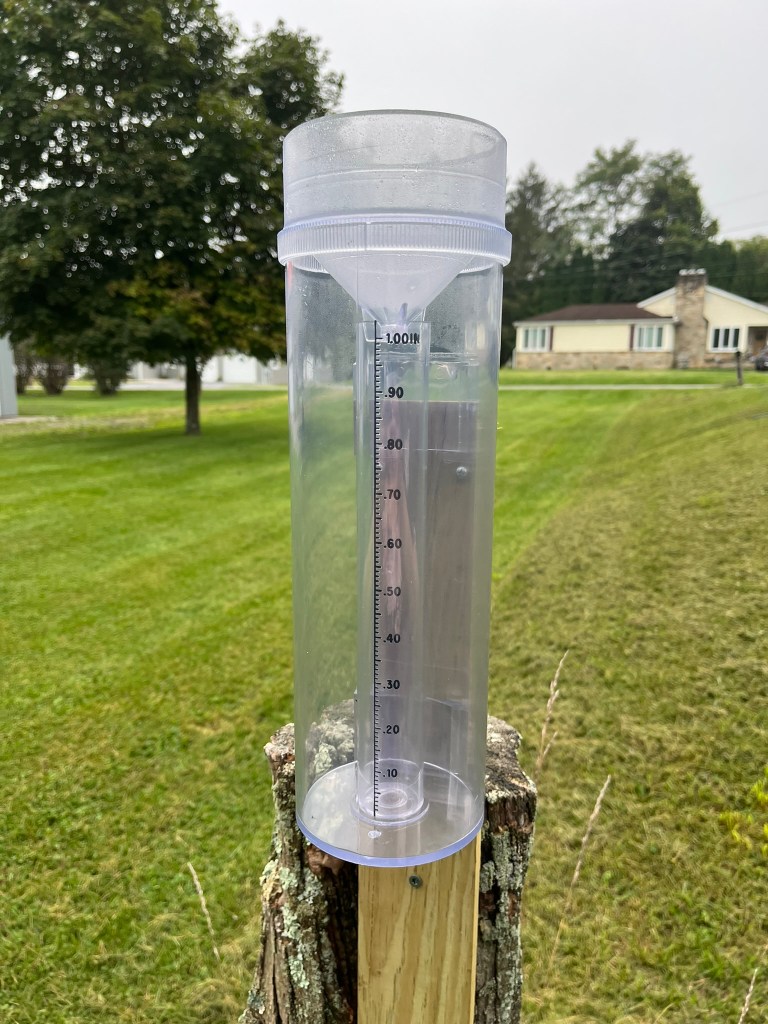
The process is a simple daily ritual: check a standard rain gauge every morning and upload the data to the site. The best time to check is between 6:30am and 9:00am. You can use the CoCoRaHS website or their mobile app. The process is quick- on average, it takes me about 3 minutes every morning.

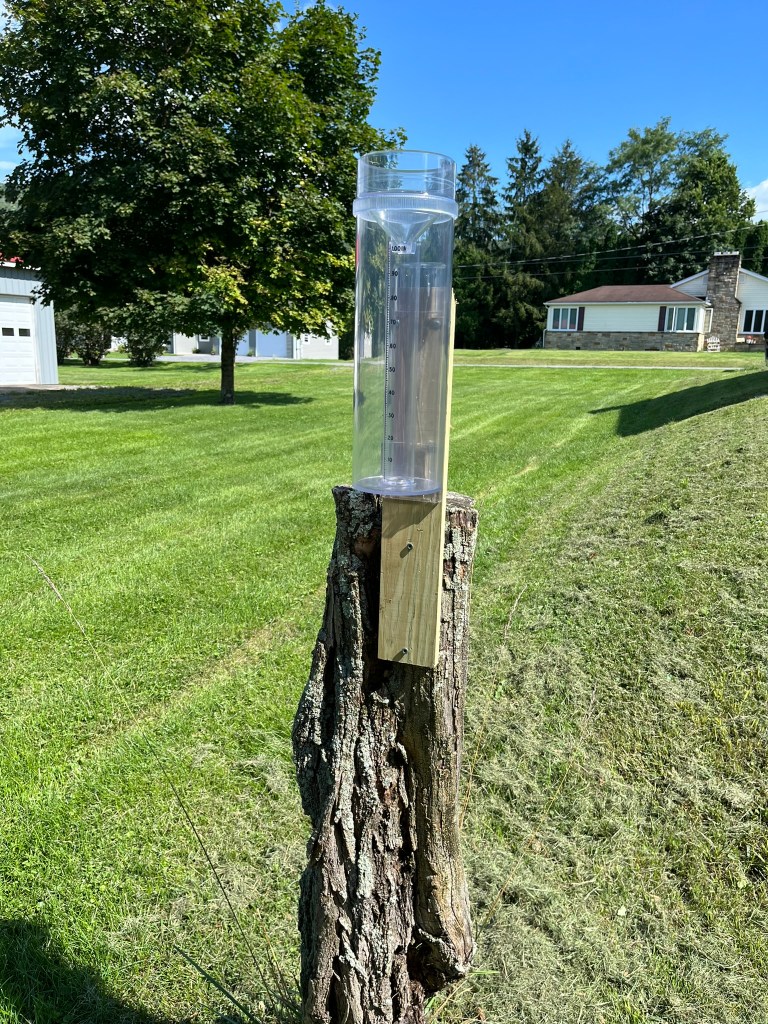
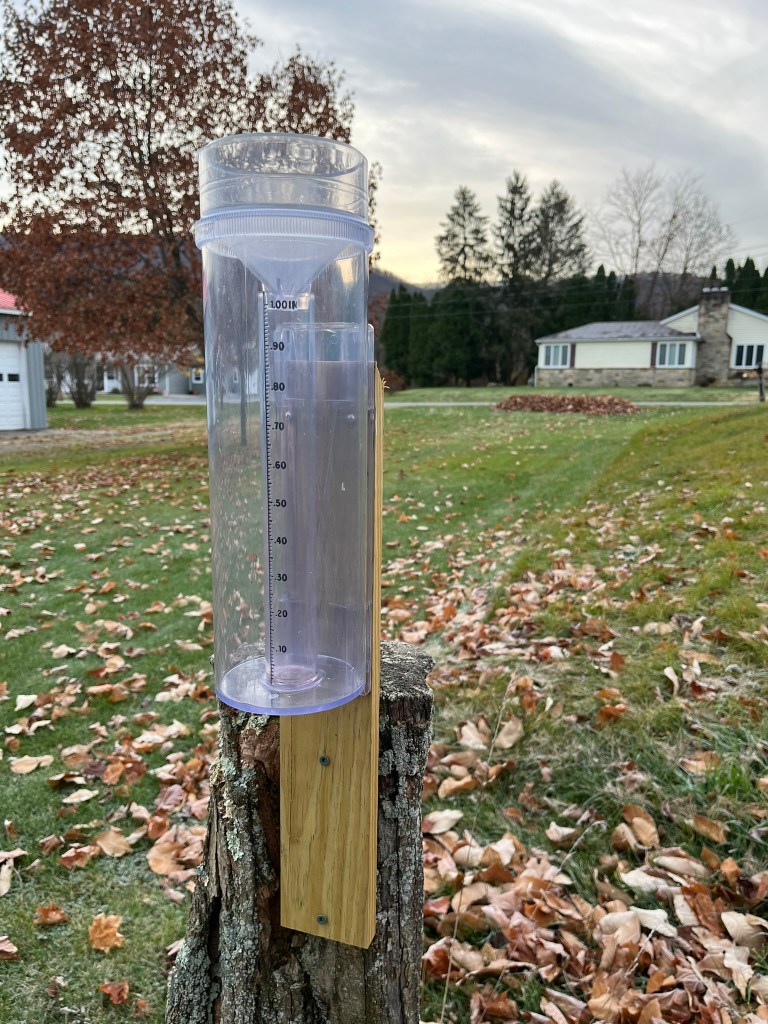
I started my gauging station on August 13, 2024. I’ve reported a measurement for 124 days this year- so far! My grandfather helped me install my gauge on an old post in my backyard. CoCoRaHS HQ provides lots of training resources for selecting a spot and setting up. You can buy cool signs for your station, to let people know what you’re doing!

Since commencing operations, I’ve measured 10.94″ of precipitation. According to the CoCoRaHS Data Explorer, this is Below Normal for the year. I definitely agree- we have had less rain this fall and early winter than in previous years. By gauging precipitation in my yard, I’m tracking climate change in real time.

Rain gauging has made me more aware of the weather, and how it’s influencing my environment. I started to be able to correlate days without rain and my browning grass… and how we received most of our rain in heavy storms. I could track the days between a hurricane making landfall in the south and when we would receive its rains. I can do the same for lake effect snowstorms- it takes 3 days for the snow to travel south from Erie!

Right now, I’m only tracking precipitation collected in my gauge. I have yet to need to calculate SWE (Snow Water Equivalence) or measure ice accretion. I don’t yet have a snow board, which I’m going to make during my winter break. Plus, participants can make weekly conditions reports, of which I have yet to try.

I’m also branching out from the CoCoRaHS website and sharing on Instagram. I started a highlight for all my daily gauging pictures on my Story. Recently I posted a Reel on how to take a precipitation measurement from ice. As Centre County Coordinator, it’s important to me to get the word out and share how simple the “daily ritual” is… less steps than my morning skincare!

Looking back on the year, I can say I’ve had a positive experience. Even though I’m staring down climate change in the face, I’m hopeful. Thousands of Americans, all over the country, are taking notice of the weather. Our data is helping scientists form new models and predictions… which can help everyone make better choices in response to weather.

If you’re interested in CoCoRaHS, feel free to send me an email! I’m happy to help connect you to the resources to get started. Anyone can gauge, anywhere in the world and take part!

2024 eBird Year in Review

Birding is one of my favorite hobbies, and I try to squeeze in as much as I can. With my work schedule and life schedule, I’ve had minimal time birding until this past Fall. I learned about eBird this summer, and I’ve been growing my life list ever since. I’ve observed 43 species this year, and lucky enough to make memories at the same time.

First was when I went birding at Fisherman’s Paradise with the State College Bird Club. Observing the Great Blue Herons interacting with the Bald Eagles was new and exciting for me. I blogged about the trip on September 29th on Birding at Fisherman’s Paradise.

My second memorable trip was birding at Soaring Eagle Wetland (SEW). While the birds I saw there were not new to me, exploring the area was exciting. SEW has many active projects, and when I visit again, it will still feel like a brand-new place. I blogged about the trip on November 3rd on Early Fall at Soaring Eagle Wetland.

Another recent memory- I was birding with friends at Bald Eagle State Park will go in the books as a highlight. We were chatting on the beach area when one of my friends spotted an unusual bird out on the water. I focused my binoculars and discovered a Common Loon in winter plumage. It was my first-ever Common Loon, and having spotted it with friends felt extra special.

There’s still plenty of time to bird this winter. I’m participating in Project Feederwatch until it finishes in April. I’ve had a blast spending weekend mornings observing my backyard. There is a Downy Woodpecker that visits every day at 11:00am, rain or shine. Plus, Tufted Titmice are a daily treat, bringing joy to every morning. Visiting a winter raptor survey is on my to-do list, something I’ll share here when the trip concludes.

2024 was a successful year for birding. Despite not birding 24/7 all year, I’ve been able to make memories, add to my life list, and take part in fun projects. The rest of this winter and next year look to be even better. I’ve developed my identification skills and am working on becoming a better photographer. I can’t wait to share with you what comes next!

2024 Bird Species

  • Turkey Vulture
  • Eastern Bluebird
  • Common Merganser
  • European Starling
  • American Robin
  • Red-tailed Hawk
  • Mourning Dove
  • Red-Bellied Woodpecker
  • American Crow
  • House Finch
  • Dark-eyed Junco
  • Red-winged Blackbird
  • Northern Cardinal
  • Black Vulture
  • American Goldfinch
  • Field Sparrow
  • Common Grackle
  • Common Nighthawk
  • Great Blue Heron
  • Bald Eagle
  • Ring-billed Gull
  • Black-capped Chickadee
  • Eastern Phoebe
  • Tree Swallow
  • Cedar Waxwing
  • Double-crested Cormorant
  • Osprey
  • Killdeer
  • Blue Jay
  • Chipping Sparrow
  • Tufted Titmouse
  • Wood Duck
  • Mallard
  • Grey Catbird
  • Downy Woodpecker
  • Pileated Woodpecker
  • White-breasted Nuthatch
  • Carolina Wren
  • White-throated Sparrow
  • House Sparrow
  • Song Sparrow
  • Canada Goose
  • Common Loon

2024 iNaturalist Year in Review

2024 is my first year of using iNaturalist to note new and familiar species in the field. I focus on identifying plants and fungi using iNaturalist. I try to identify the genus in the field, then the species after some reflection and research. This year, I made a total of 68 observations spread over 59 species.

44.12% of my observations were of plants. I have a ton of favorite observations, but there are a handful of very memorable ones…

Witchhazel

27.94% of my observations were of fungi. My favorite observation was of Trametes versicolor, the Turkey-Tail Mushroom, which grew on a stump in my yard.

Trametes versicolor (Turkey-Tail Mushroom)

A small number were of insects, which were hard to photograph clearly. My favorite observation of the year was of Atteva aurea, the Alianthus Webworm Moth. This picture turned out so beautifully… it’s a shame it’s only on iNaturalist!

Atteva aurea (Alianthus Webworm Moth)

Most of by observations are for August through October. I was outside much more this fall than I was in the spring or summer. With my Master Naturalist class, I was able to be outside one evening every week and almost every weekend. We had a dedicated class for iNaturalist, which is where I identified most of the insects from the year.

The most important part of iNaturalist is the online naturalist community. I relied on the help of others to identify and affirm my identifications. 3 users helped me the most: mabrybiggs, tz_nh, and chia. I am indebted to them for helping me learn about new-to-me species. I’ve been able to help with a few identifications for others, but not as many as they helped me with!

I can’t let any year-in-review go without a goal for the next year… in 2025, my goal is to make at least 150 observations… and to write about them on TKN. I let my iNaturalist activities lie at the wayside this year, and I would like to highlight them more.

Food for thought… do you use iNaturalist? If so, how many species did you identify this year?