Midwinter at the Arboretum

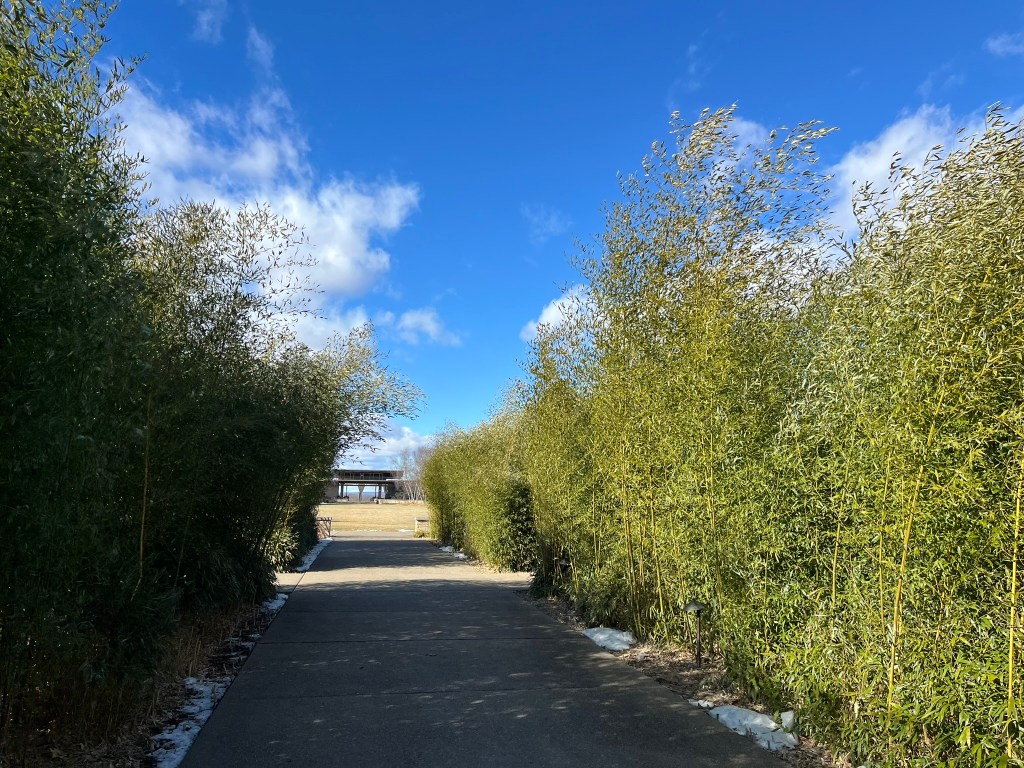
Lime-green stalks of bamboo greeted me as I entered the Arboretum at Penn State. This wonderful, ever-changing botanical garden always captures my attention and imagination. Even at midwinter, I enjoy spending my midday break walking among the dormant plants.

I always start with the Oasis Garden. Taking the first left, I wandered through and spun the ice on the Lotus Pool. The walls protected me from the wind as I poked around the plants. Very little was growing here, with most fading away into the mulch. The Rose and Fragrance Garden was more promising. The little buds peeping from the tips of branches signal oncoming Spring. As I finish looping through, a gust of wind shakes the waxy magnolia leaves, causing them to clack like bones.
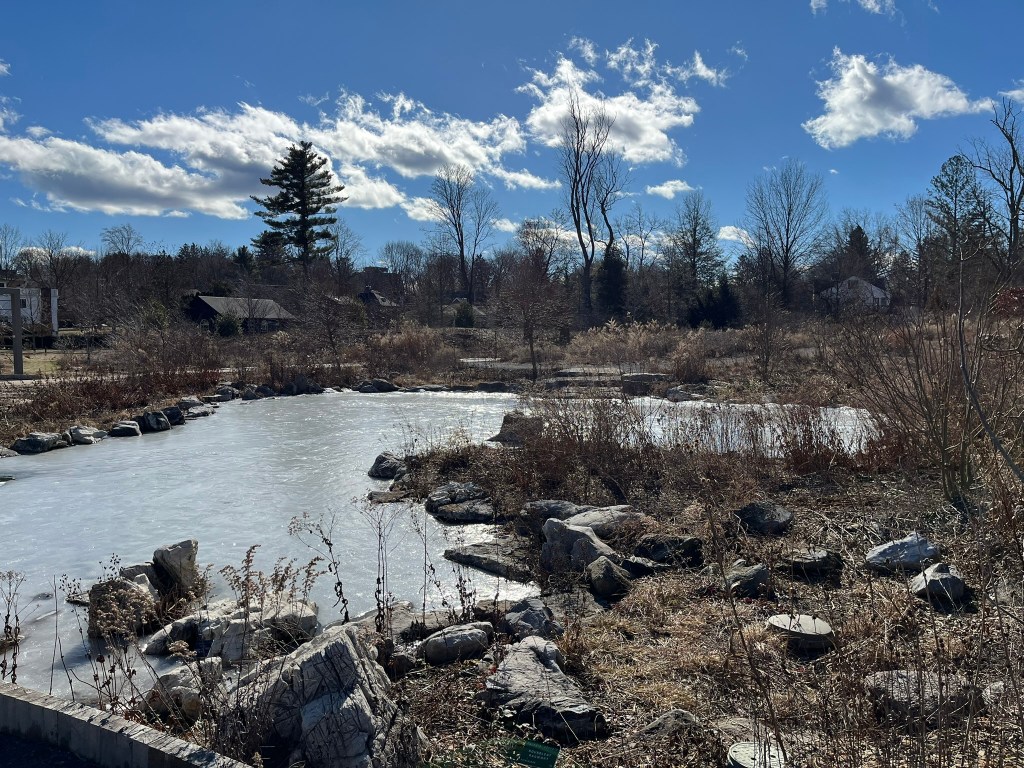
The walled gardens lead into the Pollinator and Bird Garden. Here the wind gusted, unobstructed by trees or hedges. I pull my shawl closer to my neck and continue to the pond by the Pollinator Plaza. From the top of the willow house, a Song Sparrow calls, spinning around on its perch to watch me. Most other birds are flitting overhead, or on a beeline to the Bird House.

The small wooden building is a relief from the wind. Another visitor is sitting on the porch, so I veer to the back and rest on the bench to watch the feeders. Dark-Eyed Juncos were tumbling over each other as they dig through the mulch for seeds. From the tops of the evergreen trees, a Blue Jay crunched a peanut. After a few minutes, a trio of Black-Capped Chickadees swept in to chase House Finches. I could- and I have- spent hours in this exact spot. Yet with my break ticking to a close, I knew I needed to keep going.

The Pollinator and Bird Garden connects to an esplanade with a giant sundial. The sidewalks border the Children’s Garden. I veered left into the Children’s Garden and entered the faux cave. Cold water dripped from the ceiling, most likely ice melting from the roof. The path carved through the cave, then out and behind the Glass House. Grey and black squirrels danced in the trees overhead as I walked. An employee was tending to the garden, and I stayed out of their way as best as I could.

From the Children’s Garden, I followed the the Strolling Garden path to the Poplar Court. The Black Poplars stretched high into the sky over my head. I wove in and out between the trees, admiring the neon yellow and neon orange lichens. Most appeared to be a species from genus Candelaria. (I’m still waiting for some confirmations on iNaturalist now.) I took as many pictures as I could before I hurried back to work.
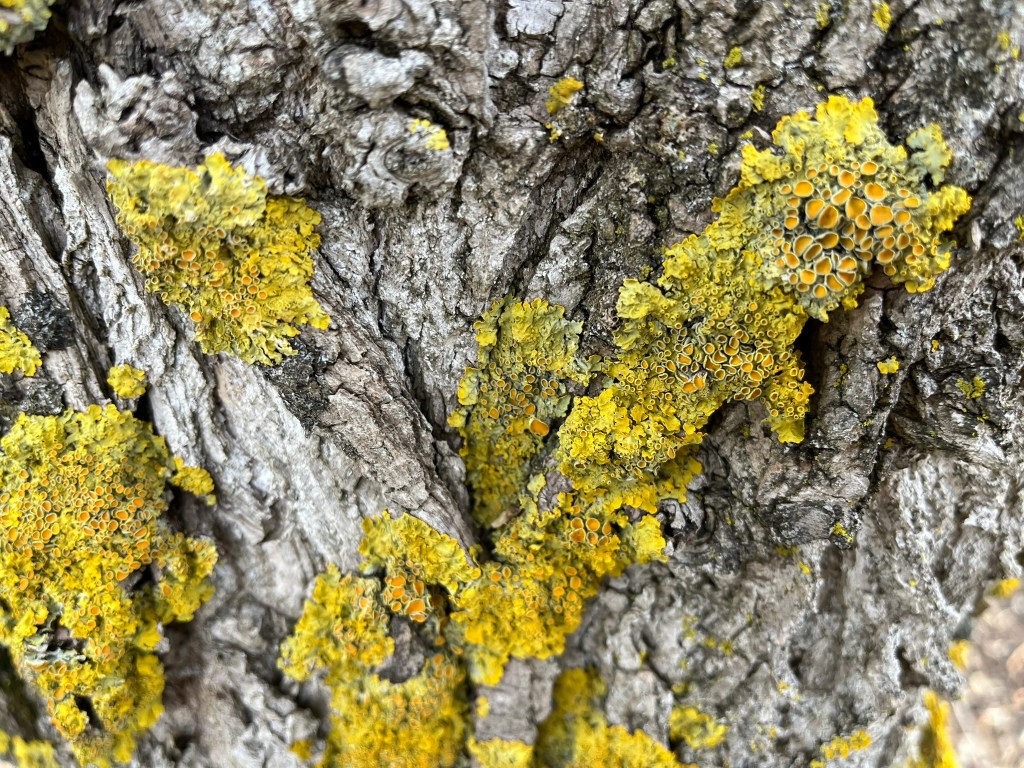
Xanthoria parietina (Common Sunburst Lichen)

Even though there were few blooming flowers, the Arboretum is still full of life in winter. From lichens to songbirds, there is a little bit of something for everyone. During my walk, I found a pamphlet rack, which had a booklet on trails in Hartley Wood. As I’ve been walking, I’ve been planning the rest of this year’s adventures… which won’t take me very far at all!

Catch Me Outside for 1,000 Hours

Animal tracks in the snow

On the first 40-degree day of February, I went on a long walk. It was my first walk as part of my 2025 goal: spend 1,000 hours outside by December 31st.

I don’t choose traditional resolutions. Instead, I pick one big goal for the year, and work hard to achieve it. Past goals have been reading 100 books, folding 1,000 paper cranes, and going on a book-buying ban. This year, my mom recommended that I try to spend 1,000 hours outside in a calendar year.

This goal aligns with my belief that everyone should be spending more time outside. The founder of 1,000 Hours Outside suggests that children who spend many hours outside per day have improved health and wellness. I disagree with the founder’s other beliefs, but have found evidence to support this claim. A review found that outdoor play is a practical method for improving children’s health (McCurdy, 2010). Another article suggests that exposure to many different bird species outdoors can improve mental health (Methorst, 2024). Birding is an excellent vehicle for improving health on the sly (Dresser, 2024). As I’m working on improving my health, spending more time outside should help.

I also chose this goal with the hope of breaking a screen addiction. On average, I spend about 4 hours per day on my iPhone. I know I spend at least 8 hours per day working on my laptop. Even with a little overlap, this amounts to almost 70 hours of screentime per week! When I’ve spent long periods of time spending 90 minutes or less on my iPhone per day, I have improved mental health. Sure, this is anecdotal evidence, but it is my experience. I want to replace this non-work-related screen time with time spent in nature.

As odd as this may sound, I also chose this goal to help me reconnect with the outdoors. After a tough winter, I’m disconnected from the natural world around me. I admit that in January, I was getting out 1 to 2 times per week. I’m craving spending time outdoors to explore and enjoy the natural world.

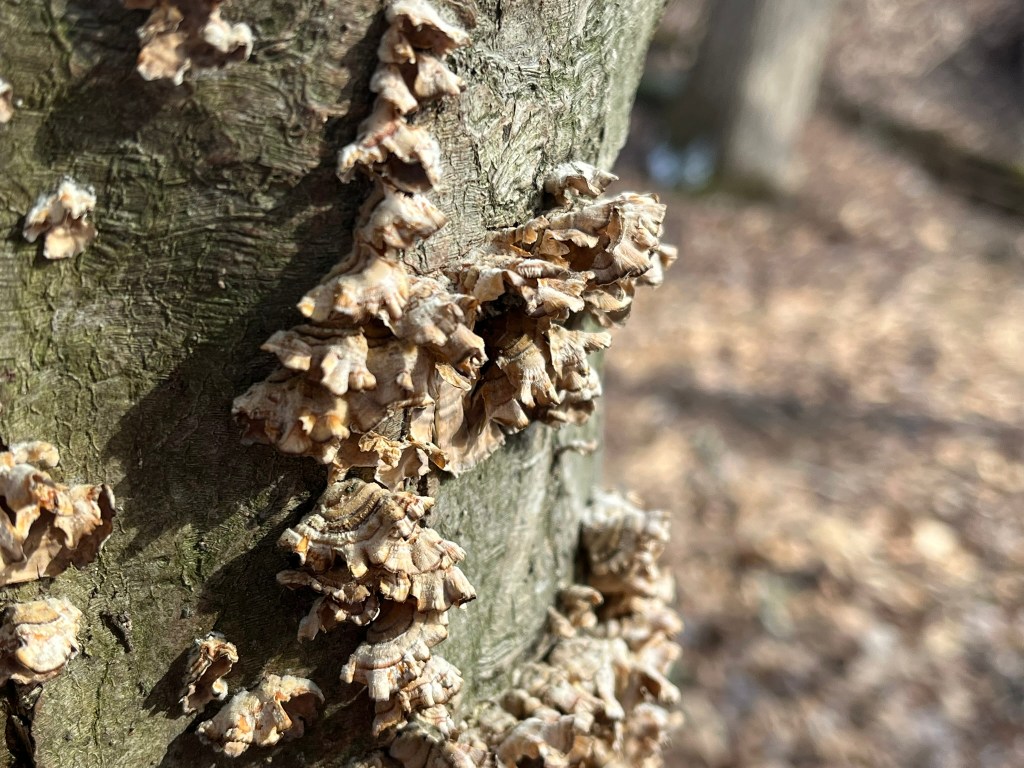
Stereum complicatum (Crowded Parchment)

I started tracking on Monday, and got an hour in right away. I let myself meander through the park and enjoy myself rather than hustle to achieve a step goal. I was able to take notice of some mosses and lichens, and found a fresh woodpecker hole in a tree. I felt refreshed, and had a super productive afternoon afterwards.

While I’m starting out a little behind, I know I’ll catch up soon. I’m counting down the days to when I can go hiking and kayaking at the park. I’ve squirreled away the pennies for a hammock rack to put in my yard for reading outdoors. Our grilling station is set up and ready for when it’s not snowing or raining. I’ve been making plans for spring hikes with my siblings. I’m very energized and excited about finishing this goal- and I’ll bring you along with me!

Have you attempted a 1,000 hours outside challenge?

Exploring Local Lichens

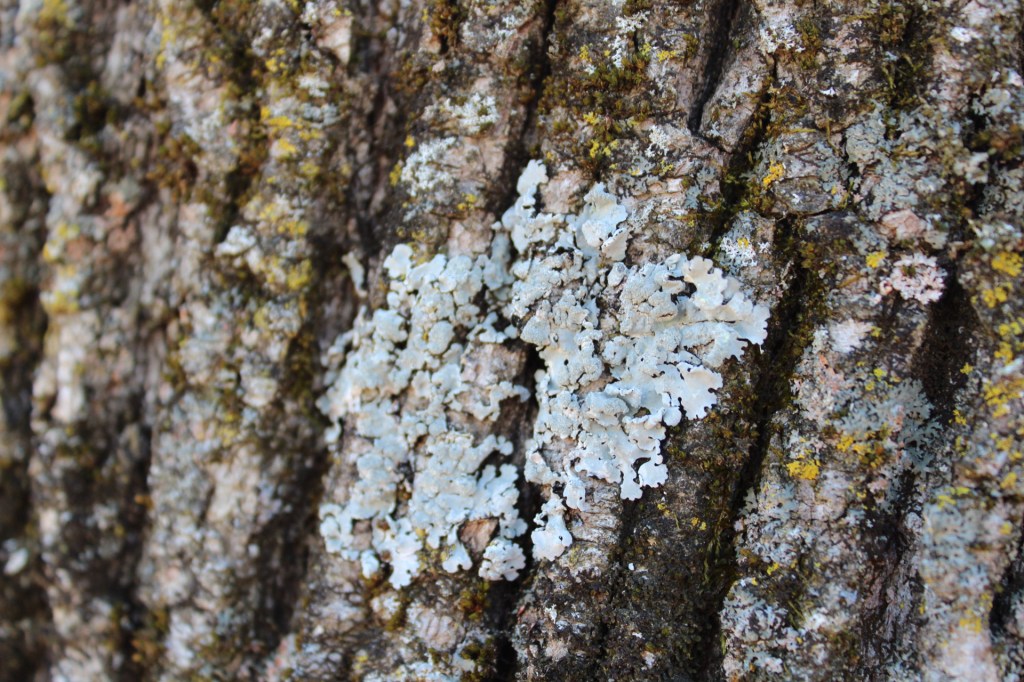
Foliose lichen found on a Norway Maple tree

Despite my interest in mushrooms, I know little about lichens. At the January Community Nature Journaling meeting, Stephen Bucklin introduced us to lichens. I learned a little on their ecology, physiology, and reproductive systems. Since then, I’m noticing lichens a lot more, especially in my own backyard.

I first noticed some lichens growing on the Norway Maple tree in my front yard. On the eastward side of the tree were many lichens, and I took a couple of snaps of the largest ones. The majority of them appear to be at least be Parmelioideae; typical shield lichens. To the touch, the lichens were cold and a little leathery.

The Norway Maple also had many small yellow lichens, which my camera and I struggled to capture. They grew in many small spots, some smaller than a pencil tip. Most were between the size of a pencil eraser to bottle cap. If I touched them, they brushed right off the tree. In the picture above, you can see the abundance of the yellow lichen all around the big shield lichen.

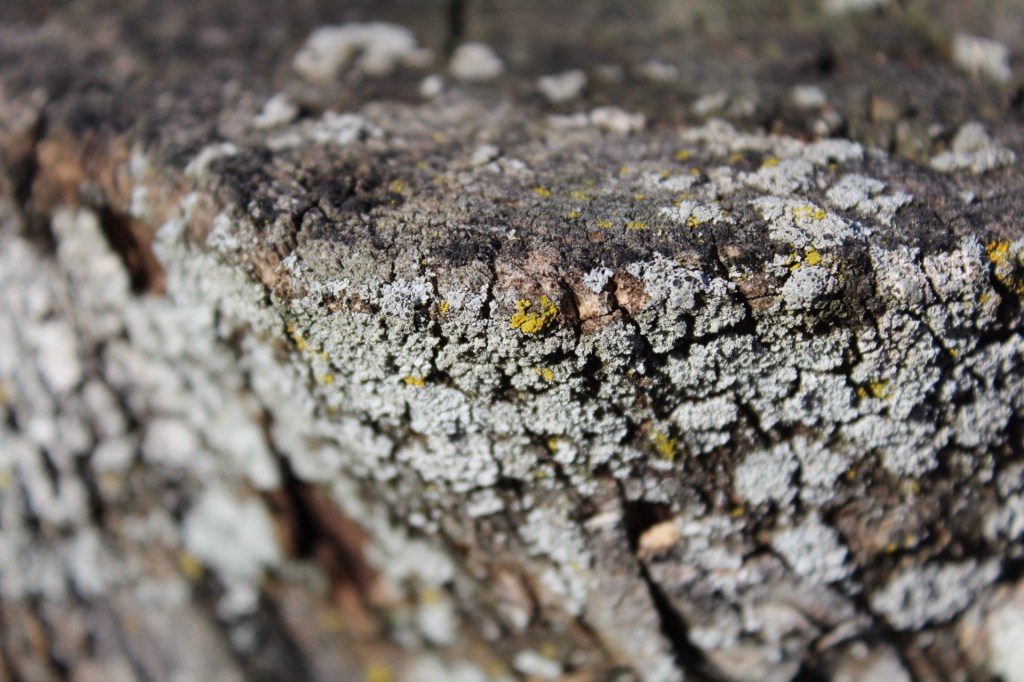
Crustose lichen found on a post

On the post that holds my CoCoRaHS rain gauge, a crustose lichen appears on all sides. It didn’t brush off using my finger pad or nails- the medulla of the lichen anchors it to the substrate. In this case, the substrate is a post of unknown origin. Looking close, I could see little black dots- the mycobiont’s reproductive structures.

Foliose lichen found on same post

Near the ground, the post had another species, a foliose lichen. Yet again, iNaturalist suggested that it hailed from the typical shield lichen family. I’m waiting for more species suggestions from experts now. These felt cold and leathery to the touch, too. I liked how bright and green they were in comparison to the grey-green of the crustose lichen at the top of the post.

Foliose lichen and Ulota crispa competing for habitat

On a dead snag in my yard, I found an example of a lichen and a moss competing for habitat. The foliose lichen spread all over the trunk of the snag, in groups roughly the size of my hand. In one spot, Ulota crispa, crisped pincushion moss, was growing over and up through the lichen. Lichens take anywhere from tens to hundreds of years to grow and develop. On the flip side, a moss can grow in spread in a year and a half or less. The moss is out-competing the lichen on this tree. I’m going to keep an eye on its development in the future.

I’m surprised that my yard had so many examples of lichens. I only have three trees, a snag, a forsythia bush, and a single post. I didn’t see any lichens growing on my house or garage. With such little habitat, the lichen has found its niche and is growing. Considering how long it takes for a lichen to develop, I can say that they may have been “born” at the same time as me. Thinking about it, some of these lichen may be older than me!